By Mike Nesbitt | Contributing Editor
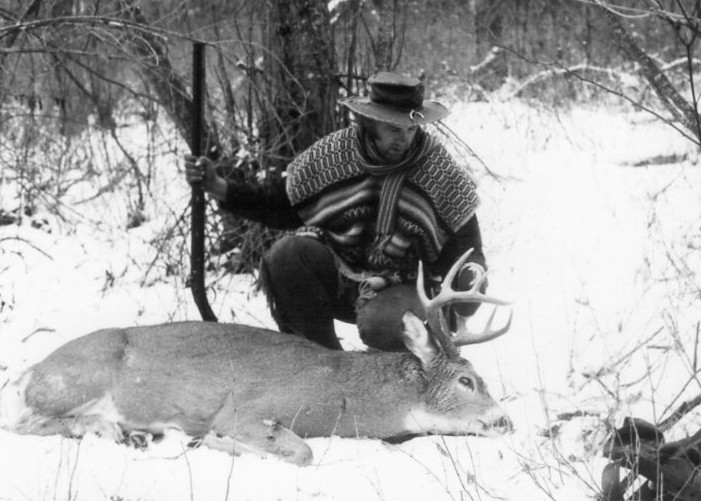
It isn’t hard for me to remember some good hunts where either the success of the hunt had been totally because my second muzzleloader was there, or just when the second gun simply added to the success of the hunt.
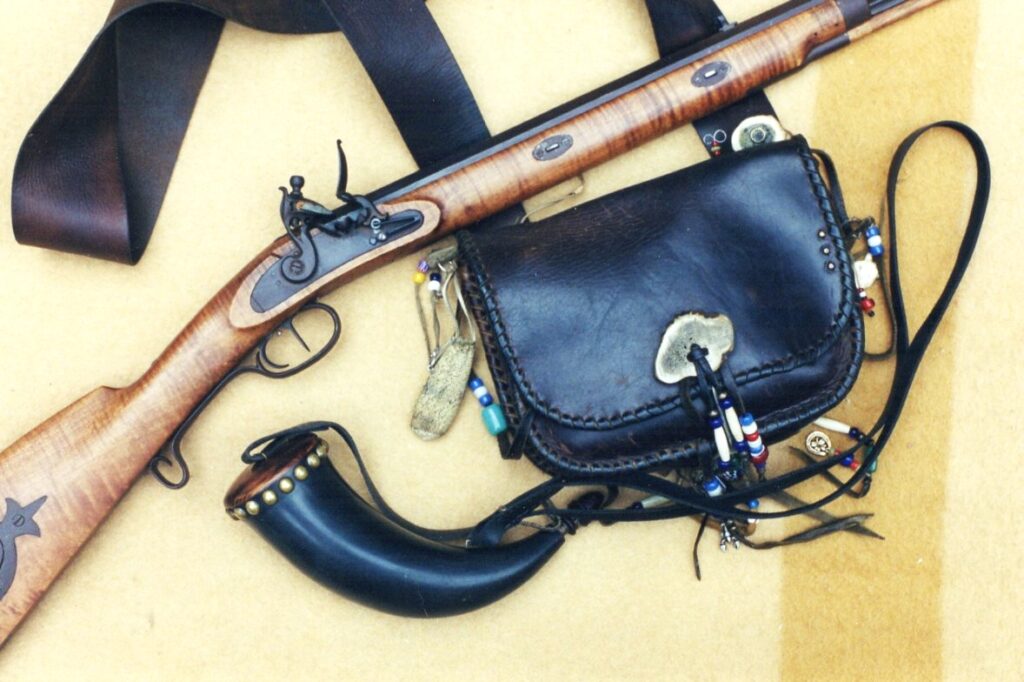
My own first game with a muzzleloader falls into this situation, where the success of the hunt can be credited to the second gun. That was in 1975, just over 50 years ago, when I was on a deer hunt up at Lyman Lake along with others. Ol’ Bill Walker asked me to help bring in some firewood to the main camp. While doing that, I carried a 20-gauge Northwest Gun instead of my .50 caliber percussion Hawken rifle.
While bringing in some of the firewood, that Northwest Gun got put to good use when a grouse was collected with it, using a load of #5 birdshot. That was the first brass tack for my old Northwest Gun and the first black powder game for me. If I hadn’t had that 20 gauge along as a second gun on that hunt, the grouse might have died of old age, especially if I had tried to hit that running bird with my muzzleloading rifle.
That’s just one example and that’s not the only time when the hunt was “saved” by having a second gun along. Yes, for these first examples the Northwest Gun will seem outstanding. They are! Read on and I hope you’ll enjoy seeing why.
There are times when the second gun taken on a hunt actually proves to be the gun that gets used the most, and gives the most reward to the shooter. Thinking about the second gun in that way reminds me of another trip to Quebec, further north this time. I’d gone further north in search of caribou but the migration for the season had already passed, no caribou were seen. There was still plenty of good hunting though because I had brought along my 20-gauge canoe gun by Jackie Brown and that little smoothbore earned some brass tacks on that trip.
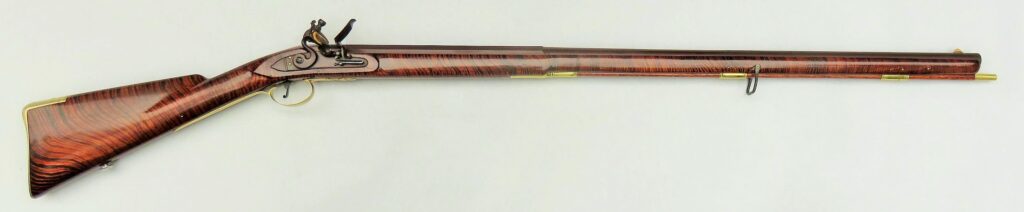
On my first day in camp, I headed out while carrying just the 20 gauge, leaving my .54 caliber flintlock Leman in the tent. There were flocks of ptarmigan close by and when I returned to the camp, I was carrying three of those birds that were turning white. The load I used had 60 grains of FFg powder under a Wonder Wad, then the same 60 grain measure was used filled with #8 birdshot so the powder and shot had the same volume, followed by another Wonder Wad. That short 24-inch barreled Fowler worked just fine, although I was wishing that I’d taken some larger birdshot on that trip, maybe some #5s or #6s. The #8 pellets were not penetrating quite well enough but I actually can’t complain because no birds were lost. Later the shot load was increased to 70 grains, adding one-sixth more shot to the load, and the heavier shot loading helped anchor the birds more quickly. That canoe gun was just the ticket for bringing in camp meat.
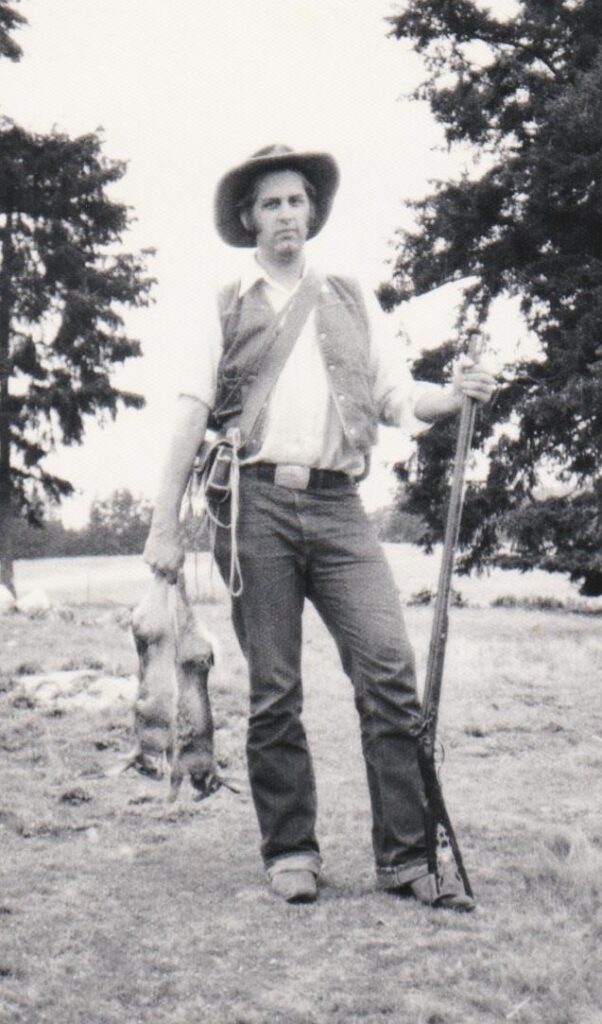
The next four days were devoted to looking for caribou and carrying just the Leman rifle. Ptarmigan were still the only things found up there and one of the white birds was collected per day with that rifle, all taken with head or neck shots. Then, on my last day of hunting, both the Leman rifle and the 20-gauge canoe gun were carried and the canoe gun bagged two more ptarmigan that day. Of course, carrying two guns basically means that one of them must have a sling and that’s one big reason why I favor a sling now on my smoothbores.
To say the least, my hunting trip wouldn’t be quite as memorable if that canoe gun hadn’t been there as my second gun. That 20-gauge added greatly to the hunt as well as adding tasty ptarmigan to the daily menu in camp. While stories about how the second gun was used to add to a hunt are great to recall, we can’t forget that there will be many times when the second gun isn’t used at all.
That can bring us back to the basic fact that a second gun is simply that, it’s a second, to be used either if necessary or if possible. By using it “if necessary” I mean that the primary gun, usually a rifle, breaks down or just becomes non-shootable somehow and the second gun must take its place. The “if possible” falls into the better situation where big game tags might be filled with the primary rifle and then more hunting can be done for small game with the second gun.
While on the hunt just described, I had some 20-gauge round balls in the pouch with me, and the patches to go with them. Those were there just in case my .54-caliber Leman broke down somehow and couldn’t be used. In that case I would have continued hunting for caribou with the canoe gun; loaded with a good round ball load. Actually, I considered hunting caribou with the canoe gun as it was, seeing as how the short canoe gun is so easy to carry, and I’m sure many caribou have already been taken with smoothbores.

One rather obvious type of gun that is often taken on a hunting trip as a second arm is a shotgun. Having a shotgun in camp can really “fill the bill” when a big game hunter starts looking for small game. After all, the situations I’ve just described used smoothbores loaded with birdshot to take those pieces of smaller game. When talking about a second gun in the hunting camp, a shotgun simply can’t be ignored.
But, let’s broaden our horizons just a little and think of how the situations might be if our second gun in camp was another rifle, perhaps a small bore. Then the idea will become plain and easy to see, hunt with the big bore rifle and fill those game tags, then hunt small game with the lighter small-bore rifle. That’s a grand idea and with a lot of good luck that’s the way the hunt would work out.
Of course, we’d have to do some studying before deciding on the caliber of that small-bored second rifle, studying of the local game laws as well as what we might be asking of that smaller gun. Looking at the minimum bore size for a muzzleloading deer rifle is what I have in mind and that will be important if we want that second rifle to be a back-up for our larger bored big game rifles. We’d want to know and understand the game laws and requirements for our small bored rifles if we intend to possibly hunt deer with them.

In my home state the smallest legal muzzleloading rifle for deer is the .40 caliber and that legality has influenced me on my selection of a second rifle, most certainly. I will say, over and over, that I like a .40 caliber rifle for my second gun in camp because, if the need came along, I could hunt deer with that rifle. At the same time, I will quickly admit that I have never hunted deer with the .40 and its .390” round ball because, in my opinion, it doesn’t have the punch and power that a regular deer rifle should have. Even so, I’ll continue to choose a .40 most of the time for my second rifle in a deer hunting camp because the option is mine whether to use it or not. And, if the .40 was used for deer hunting, it would be fired only when those shots were so good and easy that we’d consider the deer already “in the bag.”
Of course, if a deer is bagged with the bigger rifle, then the .40 would be just as at home for hunting small game as the .36 or the .32. Over the span of the years, I’ve taken many rabbits with my .40 caliber guns, mostly with the .40 caliber percussion rifle built for me more than 50 years ago by Ted Fellowes of Seattle. That was my first .40 caliber rifle and that .40 certainly did lead to at least a couple more.
More recently I copied an original Leman percussion rifle that was in .33 caliber. My old habits got the best of me and I made the copy in .40 caliber, although that is the only real difference between these old and new guns. That Leman was a fine rifle and my copy doesn’t look quite as good; let me admit it. Even so, I’m rather proud of my work, which was done in Dave Dolliver’s shop while I worked as Dave’s apprentice. And on top of that, I’m proud of the way this rifle performs on the target range. It has brought me some good wins and a couple of shooting prizes.
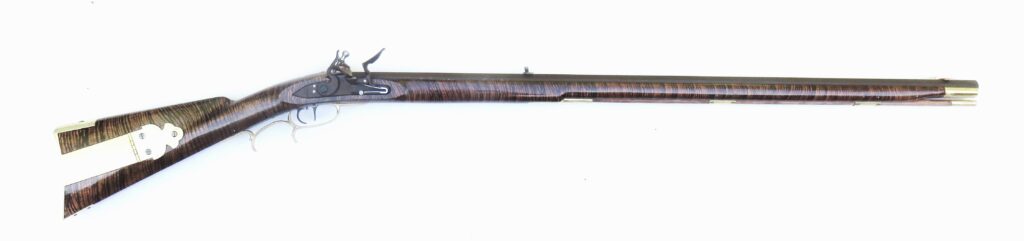
If a deer has already been collected on the hunt; there isn’t any good reason to pick the .40 over a .36 or a .32. I’ve hunted small game with all three of those calibers and I’ll admit that I like the .36 a little better than the .32. Either caliber will take small game, such as rabbits or squirrels, very nicely and that can add good things to the menu while you’re in camp.
Okay, let’s change the course of this type of thinking just a little bit. What if we were going on a small game hunt? Would we still want that second gun in camp? You bet we would! On this hunt that second gun could easily see more use than the primary gun.
For a small game hunt, I want both my small-bore rifle, and I’m thinking of my .40 caliber Leman percussion rifle when I say that, along with a shotgun or a trade gun for use with birdshot. Which gun gets carried out of camp the most will depend on a whole lot of little things such as; what are we hunting and where are we hunting? For rabbits I’d find it hard to leave the .40 behind but for grouse, considering a shot on the wing, the scattergun would get carried the most. Also, if those rabbits were being hunted in rather open country, where a good long shot can be expected, the scattergun would be left in camp because the rifle would have advantages. In addition to being selective, there would be times when we’d enjoy carrying both guns.
When going on a hunt, a second gun is no good at all, if you leave it behind…