By Mike Nesbitt | Contributing Editor
With the good weather of Spring recently sprung upon us, it was high time to hit the shooting trail again.
At the Capitol City Rifle & Pistol Club, near Olympia, Washington, our black powder shooting trail is a very popular place and we try to do at least some shooting on it once per month. You might say, we are either doing some shooting on that trail or we’re just looking forward to doing that shooting. It’s fun!
But for me, this time my shooting was dedicated to learning more about a pair of guns which I had never used on the trail before; my #3 American copy by Cimarron using .44 Russian cartridges and my Model 1894 Deluxe rifle in .38-55 caliber, also from Cimarron Fire Arms. Those two guns could both be used on the trail with black powder loads, also for the “Meat Hunt” and the Revolver Match which are two of the events at our Buffalo Camp, and I was very interested in seeing how those guns would perform.
Along the Trail
Our black powder trail has been described before, in other stories, but let me “lead you through it” once again just in case a new reader or two might be seeing this for their first time.
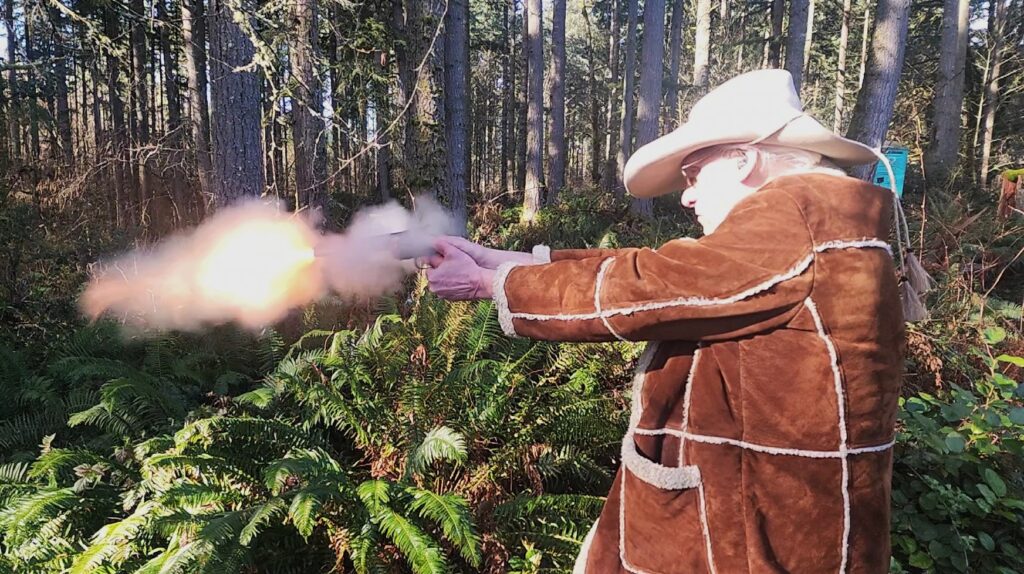
The trail itself winds its way through the timber and on the right-hand side of the trail (and only on the right-hand side) are several hanging steel “gongs” for targets. Those targets are in several shapes and sizes; all posted at un-indicated distances. This makes shooting from the trail so much like a hunting situation where the hunter probably won’t know the exact distance to the target. Hits on those targets are usually heard but also the swinging of the gongs show a good shooter’s reward.
Other clubs also have black powder trail-walks, or at least they should. And these trail-walks are very individualistic, no two (that I’ve seen) are the same. Our “trail” is, or was, an old access road, just one narrow lane, which went through the woods with hills and turns. The targets were selected for the various shooting stations depending on what would be behind them. Larger targets were installed where there was more room, or distance to the wooded ridge that serves as our backstop.
While none of the distances to the targets are posted, because we enjoy maintaining the “hunting-like” atmosphere, the closer targets are generally smaller than for the longer distance shots. I helped install at least some of those targets and when putting then in, the distance to the targets was not considered. What we did consider was visibility from the trail, especially from the shooting station. It can be said that our longest distance target is not over 100 yards and let’s remember that the primary guns to be used on this trail-walk are open-sighted muzzleloaders.
Our trail-walk, with its windy trail, is much more “woods-like” than one trail on another club’s grounds. That other trail was laid out along an abandon railroad grade, which was very level and straight. Both are good, of course, and I mention that only to illustrate how different a trail-walk might be.
We always do our shooting on the trail in groups of two shooters or more. And on the day I’ll be referring to, we had a good group of just over half a dozen of us. (Mike Holeman was kind enough to take the pictures of me.) Therefore, our club’s rules for using the trail must be observed. Safety first, obviously. While we might be carrying repeating rifles, such as my Model 1894 in .38-55, we carry those rifles empty and with the actions opened. If we were carrying muzzleloading rifles or smoothbores, those can be carried with loads of powder and patched ball in the barrels but with no priming or percussion caps at the breech. The time to prime a muzzleloader on the trail is when the shooter steps to the shooting station. Likewise, with a breechloading rifle, the gun will not be loaded until at the shooting station.
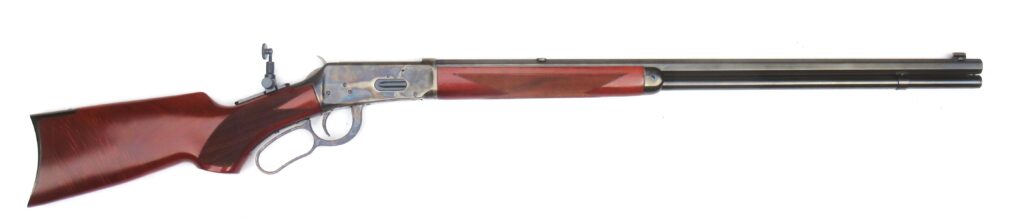
This is Cimarron’s Model 1894 Deluxe in .38-55 with the 26-inch octagon barrel. Notice the rear sight.
For revolvers, our rules require holsters. At the first revolver target, the gun can be loaded. With percussion revolvers, the safest way to handle this is to load all chambers with powder and bullets, then cap all of the gun’s nipples. With that done, the shooter can take a shot at the target. Following that shot, if the shooter intends to move on to the next target, the gun is returned to the holster while leaving the gun’s hammer down on the first cap, which makes the revolver very safe to carry.
We practice the same safety observations for cartridge revolvers. Load the entire cylinder at the first target, take that first shot, then leave the hammer down on the spent chamber and put the gun in the holster.
My first problem when I considered shooting my #3 American on this trail was getting a holster to fit that gun with its 8-inch barrel. That was nicely solved for me by Allen Cunniff who made the “Slim Jim” cross-draw holster which fits my long barreled .44 replica very well.
Yet, if a pistol shooter did not have a holster, they could still shoot, using the safety considerations that we use for rifles. They would carry their empty pistol while on the trail and only load the gun just before taking the shot at the next target. Once again, they would load their breechloading revolver or prime their muzzleloading or percussion revolver only at the shooting station.
Ten Cartridges
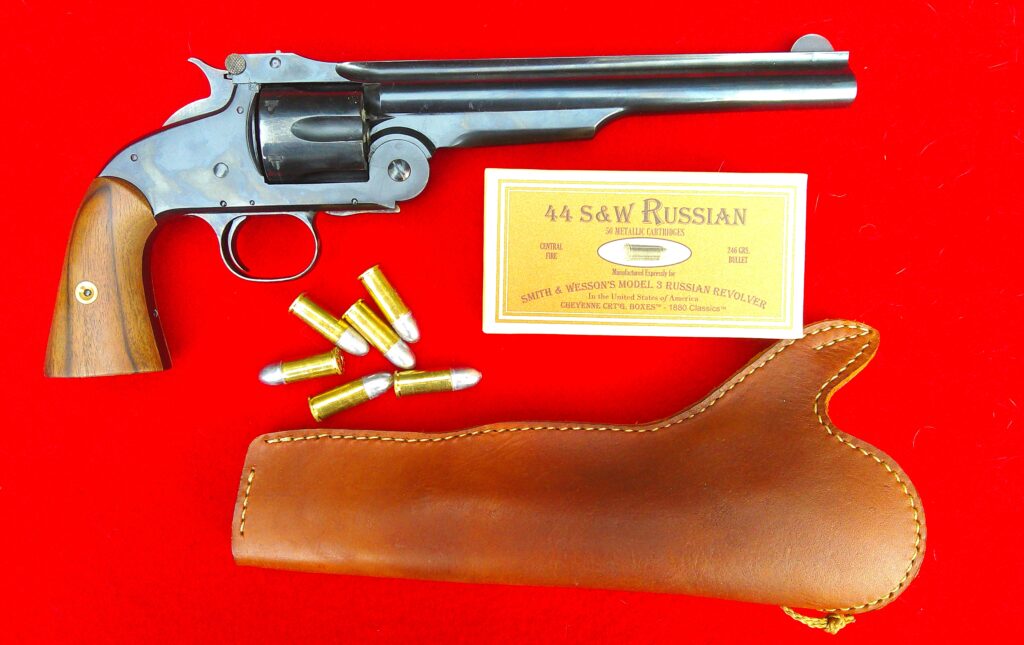
To get myself prepared for doing this shooting on the trail, I took only ten cartridges for my .44 caliber #3 American. That equals the number of targets on the trail that are designated for the Revolver Match at Buffalo Camp. Those targets are not identified with placards until the event is to be shot but I can easily remember them. And while doing my shooting, several thoughts occurred to me about this new replica of the first big bore Smith & Wesson “Army” revolver.
For one thing, the gun’s grip is rather straight. It isn’t bad but I will admit how my hand favor’s the grip on the New Model #3 much better. Of course, that New Model grip has the advantages of evolution on its side. The Smith & Wesson #3’s went from the American model to the Russian model, then changed again for the Schofield version. Each version had a different shape to the grip. Finally, in 1878, the New Model #3 was introduced with its different grip, and that version stayed in production up until 1912, a good long time. I’ll be hoping I can still like this American model as much as the New Model #3 and we’ll have to see about that…
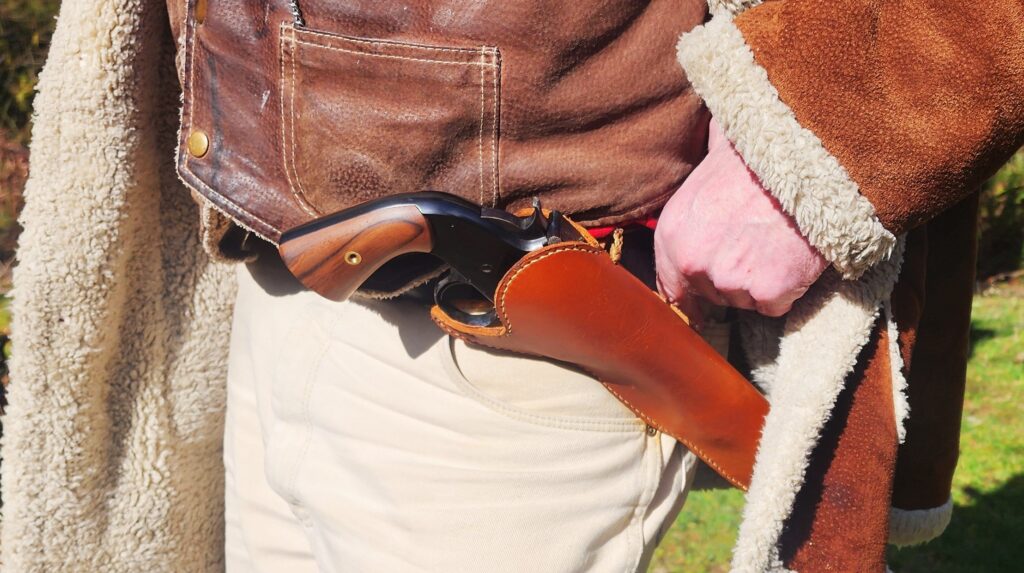
In my previous story about the #3 American from Cimarron, I mentioned the trigger pull which, to me, was really on the heavy side. That trigger pull was “lightened” by reducing the width of the trigger spring. (Be advised, messing with the gun’s internal parts will void any warranty, but so does shooting reloaded ammunition.) For me, getting a better trigger pull was a simple necessity and now this gun is performing much better.
The loads I continue to use feature a 250-grain round nose bullet, one that was designed for the .44 Russian or .44 Special, loaded over 18 ½ grains of Swiss or Olde Eynsford 2Fg black powder, all contained in the new Starline .44 Russian nickel-plated or brass cases. I’ve been using that load for more than a couple of years now and it certainly does satisfy me. Of course, a good black powder lube must be used and now I’m using Vigilante’s Number 1 bullet lube most of the time.
One little difference in my loads for the .44s is the card wad, punched from empty milk cartons, that goes between the powder and the base of the bullet. So far I don’t see any real improvement in accuracy with the revolver loads but I do see a shrinking of my groups when that wad is used in .44-40 loads and fired in my ’73 rifle. That allows me to assume that a similar improvement should be realized with the revolver loads. The wad punch was purchased from Buffalo Arms.
While I did not keep a shot-by-shot record of my revolver shooting on the trail, I did hit more than I missed. The Cimarron American in .44 Russian-Colt-Special was certainly doing better and the lighter trigger pull was showing its advantages. To put it simply, I was quite pleased.
But I was even more pleased with my rifle shooting which was done at the same time. And the rifle I used had never been carried down the trail before, my Cimarron Model 1894 Deluxe in .38-55. The old .38-55 is a famous woods-gun and for the shooting being done, it easily fit right in. In my opinion, it did fit right in and I’ll be highly tempted to use it again or even try it for the Meat Hunt at Buffalo Camp.
Rifle Loads
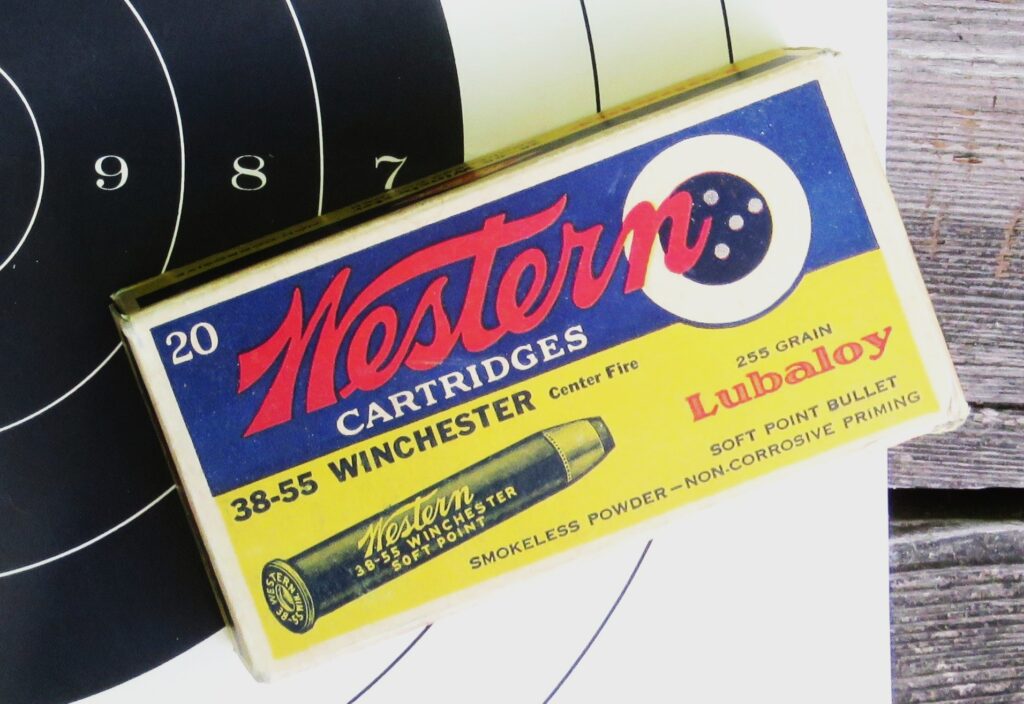
The loads being shot used bullets cast from Lyman’s #375248 bullet mold sized to .380-inch, which with my alloy weigh-in at 255 grains, over 45 grains of Swiss 2Fg powder. That is not a light load, although it does sound like it is 10 grains of powder below the old standard of 55 grains. It is less than 55 grains, for sure, but the old 55-grain loading must have been done with balloon head cases because the later factory black powder loads used only 48 grains of powder while keeping the original name for the cartridge of .38-55. And my loads using the 45 grains of Swiss 2Fg give the bullets a muzzle velocity of 1,335 fps, about 15 feet per second faster than the old published velocity for the black powder factory loads.
Between the powder and the bullet, there is another card wad punched from the empty milk carton, with another wad punch from Buffalo Arms. The 45-grain powder charge still needs to be compressed and compression is done with a compression die which forces the over-powder wad down to the proper depth, giving the bullet ample room in the case to have the overall length of the cartridge of 2 ½ inches. If that length is exceeded, the cartridges cannot be fed through the rifle’s action from the magazine. They could, however, still be fired if loaded single shot.
One point must be made about shooting those too-long cartridges single-shot in the Model ’94 is that they must be fired after being chambered, because the loaded cartridges are too long to be extracted and ejected. That means, if a “cease-fire” was called while shooting, the rifle could not be unloaded. The only way to unload the rifle would be to shoot it.
Nothing like that took place on this trip down the trail and the rifle targets were all getting hit very nicely. Of course, I was still loading the rifle with one shot at a time, according to the club’s rules for shooting on the trail but I did take the option of loading some of those cartridges into the magazine and then levering them through the action to chamber them. Everything was working as it should.
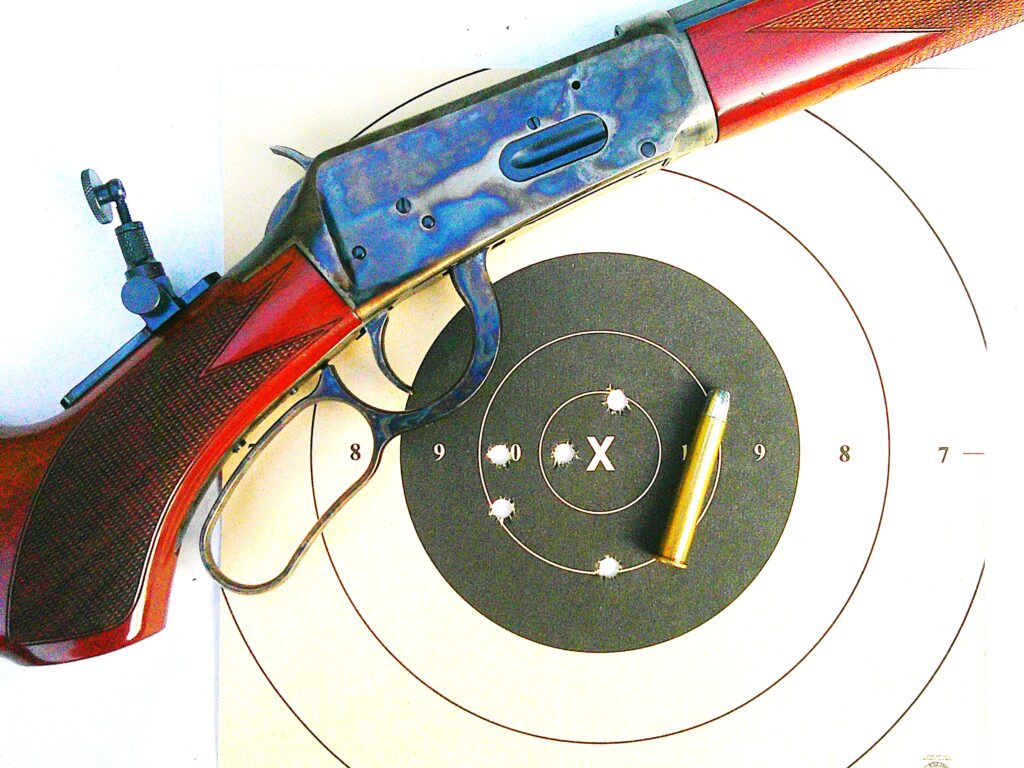
And I was getting hits like I should. There are a couple of rifle targets on the trail that seemed to be especially appropriate for the .38-55 and they are both silhouettes of bears. Those are both fairly long shots too. Maybe someday this .38-55 will be used to hunt black bears so I was very interested in seeing how the rifle performed on those targets. Both of them were hit with ease which made me very happy.
Photo Finish
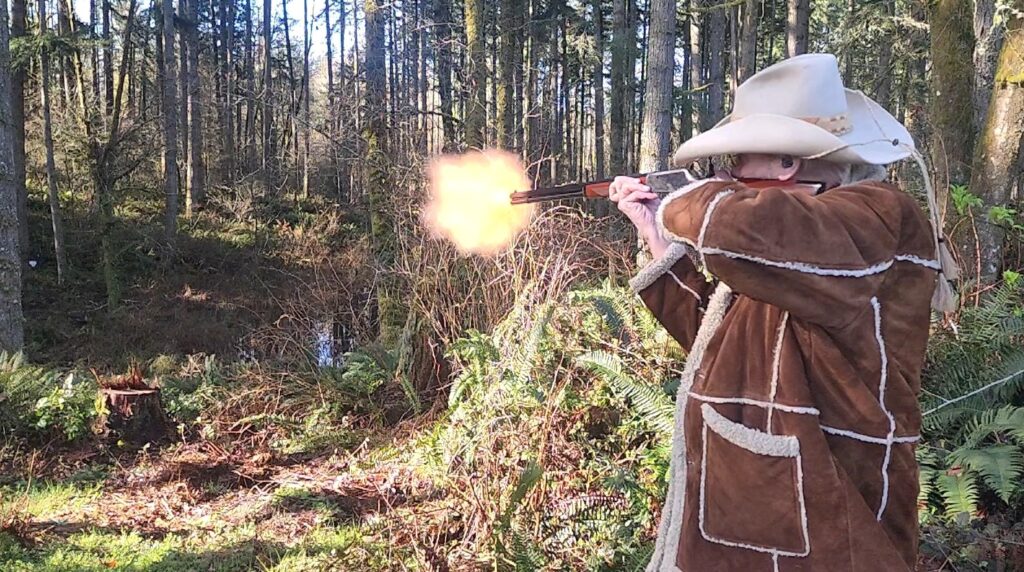
Another target, a fairly small one, is rather outstanding. That one is a silhouette in the shape of a mountain goat and it is a rather long shot. While I was aiming at that target, Holeman was taking a picture of me doing my shooting. His picture catches the muzzle flash very well, before the smoke from the black powder load can be seen. In that picture, looking to the left side, you might see a small white dot next to an evergreen tree. That white dot is the mountain goat target and in this picture the bullet had not gotten there yet. The shot was a good hit which naturally delighted me.
The entire trip down the trail with this .38-55 was quite rewarding and I, at this time, can’t remember any of the rifle targets which were not hit with the first shot fired at them. Of course, I did share a few rounds with others who wanted to take a try at shooting that rifle. This ’94 in .38-55 is becoming a rather popular gun in our club.
The black powder trail-walk is also very popular and I believe it is easy to see why. Even though we can only open the trail one day per month, because the black powder range must be closed to use the trail, there is usually a good collection of shooters who join together for the good shooting. We can also point out that shooting on the trail gives the shooters the opportunity to use their guns in a more “hunting-like” way, something that just can’t be experienced when shooting from a benchrest. And, like I said at the beginning of this tale, it’s fun!