By Mike Nesbitt | Contributing Editor
The process of learning the insides and outs of a new black powder revolver has just begun, again.
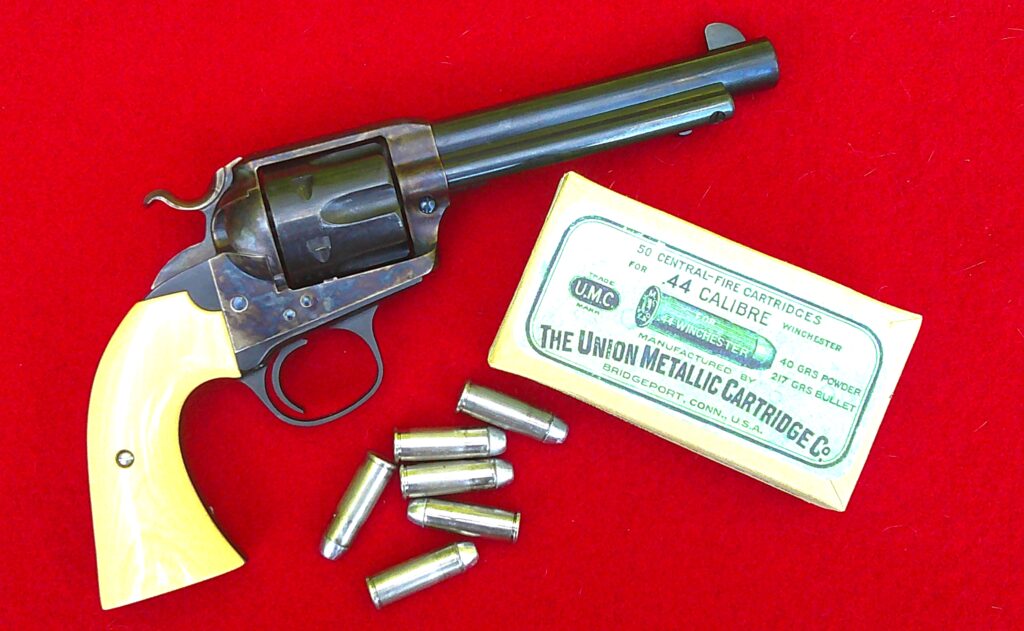
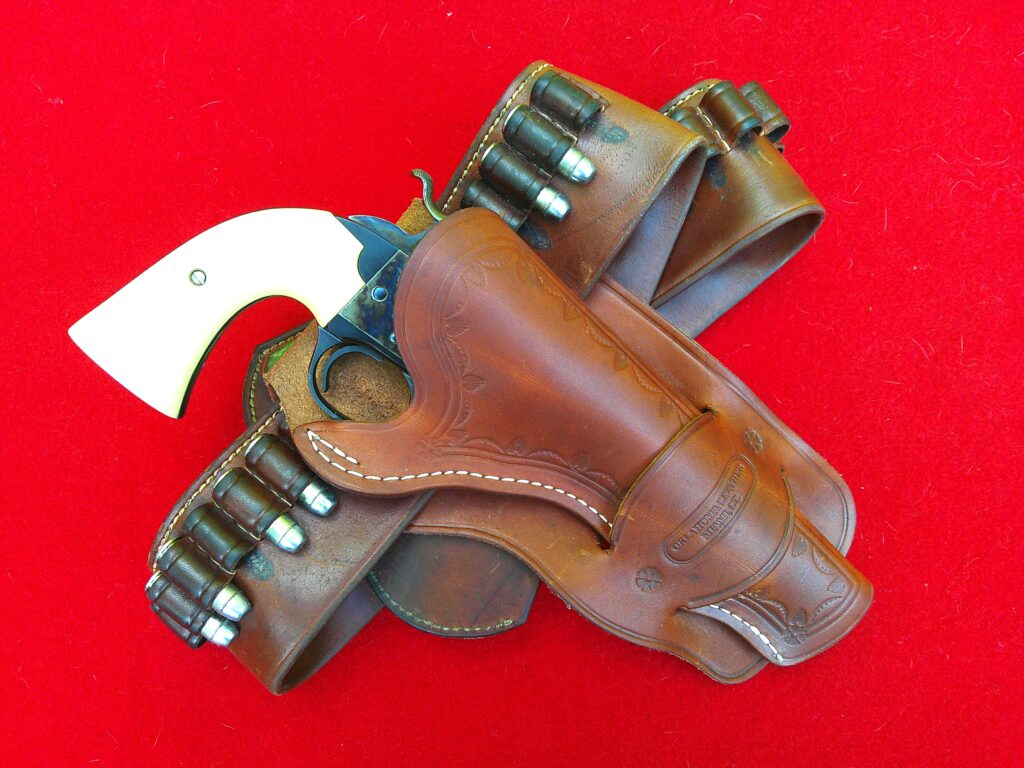
This time it is with a lovely Cimarron (Uberti) Bisley Model in .44-40 caliber, with a 5 ½-inch barrel and ivory-like grips which contrast so nicely with the color casehardening on the frame and hammer. Bisley Models have been my failing for several years, although this is the first one I’ve gotten wearing the Cimarron or Uberti address.
It is well known that the .44-40 in a revolver is somewhat of a real beast when fueled with full black powder loads. That simple fact steered me away from some other .44-40-caliber revolvers but the looks of this Bisley won my heart, and it became mine. And, as my interest in shooting .44-40 revolvers took a sudden upward swing, I began to study the situation more carefully, including the history of the old .44 W.C.F. (Winchester Center Fire) cartridge.
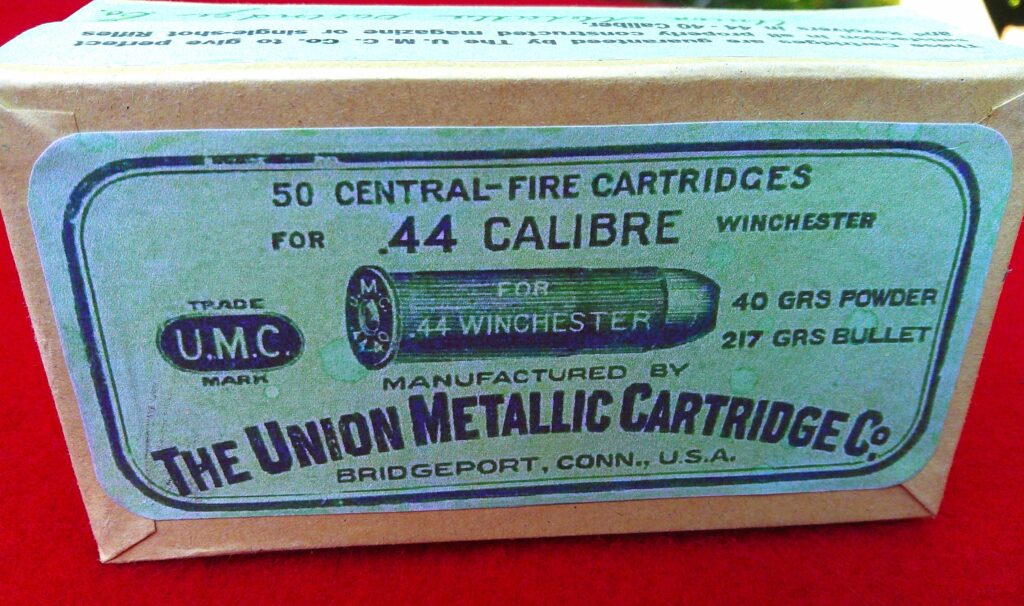
There was also a short-lived “low velocity” black powder loading for the .44-40, loaded by U.M.C. in the early 1900s. That load used the same 200-grain lead bullet but it was powered by just 28 grains of black powder. Why that was done, or tried, is not exactly known, although shooting a fully loaded black powder .44-40 in a revolver can give any shooter a rather good hint. That’s a real blast! What it did was to give the lighter loaded .44-40 the same approximate performance as the older .44 Henry rimfire cartridge. More than likely, the 28 grain loadings were probably not the most popular, if we can say that at all, in revolvers where the reduced blast and recoil would be the most noticeable.
For one thing, the reduced velocity black powder loads for the .44-40 might not be completely complimentary for that cartridge if the main use for the .44-40 revolver was to be teamed with a rifle or carbine in the same caliber. That, of course, was the main reason for having the rifle and revolver companion pieces. Reducing the powder charge by a full 30 percent is cutting it down quite a bit. But what would such a reduction actually mean in feet per second? That was something which made me curious and I had to find out.
So, a small batch of cartridges were prepared, loaded with 28 grains of Swiss 2Fg powder under the 205-grain bullets, cast from Accurate Molds’ 43-205C mold. Those loads, however, would not necessarily offer a good “look” at how the old UMC loads would perform. The reason for that is because the old loads were, undoubtedly, assembled in balloon-head cases while the ammo I prepared with fitted in solid-head cases. There is a difference in the internal volume of those different cases which immediately results in different pressures and velocities.
That can be illustrated this way; the old standard loading with the balloon-head cases was 40 grains of powder. While using modern solid-head cases, my standard load uses 35 grains of powder, usually Swiss 3Fg. Dropping to 28 grains of powder in the balloon-head cases is a reduction of 12 grains, or 30%.
When I loaded my trial loadings with 28 grains of powder, that was a reduction of only 20%. In order to create a more parallel comparison, to more closely duplicate the performance of the old U.M.C. 28-grain load, I should have tried using 24 ½ grains of powder. Maybe someday I’ll do that…
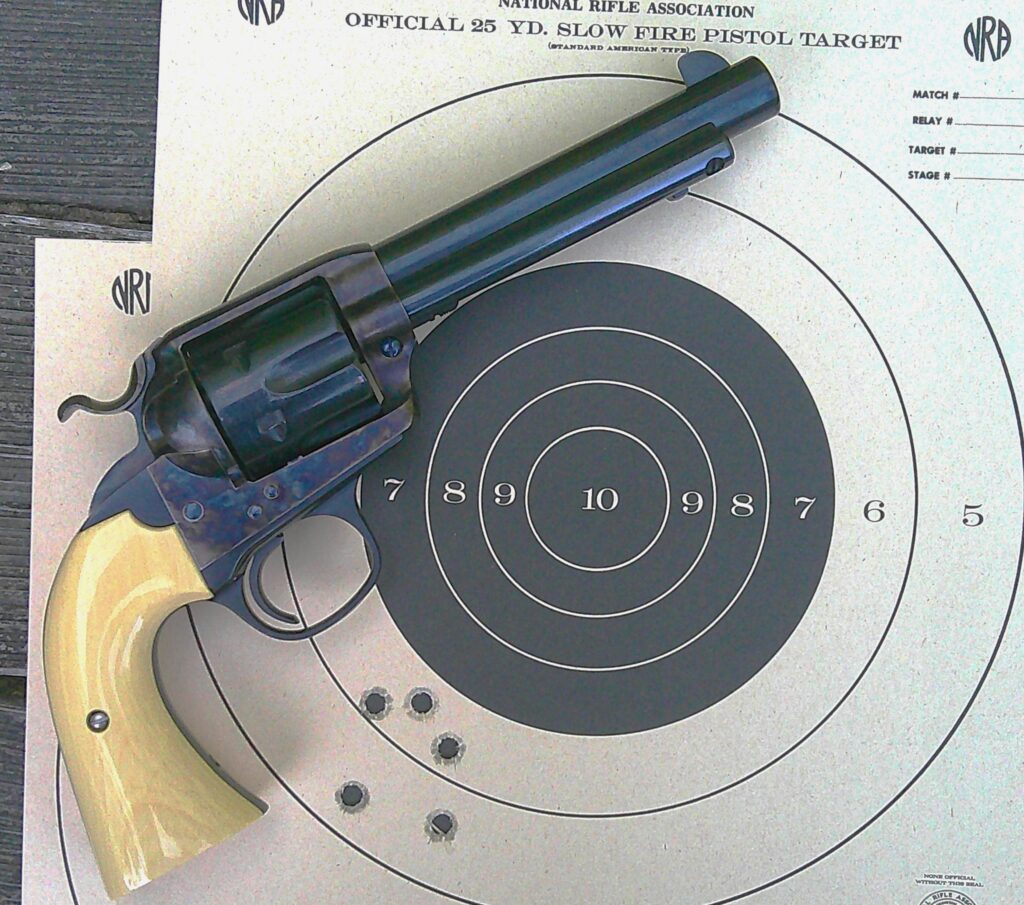
For now, I’d try the 28-grain loads in the Bisley just to see how the gun likes the idea. Those were used for the very first shots I fired in this gun and they were quite “informative” in regards to what this gun might really like. Those first shots were fired at a bullseye target, posted at just 30 feet, with the revolver held down on the bench, with the chronograph sitting in just the right place.
Five shots were fired and those grouped very nicely. However, as I had feared, the front sight looks like it was made for a .44 Special or even a .45 Colt, a good bit too high for the faster .44-40. This puts the bullet’s point of impact too low. With these five shots, with the sights aimed at the center of the bullseye, or dead on, the bullets all hit at 7 o’clock below the black. And the velocity of those loads averaged a rather pleasing 821 feet per second, which is a good 100 fps slower than the standard .44-40 black powder load.
Those five shots were followed by another five rounds of the 28-grain .44-40 loads, which were fired at another target, also at 30 feet, but shot offhand. The same point of aim was used and the bullets impacted in a wider group (which was easily expected) down at 6 o’clock at the bottom of the black. That was actually pleasing, the gun will certainly shoot. All it needs is some loving care to “adjust” the front sight or find a load that will print near the center of the target.
After firing those shots, another cylinder was put in this Bisley (which just happened to fit) and some shots with .44 Russian ammo were fired. Those, of course, gave the gun a whole different character, a character which I found quite likeable.
First of all, the gun was “tamer.” With less recoil and the lower blast from the muzzle, the Bisley simply felt more cooperative, a feeling that I found very enjoyable. Those were also aimed at the center of the black, right where the X would be if the target had an X, and they did hit much closer to the point of aim.
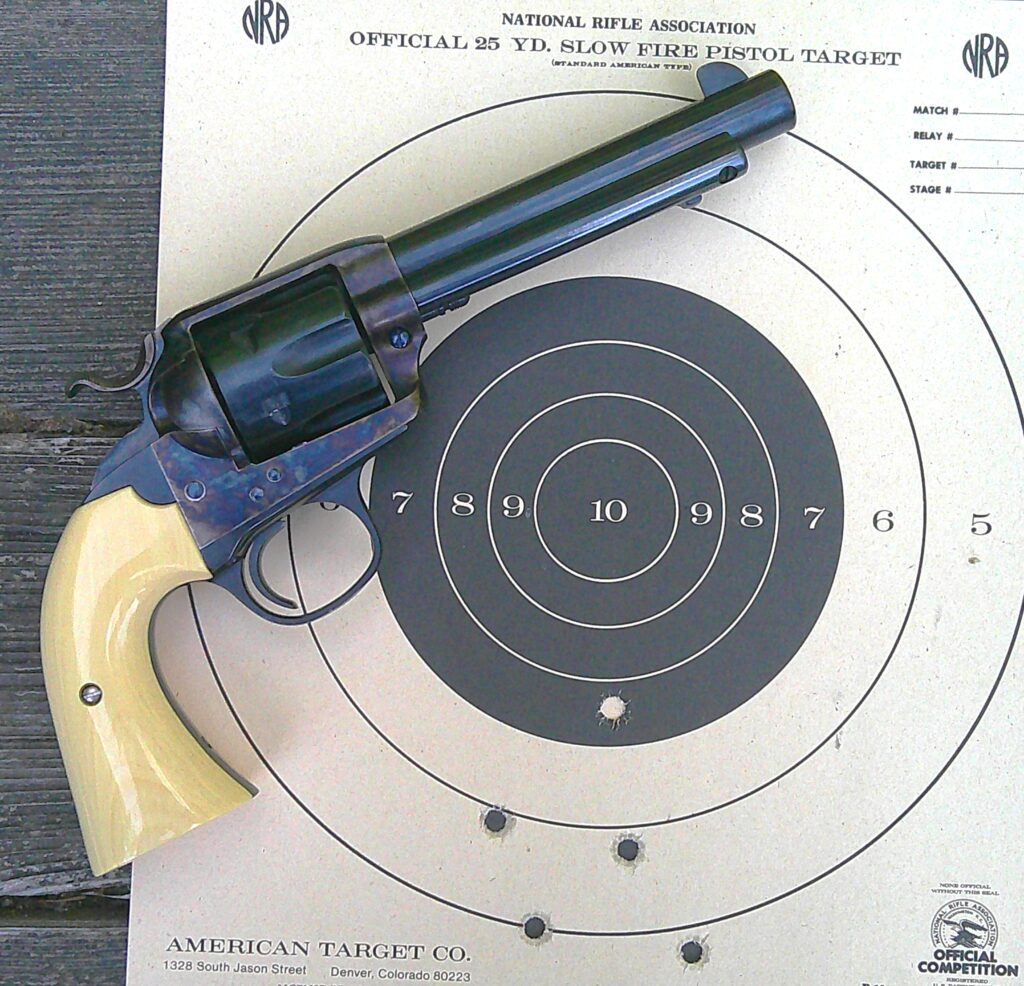
Firing those shots did not convince me to get a .44 Special cylinder for this gun but they did not discourage that idea either. More shooting would need to be done and the new Bisley was given a break until the very next day.
That following day, with more of the same ammunition, the Bisley was given a second try, maybe a second chance. It was still shooting low and somewhat to the left with the .44-40 loads, the last of my sample of the 28-grain loading. Then the cylinder was changed again and more .44 Russian loads were tried. Those .44 Russians, loaded in new Starline cases, were fueled with 18 ½ grains of Swiss 2Fg powder under a 245-grain bullet, cast from Lyman’s discontinued #429184, the original old bullet style for the .44 Russian.
A few years ago, some very similar loads for the .44 Russian were speed checked and they had a velocity of just about 700 feet per second out of a 6 ½-inch barrel. Shots fired from this Bisley will be just slightly slower because of its 5 ½-inch barrel and before my trials and errors with this gun are over, we’ll see what that actually is.
The slower and heavier bullet, due to more barrel time, should print higher on the target. Five shots using the .44 Russian ammo at another target, still posted at 30 feet, show that to be a fact. But those bullets were still low, although printing in a good group at the bottom of the target’s black. That is not what I’m really looking for but it did tell me more of what needs to be done.
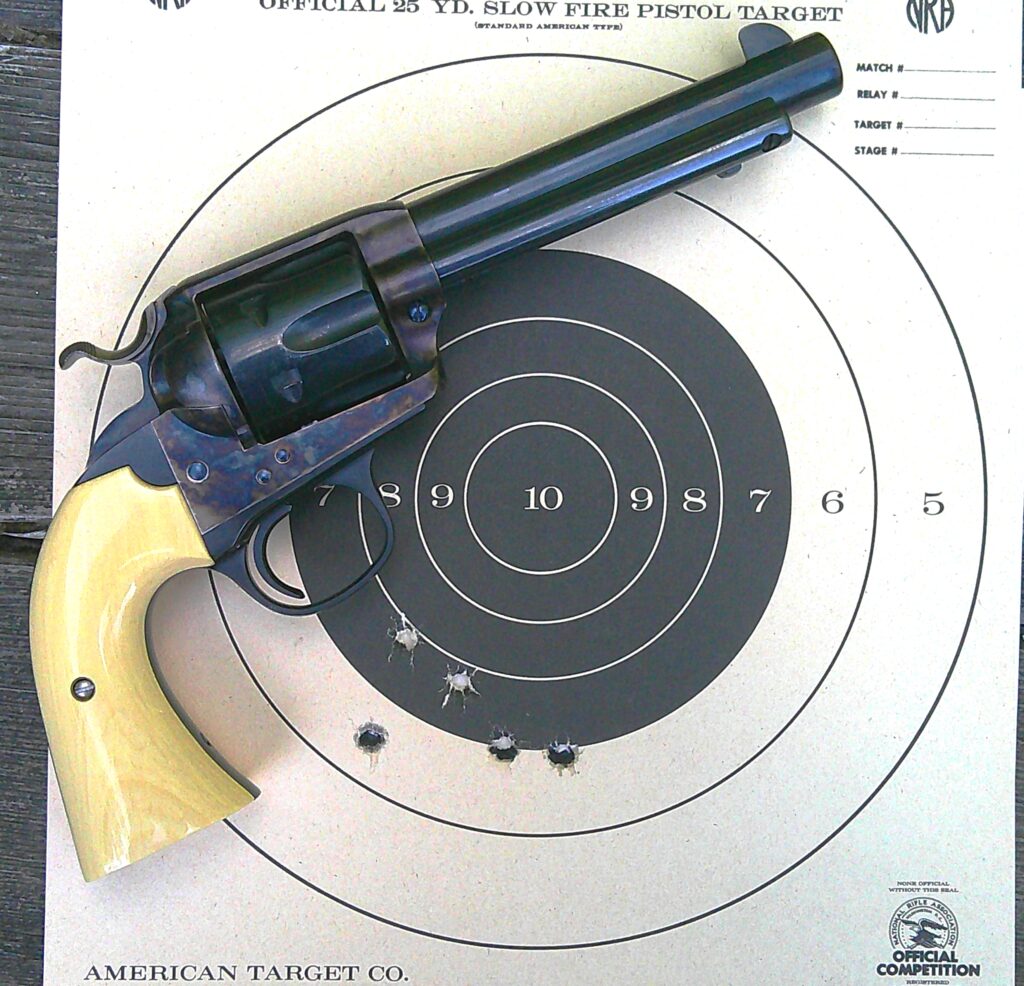
First of all, the front sight does need to be lowered. I’m going to do that slowly and carefully, with more checks on targets to be sure that it doesn’t get lowered too far. The front sight will be ground or filed down in a very similar fashion that I used to “set the elevation” on the short barreled .36 Navy that received a custom front sight. There is no point in being in a hurry with such a project and I might possibly report on my progress before actually completing or being satisfied with the job.
Next, the shooting with the .44 Russian ammunition convinced me, rather quickly, that I want a .44 Special cylinder for this gun. A new cylinder was not in stock at VTI, so a .44 Special cylinder was put on back order. If you are looking for parts for imported replica arms, by all means go to VTIGUNPARTS.COM and see if they can help you. I’ve bought from VTI before and they are highly recommendable.
Of course, I’m wishing that the new .44 Special cylinder was in stock. But there is no point in getting impatient about such things because I still have plenty to do with this new Bisley, and that includes cutting down the front sight. My “plan of attack” is to work on lowering the front sight a little at a time, then taking the gun to the range for a test firing to see if any progress has been made.
My progress will be “measured” in groups of five shots each, with notes on where the centers of those groups are, seeing if they have climbed in recognition of the work that has been done. If I feel that a report, or reports, on that progress is justified, I’ll be glad to mention what I have done and what tools were used to do it. For now, I’m actually delighted with the prospects of doing the work and, of course, the necessary shooting. I expect this new Bisley to become a real pet, a true favorite, and this is only the beginning.