By Mike Nesbitt | Contributing Editor
It seems like most of my reloading lately has been for shooting with black powder cartridge revolvers.
This suggests that an article, maybe just in general, about reloading revolver cartridges with black powder might be welcome. One thing I will say here at the start; it isn’t as tricky or as hard as it sounds.
First of all; what is a black powder revolver cartridge? Let me put it this way, the very first revolver cartridge that was made or designed for shooting with smokeless powder was the .357 Magnum, introduced by Smith & Wesson in 1935. That means almost any and all revolver cartridges except the .357, the .41 and .44 Magnums are, or originally were, black powder rounds. I know, someone is bound to speak up and ask “what about the 9mm Luger when it is used in a revolver, or the .380 or .45 ACP?” Yes, we can find revolvers chambered for those cartridges but they were designed for automatic handguns and not originally intended for revolvers. (Even so, when shot in revolvers, those cartridges could be reloaded with black powder. One example is the .41 Magnum; I know of a fellow who has loaded his .41 with black powder and getting very good performance with it.)
Reloading revolver cartridges with cast bullets and black powder is, in general, a very simple and straight-forward task. But there are some things you don’t want to do. Let me run through some of the basics about black powder reloading where some details can be mentioned.
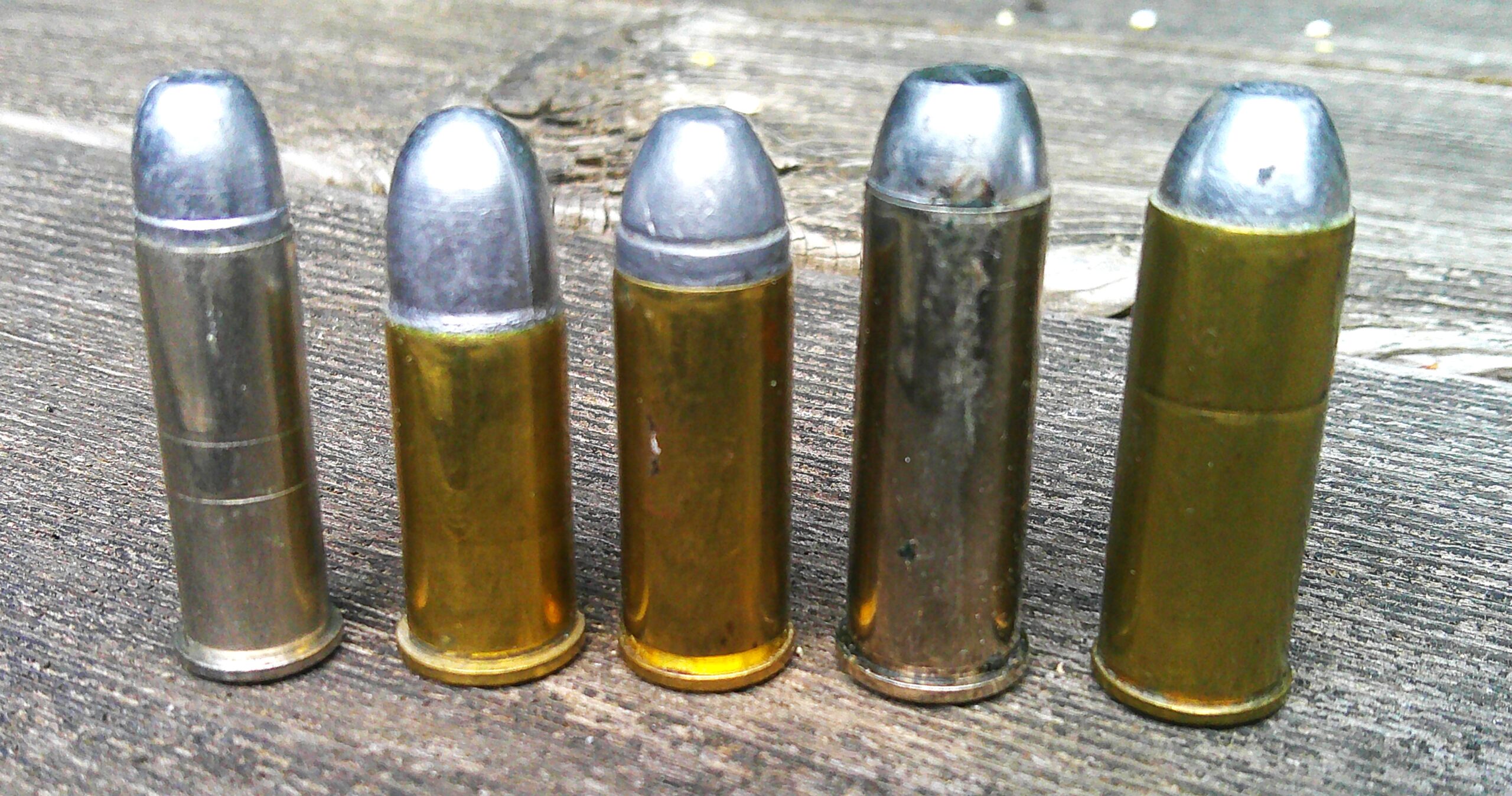
One more note before getting to the reloading; the cartridges I like to use are the old-timers that have never been out-done, at least not with black powder. Those are the .45 Colt and the .44-40 for power and the .44 Russian must certainly be mentioned for accuracy. There are others, of course, and some of them will be mentioned as we get into the reloading process.
Where to Begin
As a place to begin this discussion about reloading with black powder, let’s start with the brass cases. If those cases have been previously fired with black powder, they need to be cleaned. My routine is to de-cap the empties and then soak them in soapy water. I like to use warm water just because it is more comfortable when I reach into the container to retrieve those soaked cases, one at a time. Soapy water softens the black powder fouling which is always present after shooting.
Then I like to use a bristle brush, a case cleaning brush with plastic bristles, to brush out the inside of the cases. Following that, the cases are put on a drying rack and allowed to dry. In good weather, with sunshine, that drying rack is left outside where the cases can be dried in less than an hour. Those bristle brushes are available in several sizes from Buffalo Arms Company.
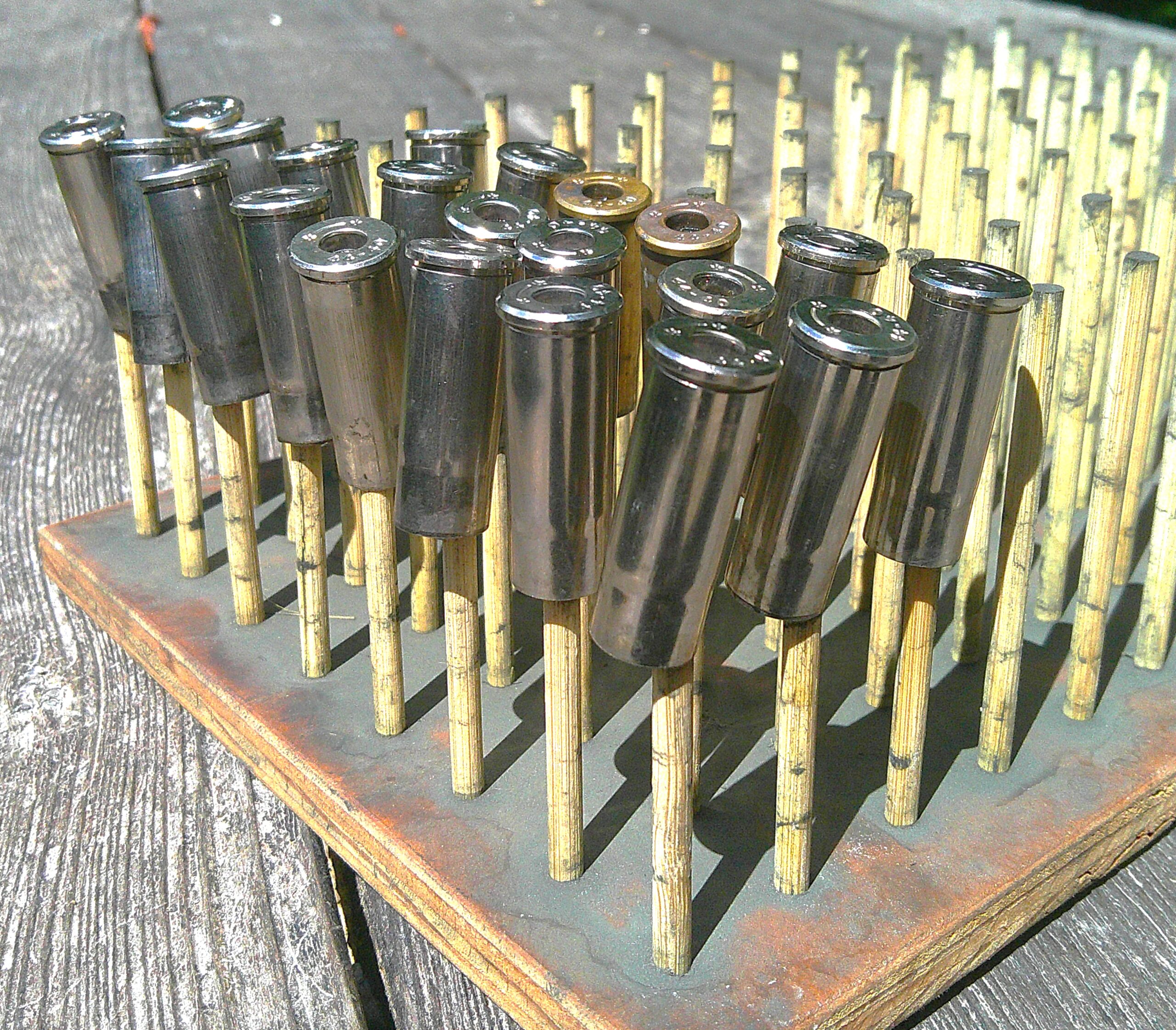
As a personal note, I like to use nickel plated cases. The nickel plating makes the brass easier to clean which really helps in keeping them looking good. One possible minus point to that is how the nickel plating might make the cases more brittle which can shorten their life or number of times they can be reloaded. Starline makes nickel-plated versions of their brass cases in several calibers.
While we will probably be loading ammo for an old black powder revolver cartridge, such as the .44-40 or the .45 Colt, let’s remember that the cases are not the same on the inside. The old brass cases were generally balloon headed, with a raised primer pocket. Today’s brass cases in those same calibers are solid head, which reduces the internal powder capacity. That does not present any problem, in fact it is an advantage. Using .44-40 reloads as an example, I use 35 grains of Swiss 3Fg powder under a 205-grain bullet and that gives 1,350 feet per second (out of my rifle) which is 50 feet per second faster than the old, published velocity with factory loads with 40 grains of powder. The reduced internal capacity of the brass increases pressures so it is a pretty fair trade.
The best black powders to use for revolver cartridges, in my opinion, are the 2Fg and 3Fg granulations. Which one is best for you and your gun, you’ll have to find out. There is also a 4Fg powder which is mainly a priming powder for flintlocks and I do not recommend using that in a metallic cartridge. Those very fine granules of 4Fg powder burn very fast which produces an extremely steep pressure curve. It is certainly best to stay with the 2Fg or 3Fg in revolvers.
Finding out what powder charge to use is fairly easy, if you have some of the old catalogs from the 1890s or perhaps up to World War I. Winchester catalogs from that era had the powder charges printed right in with the cartridge descriptions, along with the bullet weights. Of course, if you don’t have those catalogs, perhaps a search on the internet could be made.
There is a way to find a good black powder load without using those old references. Take a primed case that you are about to load, and fill that case with the black powder you intend to use. Then weigh the powder. That will tell you how much powder the case will hold. In the .38 Special, that will probably be 19 to 20 grains.
The old load for the .38 Special, which came out in 1903 as a black powder cartridge, was 21 grains of powder under the 158-grain bullet. Again, the newer solid head cases do reduce the internal capacity. For my .38 Special loads, I like to use a charge of 18 ½ grains of Swiss or Old Eynsford 2Fg powder under a 158-grain cast bullet. Of course, I picked the .38 Special simply as one example, other black powder loads for revolver cartridges can be found the same way.
Venturino Reference Books
Another very good reference for reloading revolver cartridges with black powder is the late Mike Venturino’s book, Shooting Six-Guns of the Old West, which is published by Wolfe Publishing Company. That book contains excellent information for black powder loads. It does not, however, include loading recommendations for Olde Eynsford powder by GOEX. The book was written just before Olde Eynsford was introduced. This book can be purchased directly from Wolfe Publishing or wherever books relating to black powder are generally sold.
Venturino also wrote a book titled Shooting Colt Single Actions which contains similar information but also includes the Colt percussion revolvers.
One really good thing about reloading with black powder is that you cannot get too much powder in the case. I’m speaking about the safety issue. In other words, a double charge with black powder simply can’t be done.
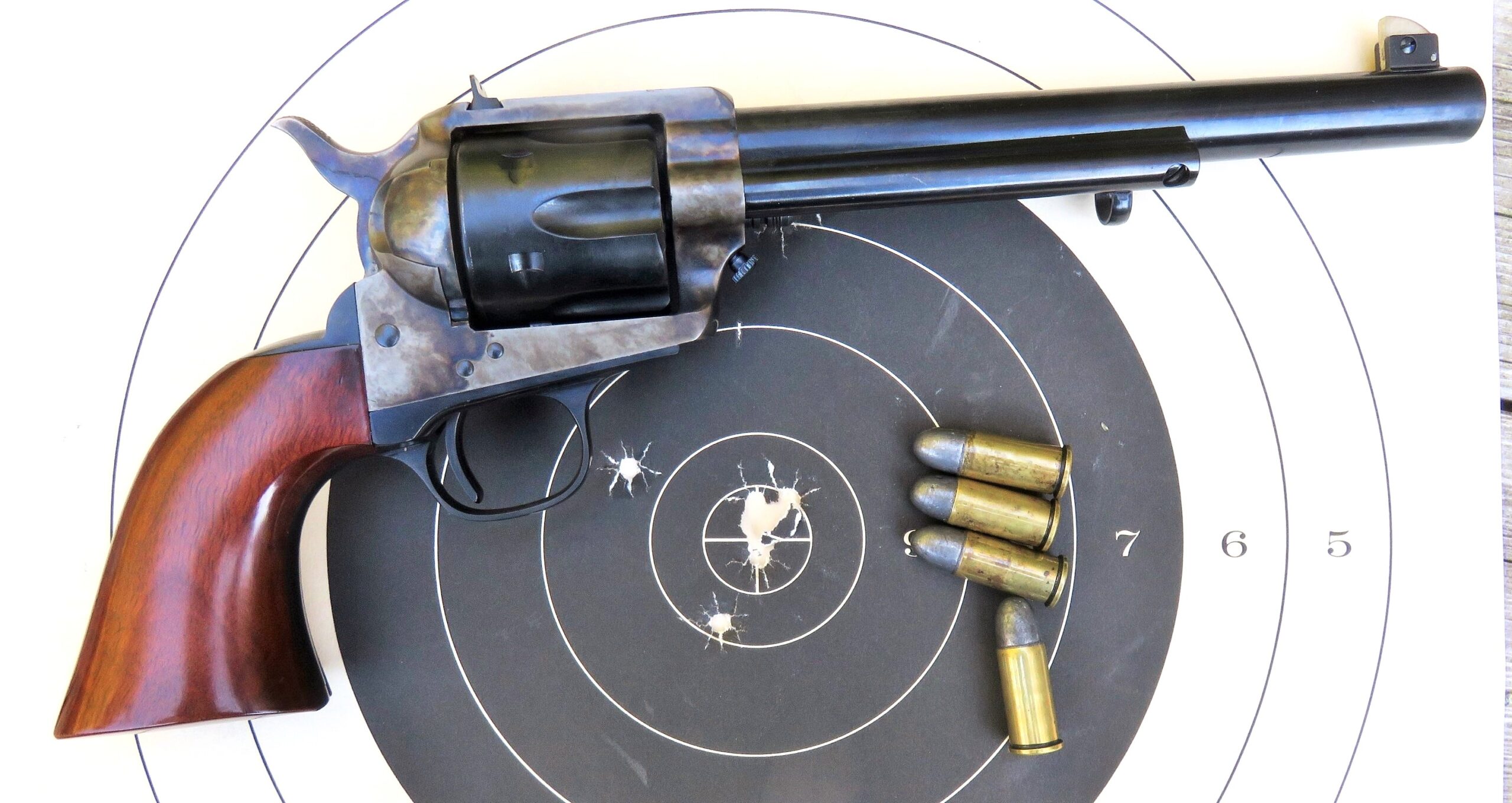
All successful black powder loads that I know of use powder charges which require some compression of the powder. That compression is not hard to do. Going back to the 35-grain loads for the .44-40, the bullets are simply placed on top of the powder charge and the powder is compressed as the bullets are seated. Care must be taken while doing this because the soft lead bullets are easily deformed. There are also powder compression dies which do a better job and I do have compression dies for some of my rifle calibers. My revolver reloading, however, does not use compression dies. Of course, I do recommend using them if you want to.
Once the weight of the powder charge you want to use is determined, my procedure is to set my Lyman 55 Black Powder Measure for that amount and check it by the scale. With that done, I load my cartridges. It doesn’t hurt to check the weight of the powder charges now and then, especially if you think something has changed in the amount of powder going into the cases. If you notice less powder being measured into the cases, perhaps the measure is getting low on powder.
Measuring black powder with a small scoop can also be done, measuring by volume. It would be best, of course, to check the weight of that volume just to be sure of what the volume is. And perhaps the differences in weight for that volume could be checked with various granulations of black powder. I will often use a volume measure with my black powder reloading but generally not with revolver cartridges. For my reloading of revolver cartridges, the bench-mounted powder measure is simply more convenient.
Very few words need to be said about primers for black powder loads, although comments about primers should certainly be included here. Black powder is easier to ignite than the smokeless powders and I’ve always had very good luck using standard pistol primers, either small or large as the cartridge case requires. Some other shooters, such as Venturino, prefer to use the Magnum primers which fire with a hotter flame. Their reasoning is that they feel the more powerful primers gives them better groups. Use the magnum primers if you want to, they really don’t hurt anything. I’ll stay with my standard primers…
Bullet Selection
Bullets for black powder revolver cartridges should always be cast or swaged lead. Jacketed bullets simply do not mix well with black powder loads. The main reason for that is because the jacketed bullets do not carry any lubricants for combatting the build-up of black powder fouling. That fouling will fill the barrel’s rifling grooves within maybe three shots and accuracy will be a thing of the past.
The same can be said of the new coated lead bullets. Those are not for black powder loads.
Selecting a bullet for shooting with black powder cartridges is, at first, rather easy. We most often want to duplicate an old factory load, which means looking for a 158-grain bullet for the .38 Special and a 200-grain bullet for the .44-40, and so on. But there are more important features about the bullets we select than just the bullet weight. Cast bullets for black powder shooting need lubrication and there is probably no such thing as too much lube, so look for bullets with wide or large lube grooves.
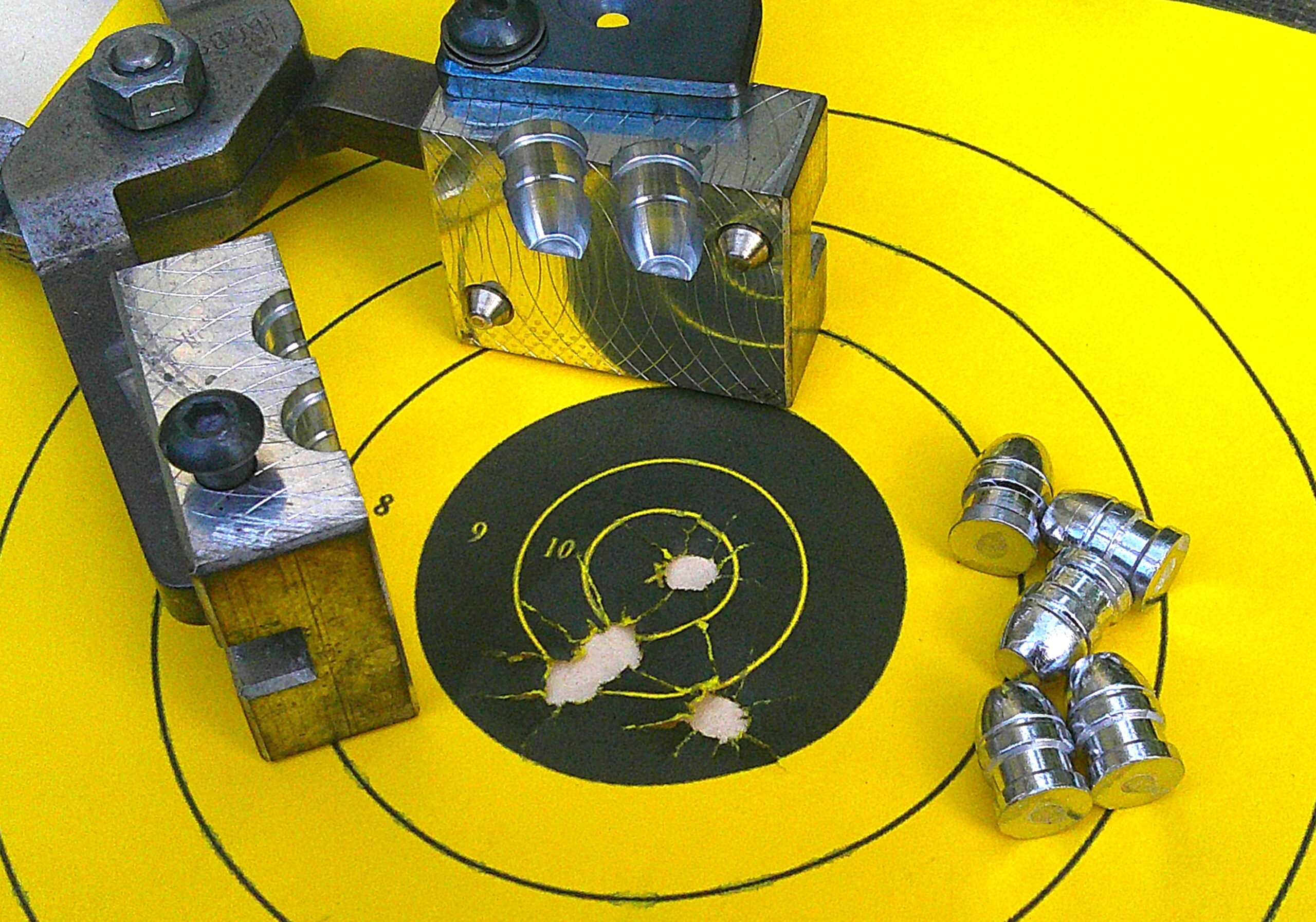
The bullet molds I favor these days are the ones made by Accurate Molds in Centerville, Utah. They have an extremely wide selection and they offer several options. Their bullet molds can be made out of aluminum (which I like the most) or brass, or steel. I recently got a double cavity mold for 215-grain bullets for the .44-40 which will see a lot of use in both revolvers and rifles. Accurate Molds’ products are reasonably priced and made to order. Take a look at their website at accuratemolds.com for more information.
Getting a bullet with generous lube grooves, you might say, puts you halfway there. The other half is getting some good black powder bullet lube. Most of today’s bullet lubes are not intended to be used with black powder loads and they can’t be recommended. What I will quickly recommend is the famous SPG bullet lube, which was developed by the noted Steve Garbe. (SPG are simply Steve’s initials.) SPG is available through most dealers who carry goods for black powder reloading or directly from SPG Sales and their website is www.blackpowderspg.com.
Another very good black powder lube is made by Vigilante Bullet Lube and the best way to contact them is to look up their page on Facebook. Vigilante is the lube I’m using the most now and I visit their tent on Vendors’ Row at the big Matthew Quigley Buffalo Rifle Match every year. I’ll soon get another tub or two of their excellent bullet lubes so I don’t run out.
A comment or two about loading tools is probably in order because the compression dies have already been mentioned. Those compression dies are the only really special pieces of reloading tools that are needed, and in fact, the compression dies are not actually needed. You can get by, especially for reloading revolver cartridges, without a compression die and still get very good black powder reloads. Standard reloading dies are my favorites and in my reloading room the dies most often seen are RCBS. In addition to that, I do have a Lyman 310 tool and dies for my .44-40 reloading, which means I can do some reloading in camp, should the opportunity come up.
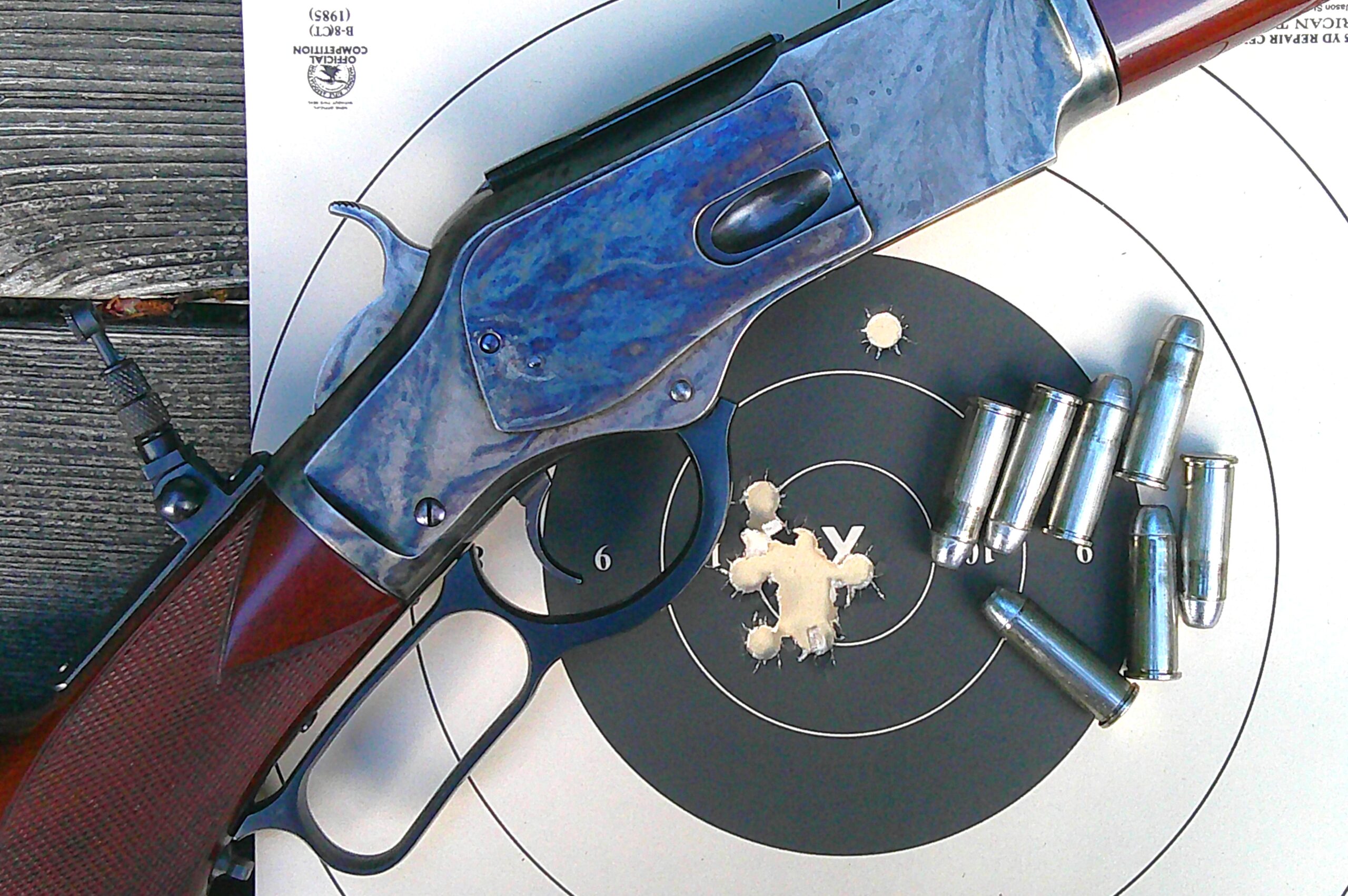
That just about wraps things up for reloading black powder revolver ammunition but I must throw in the comment that several of us will be shooting our reloaded cartridges in both rifles and revolvers. My .44-40 sees a lot of use and I just tested some of my reloads in that caliber by shooting them for group at 50 yards in my Model 1873 Winchester copy by Cimarron. The load used the 215-grain bullets from the Accurate mold, which was just mentioned, over 35 grains of Swiss 3Fg powder. The first shot was the 9 at 1 o’clock which shows that I should have taken a fouling shot. Then the next nine shots all scored in the X-ring, a couple of them just clipping it. My score was 99-9X and that, along with my black powder reloads, pleased me quite a bit.