By Dean Weingarten | Contributing writer
Editor’s Note: Dean Weingarten has spent years studying bear-human encounters, and he writes about these incidents regularly at Ammoland News.
Before 1976, it was assumed by wildlife managers that hunting bears made the bear population more cautious of humans and reduced human/bear conflicts.
In 1975, the Director of the Federal Fish and Wildlife Service stated that the taking of grizzly bears should be of two types.
- The taking of nuisance bears; and
- Limited sport hunting to create an adequate fear of man. From the Federal Register, VOL. 40, NO. 145 — Monday, July 28, 1975 p. 31735:
“In a seasonal sport hunt, bears are exposed to relatively large numbers of humans for a limited period of time, and so learn to avoid all areas where humans are encountered. It is this avoidance of man which will reduce numerous depredations and threats to human safety.”
The assumption that hunting created a fear of man was common sense, backed up by millennia of hunting observations. When a species is hunted by man, the hunted species learns to avoid humans, at least where it is hunted. Individuals of the species which fail to learn to avoid humans are quickly eliminated from the gene pool.
Some academics who study bears have claimed there are no peer reviewed studies which show human/bear conflicts are reduced by hunting more than they would be reduced with the reduction in the population of bears created by hunting.
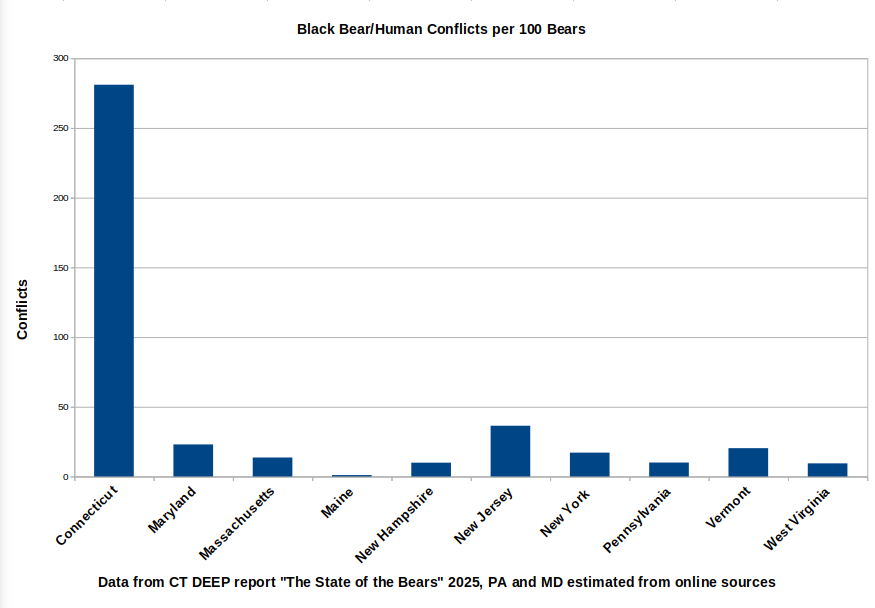
A New Jersey paper looking at both bear populations and human/bear conflicts shows conflicts are reduced by several times the proportional reduction in bear population. The recent publication by the Department of Environmental and Energy Protection (DEEP) in Connecticut reveals a startling chasm in the number of human bear conflicts between states where bears are hunted and Connecticut where they are not hunted.
Bear Invasions!
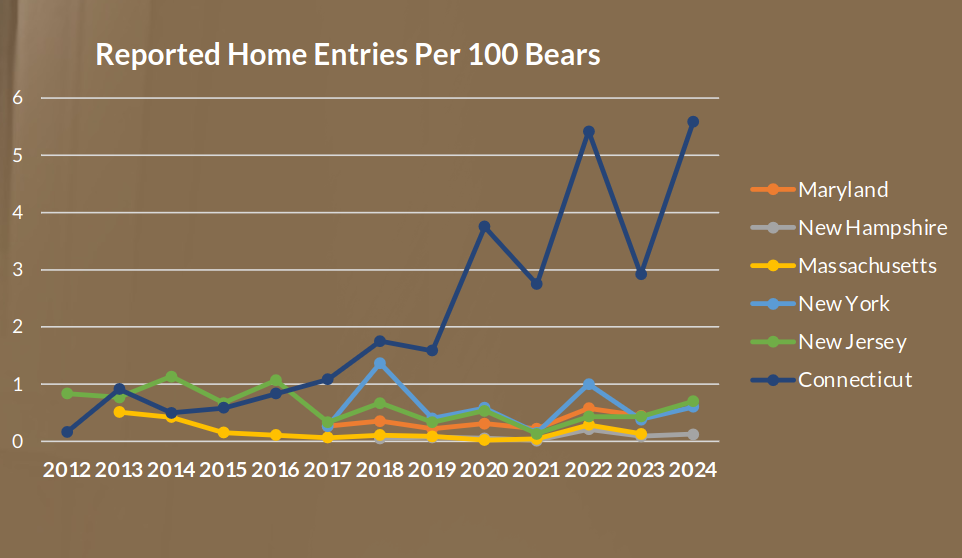
The DEEP publication contained this chart showing the increase in home invasions by bears in Connecticut from 2012 to 2024, compared to surrounding states which allow the hunting of bears:
“A home invasion by a bear is not a bear tipping over a garbage can. It is universally recognized as an unacceptable act. The difference in magnitude of the problem between Connecticut and the surrounding states is clear and obvious.
The first fatal attacks by a black bear in California and in Florida occurred where black bears invaded the homes of the victims. Bears are not hunted in California, and had not been hunted for several years in Florida.
The New Jersey report looks at the timeline of hunting and harvest of bears, and the reduction in human bear conflicts. When bears are hunted and harvested, the number of human/bear conflicts are reduced. In 2016, a regulated hunt in New Jersey dropped the bear population from 2400 to 2100 bears. This was a 13% drop in population. Bear conflicts dropped by 61% in the most serious category, by 58% in the middle serious category, and by 51% in the least serious category. Human/bear conflicts were reduced over four times the percent drop in bear population. The likely mechanism is the tendency of hunters to harvest bold problem bears which have the lowest fear of humans.

There are four mechanisms by which hunting reduces human/bear conflict.
1. Reduction in the bear population. Fewer bears, fewer bear/human conflicts. All bear populations must be controlled. Human hunting is the most effective, the least costly to taxpayers, and the most humane method of controlling bear populations.
2. Removal of problem bears. Problem bears causing conflicts are preferentially harvested by hunters. It takes time for other bears to learn bad habits.
3. Teaching bears to fear humans. Hunting by humans teaches bears to avoid humans and dogs. This happens with direct hunting experiences by bears. Not all hunts are successful, and bears learn from experience. Bears also learn to associate human scent with bear deaths in bear habitat, as bear remains left in the woods have significant human scent around them. Where dogs are used to hunt bears dog training outside of hunting season teaches bears to fear dogs. Bears learn to association loud noises with humans, pain, dogs and danger.

4. Removing bold bear genetics from the gene pool. As Stephen Herrero commented, hunting of bears removes bears whose genetics are associated with aggression toward humans. From Herrero: Fatal Attacks by Black Bears, Journal of Wildlife Management, p. 601:
Part of the answer may be that bears that try to or do prey on people are usually killed and removed from a population’s gene pool, decreasing the frequency of any genes the individual might have had that could contribute to predatory attacks on people.
The common understanding of millennia of hunters, that hunted species will learn to avoid humans, now has data to back it up. It is difficult to look at the experience of the northeast United States and claim there is no evidence that hunting reduces human/bear conflicts.