By Jim Dickson | Contributing Writer
The C. Sharps company of Big Timber, Montana (not to be confused with their rival, Shiloh Sharps) has been making Sharps rifles since 1975 to the highest standards.
Barrels are from Green Mountain and McGowan and the receivers are made from modern 8620 steel specifically designed for case hardening. It’s analysis is Carbon .18-.23%, Manganese .70-.90%, Nickel .40-.70%, Chromium .40-.60%, Molybdenum .15-.25%, and Silicon .15-.35%.
The Sharps is one of the iconic American guns. First patented in 1848 and produced in 1850 as a percussion cap breech loader using paper cartridges it was converted to metallic cartridges after the War For Southern Independence.
In 1867 Army Ordnance contracted with the Sharps Rifle company to convert around 31,000 M1859 and M1863 Sharps Cavalry Carbines to .50-70. The .50-70 was the original “Sharps Big 50”, a cartridge that the buffalo hunters said killed buffalo with much more authority than the .45-70 which came later. The company followed with a long list of commercial cartridge chamberings. The rifle was known as the “Old reliable” and it’s users were so famed for their long range accuracy with it that the term “Sharps shooter” remains today a term for an expert rifleman.
When people falsely assert that the Winchester was “The gun that won the West” Sharps riflemen responded that “The Sharps made the West safe for Winchesters.” That is a true statement and when the Army adopted the .45-70 as an excuse to get back into the rifle manufacturing business, these were sold as surplus and became the most common rifles used by the buffalo hunters who decimated the vast herds of American bison. The Army surplus Sharps carbines were joined by commercial Sharps rifles in a large number of calibers for then as now, riflemen are always looking for a new magic caliber.
Some of these cartridges really excelled at long range. On June 30, 1874, at the famous Second Battle of Adobe Walls where the Sioux were besieging a group of buffalo hunters, one of them, Billy Dixon, used his Sharps .50-90 to kill a warrior at a distance of 1,538 yards as measured by an army surveyor. This completely demoralized the attacking Sioux.
In Competition
In 1874 the Irish team, which were the rifle shooting champions of the British Empire, challenged the Americans to a match at Creedmoor which the American team won. The Americans were using a mix of Remington Rolling Blocks and Sharps rifles with the Sharps generally conceded to have a slight edge over the Remington as a match rifle.
When Lieutenant L. C. Bruce of the American team set a world record at Creedmoor in 1877 he said “The Sharps rifle made my record, I only happened to be behind it.”
The Sharps became a popular rifle for the great plains because it could reach out and touch someone long before they came within the range of the early Winchester repeaters. Native Americans quickly learned that if they tangled with buffalo hunters, they would begin dropping long before they were in range with their own weapons.
In those days shooting was a basic skill for every man and it wasn’t just buffalo hunters who could take full advantage of the long range Sharps. In Hollywood’s version of the Old West everyone used either a M1892 Winchester or a M1873 Colt Single Action Army revolver regardless of the time period in the movie. The reality was obviously different and the Sharps held its place well into the 20th century where we find a young Elmer Kieth using them. Today I value my original Sharps .50-70 cavalry carbine for its fast handling, perfect balance, accuracy, and incredible knock down power. When you have a single shot it’s nice when it hits like a sledgehammer like the .50-70 does.
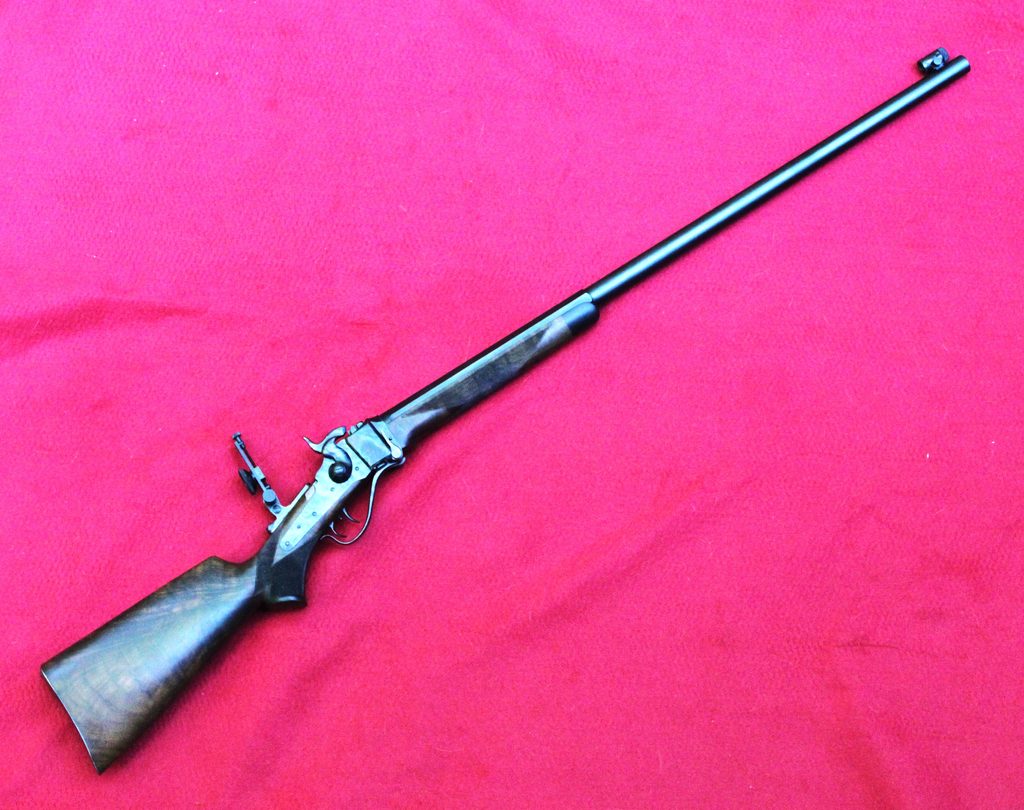
The C. Sharps Arms Co. M1874 Target Rifle is a masterpiece for precision target shooting, not a regular gun. While they chamber them in most of the old Sharps rifle calibers I asked for the gun in .45-70 as I could get plenty of ammunition, while I can’t get .50-70.
Fit and finish are beyond what anyone could reasonably expect even on a gun of this price. When I picked up the test gun at Reeves Ace hardware in Clayton, Georgia they were talking about what a beautiful rifle it was. They weren’t kidding. It’s gorgeous.
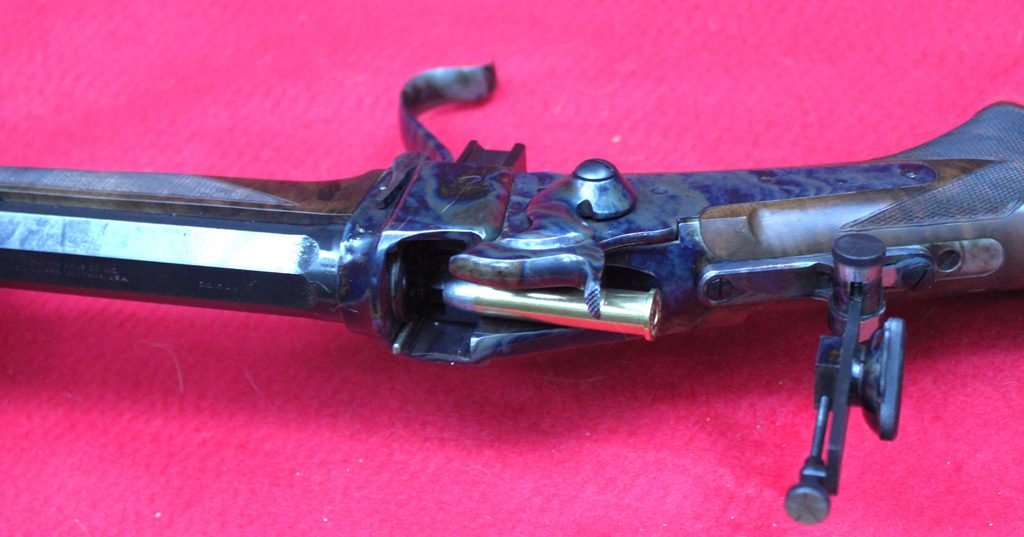
C. Sharps does their own color case hardening and the result is the most beautiful that I have ever seen on any American gun. The superb fit and finish is achieved by hand fitting in the best British and European tradition after the parts are CNC machined. In England they smoke the parts, fit them, then file down the high points. At C. Sharps Arms they use Prussian Blue instead of smoke but other than that it is the same process.
In the British Best Quality gun trade it takes a 7 year apprenticeship to master this to their standards. Obviously this is far above regular gunsmithing skill levels. Like the British gun trade, C. Sharps Arms Co. is always looking for talented individuals who want to learn and stay with the company.
This Old World hand fitting is what sets the C. Sharps Arms Co. guns apart from the rest of the American rifles and it also is what you are paying for when you buy one.
This rifle came with all the top features. The American made .45-70 barrel was hand lapped mirror bright and came with precise break in and cleaning instructions that you would use for the most precision match rifles. The barrel itself was a heavy octagon section followed by a heavy round tapering barrel 32 inches long. Total overall length was 48¾ inches.
The front sight was a Super Grade globe with crosshairs ending in a circle that you centered the target in. It even had a spirit level to make sure the rifle was not canted for that can affect the point of impact at the long range shooting this gun was designed for. The outside of the globe front sight was also casehardened for one more elegant touch.
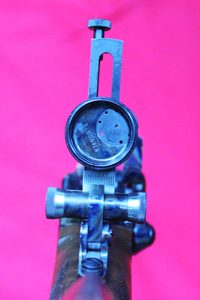
The rear sight was a Super Grade Soule type vernier mid-range sight with adjustable aperture sizes on the big disc. This 19th century sight was and is a marvel of precision intended for the most accurate shooting then or now.
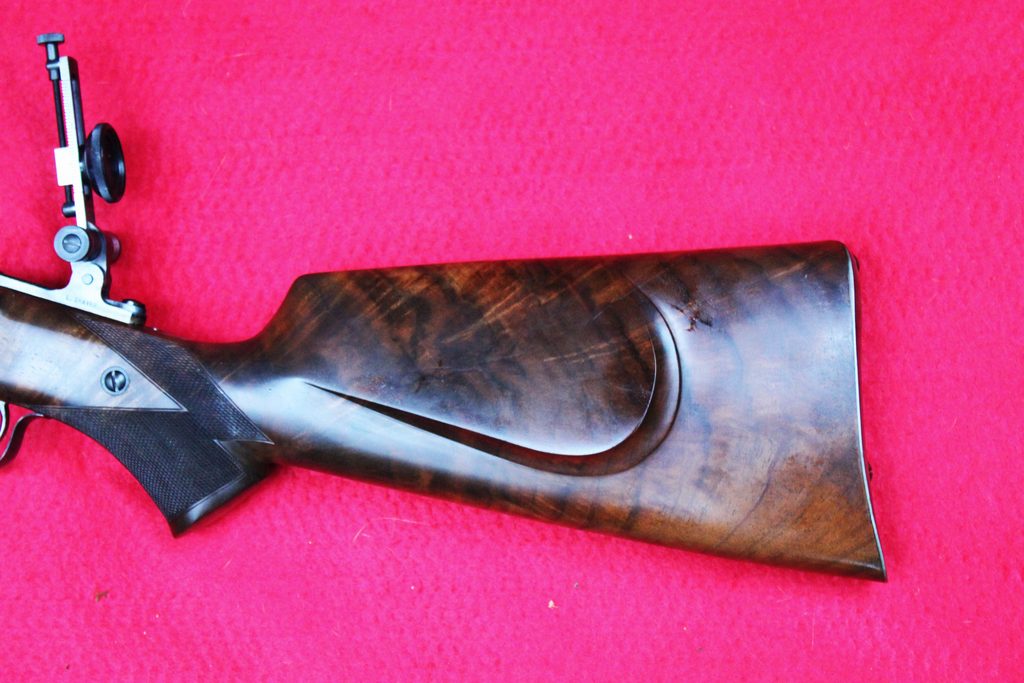
The XXX grade wood in the stock and forend were extra fancy wood which was a joy to behold. The checkering was flawless.
The buttstock was a pistol grip high comb target type for ease of use with the sight cranked up for long range work. There was a cheek rest as befitting a gun of this quality. It was capped with a casehardened butt plate with a perfectly installed nose at the top. I was delighted to see a shotgun style butt instead of a crescent butt like the one that once made contact with my shoulder only at the points of the crescent. That old Sharps hurt to shoot. With this one I never even felt any recoil thanks to a proper butt plate and the 11 pound 5 ounce weight.
The forend sported an ebony nose cap.
All this ran the price up to $5,665.81 but I can truthfully say that you are getting every penny of your money’s worth here. The classic Sharps set triggers are standard on the target models. Pulling the rear trigger with the hammer cocked sets the front trigger which can now be released with the slightest touch. In an emergency the gun may be fired by pulling the front trigger only which will now have a normal trigger pull weight.
Shooting the Legend
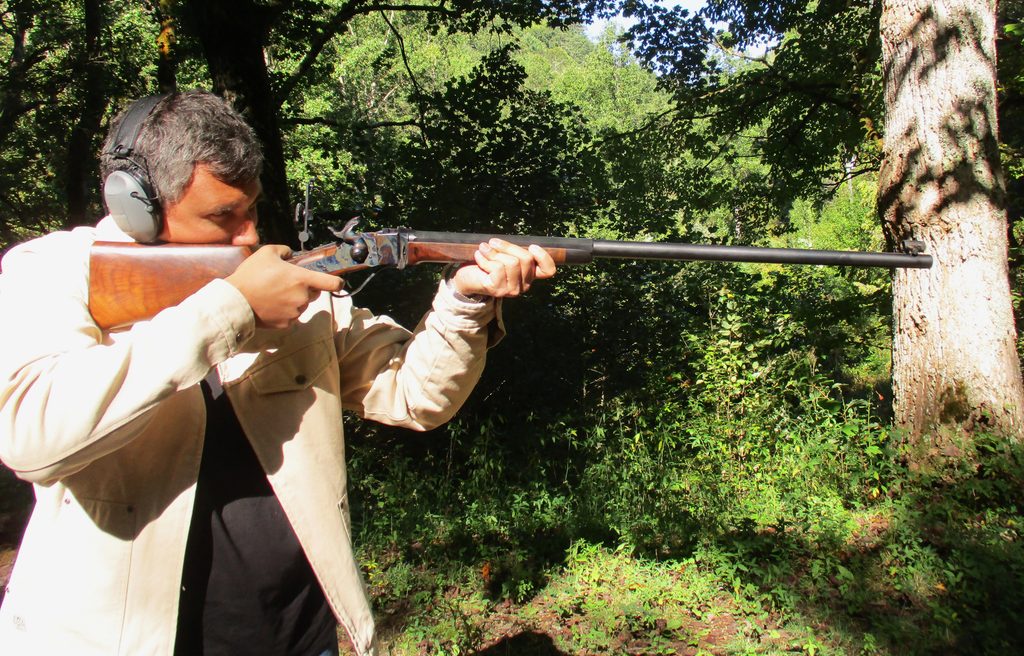
I had 470 rounds to test fire the .45-70 Sharps consisting of:
- 100 rounds of very flat trajectory Hornady LeverEvolution with a soft plastic ballistic tip which gives a vastly improved aerodynamic shape while still being safe for tubular magazines. This ammo has a 325- grain bullet at 2,000 FPS.
- 100 rounds of Hornady 410-grain subsonic at 1,075 FPS. With the increased popularity of silencers for hunting this is a much needed loading.
- 100 rounds of Black Hills Cowboy Action 405-grain FPL at 1,250 FPS. At just 100 FPS lower velocity than the original black powder load the game won’t be able to tell the difference.
- 80 rounds of Armscor 300-grain JHP at 1,900 FPS. Each 20 round box comes with four 5 round boxes inside making carrying ammo quietly afield easier.
- 40 rounds of Remington Core-Lokt Tipped Levergun 300-grain at 2,100 FPS. Another plastic tipped aerodynamically shaped flat shooting round safe for tubular magazines.
- 40 rounds of Federal 300-grain JSP at 1,800 FPS A time tested game getter.
- 10 rounds of Steinel 777-grain Lucky Ram at 990 FPS. Steinel is now shipping to Alaska where this ultimate .45-70 stopping round is most needed.
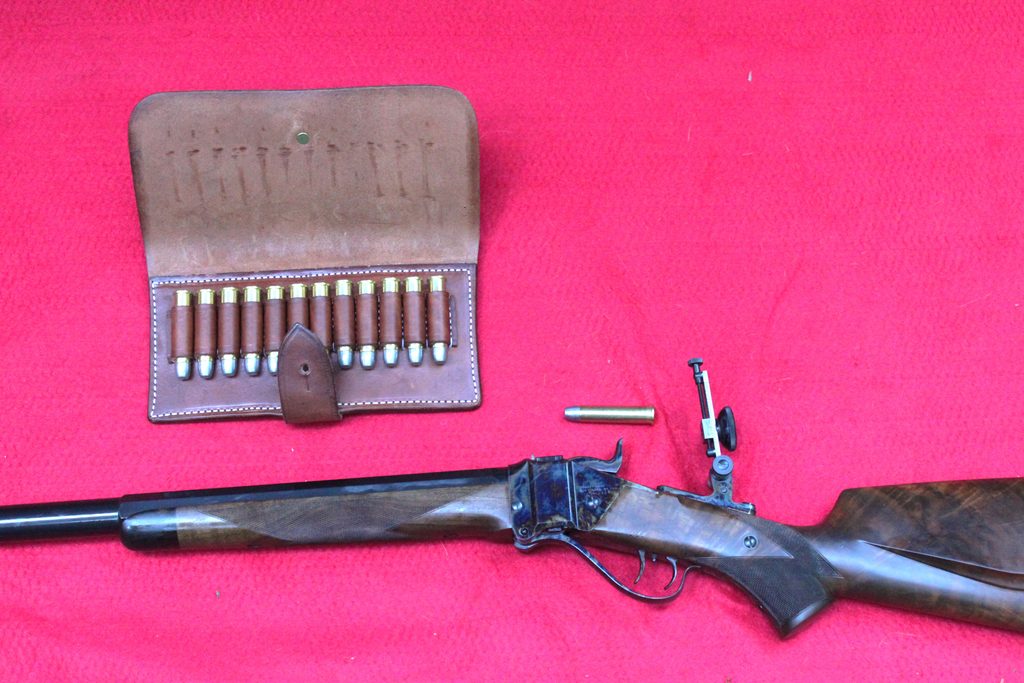
During the shooting spare ammo was carried in a leather Sharps Box 12-round belt pouch with cover from El Paso Saddlery. This is the best .45-70 ammo carrier for hunting.
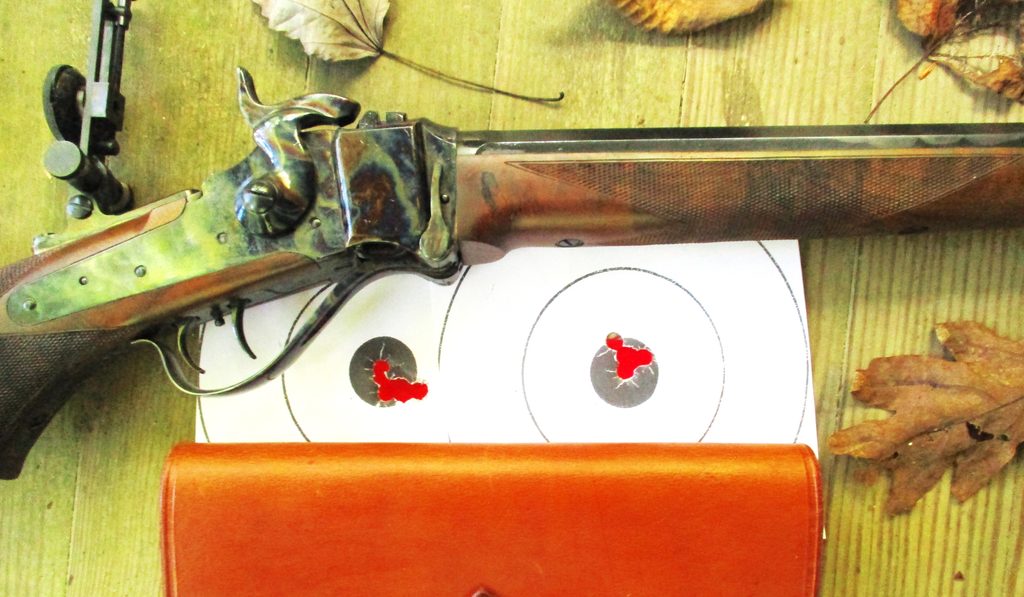
The rifle shot extremely accurately and I believe it is more accurate than I am capable of holding. If I were shooting in 1,000 yard matches I would not hesitate to use this rifle and appropriate loads against the finest of the modern rifles used in them today.
Maintenance
For those unfamiliar with a Sharps rifle it is extremely easy to use and to maintain. To load move the hammer back to the quarter cock safety position which will put the hammer about ¼ inch back and push the trigger guard forward like you would the lever of a lever action rifle which will drop the breech block allowing you to insert a cartridge. Close the breech block by returning the trigger guard to it’s normal position and when you are ready to fire cock the hammer and engage the trigger. To reload, move the hammer back to the safety notch and push the trigger guard forward dropping the breech block. If you do this fast the cartridge will be ejected fast. If you do it slow you may need to push the top of the ejector to the rear by hand then take the cartridge out by hand.
To disassemble for cleaning put the hammer at the safety position and push in the spring loaded takedown pin so you can push the takedown pivot pin 180 degrees forward where it can be withdrawn from the rifle. The breech block assembly and extractor can now be moved down and out of the gun. The firing pin can be removed by sliding the dovetailed firing pin plate to the left. Reassemble in reverse order.
For the man wanting a precision target rifle or one who just appreciates the highest quality single shot rifles made the historic Sharps rifle will deliver the goods today just as it always has.