By Dave Workman
Editor-in-Chief
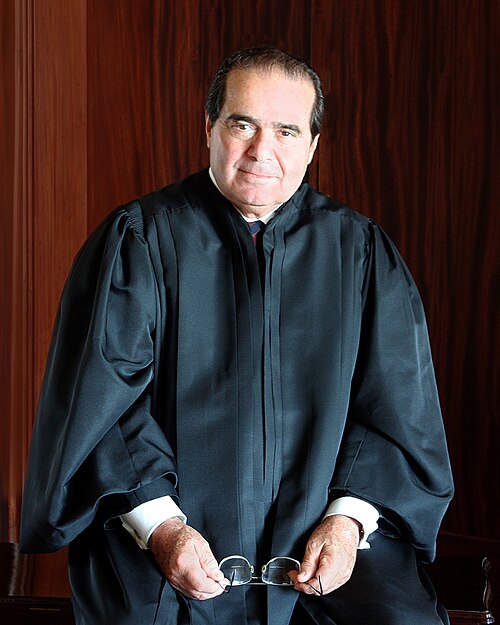
OPINION: When the New York Times published a story by reporters Mike McIntire and Eli Murray on Nov. 10 declaring the late Supreme Court Associate Justice Antonin Scalia based a key element of his historic majority opinion in the 2008 Heller case on a “misquote,” it ignited fierce rebuttals at both the National Review and Reason.
Justice Scalia’s opinion in District of Columbia v. Heller may be read here.
McIntire and Murray open their 1,157-word article alleging Scalia misquoted Sir William Blackstone among sources supporting restrictions on “dangerous and unusual” weapons when Blackstone was actually referring to “dangerous or unusual” weapons.
It’s the sort of thing which stirs memories of former President Bill Clinton trying to mince words when he talked about the definition of the word “is.”
Reaction was quick at Reason, where writer Jonathan H. Adler opened his critique with, “This past week, the New York Times published an article by Mike McIntire and Eli Murray alleging that a “pivotal legal test” for determining whether gun control laws are constitutional is “based on a misquote.” Yet it appears it is the NYT‘s reporters who misfired.”
Adler’s massive 2,081-word essay even includes a response to criticism of the McIntire/Murray from the NYTimes. At that length, with the Times’ response now part of it, the controversy boils down to a snit over semantics; just the sort of quibbling which has marked the debate over the Second Amendment, which has been going on for decades.
And now, Charles C.W. Cooke, writing at the National Review, has weighed in on Adler’s side of the debate, observing, “the Times is pretending that a key part of the Heller decision, penned by Justice Antonin Scalia in 2008, was predicated upon a misquote. As Adler — and others — have noted, the Times is simply wrong. Scalia did not make the claim that the Times insists that he did, and, by all accounts, the Times knew that when it went to print.”
It must be noted that the headline on Cooke’s article reads, “The New York Times Tries Again to Read the Second Amendment Out of the Constitution.”
Historically, the New York Times has never been friendly to the Second Amendment, holding it at a distance from all the other tenets of the Bill of Rights, especially the First Amendment, which protects the Times’ ability to publish news and opinion.
Cooke, a veteran journalist not afraid to criticize his contemporaries, literally accuses the NYTimes of being among “a bunch of ridiculous die-hards who remain desperate to find that elusive One Weird Trick that will finally remove part of the Bill of Rights,” namely, the Second Amendment.
“That trick does not exist,” Cooke wrote this past weekend. “One can not find it by butchering the preamble, or by pretending that Antonin Scalia wrote something that he plainly did not, or by falsifying the historical record, or by redefining the word ‘militia,’ or by pretending that originalism works in ways that it does not. If the Second Amendment is to be excised out of the Constitution by judges, it will be not be achieved by scholarship, but by the exercise of raw power. The Times’ erroneous piece arrived a few days after the Democrats won a big political victory. Coincidence? I think not.”
That all of this is happening now, with the Supreme Court scheduled to hear oral arguments in the consolidated cases of Viramontes v. Cook County (Illinois) and Grant v. Higgins (Connecticut)—challenging bans on so-called “assault weapons”—probably should not be surprising. Between now and Wednesday, Dec. 2 when the hearing is to take place, expect a torrent of opinions, in print and on the air, about whether modern semiautomatic rifles and pistols should, or should not, be protected by the Second Amendment.
Both cases were brought by the Second Amendment Foundation (SAF), and the organization’s leadership will be in the room for the oral arguments.
A ruling is not expected until mid-2027.