By Mike Nesbitt | Contributing Editor
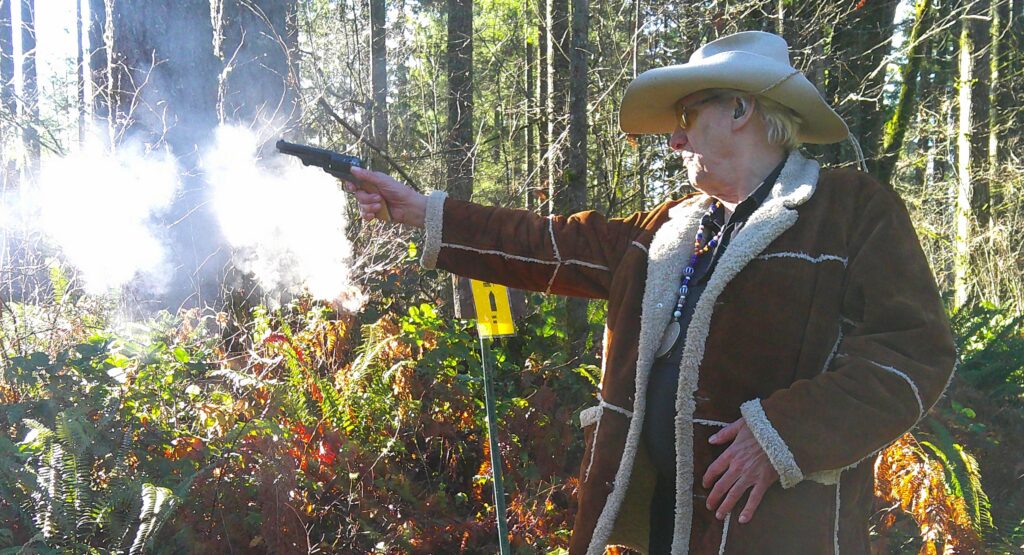
Interest in shooting cap & ball revolvers is still growing at the gun club where the Black River Troublemakers of Washington State snap their caps and burn their powder.
With that growing-interest we see new guns on the firing line as well as new ideas about the shooting we can do with them. Those new guns along with some new bullet molds plus some fresh ideas about shooting easily gives me more to talk about, and I’ll certainly try to take advantage of that.
A little while ago, I put a Remington-style .44 through its paces and that gun performed very well. My personal likes and dis-likes keep me interested more in the Colt-style revolvers but I must give credit where credit is due, that Remington, a copy of their New Model Army Revolver, is a real good shooter. I might end up giving that gun more attention.
Shortly after my doing some shooting with that Remington, Mike Holeman shows up with a new six-gun, another Remington .44. Mike’s new gun has a barrel shorter than the standard 8-inches, perhaps it is a 5 ½-inch tube. I had to ask him if he bought that gun after seeing the good luck I was having with the Remington I had tested. He said, “No, I got this gun because it came with a holster and belt.” Now I don’t know if he even noticed my good shooting with the Remington I shot, which was a gun sold by Lyman (now discontinued).
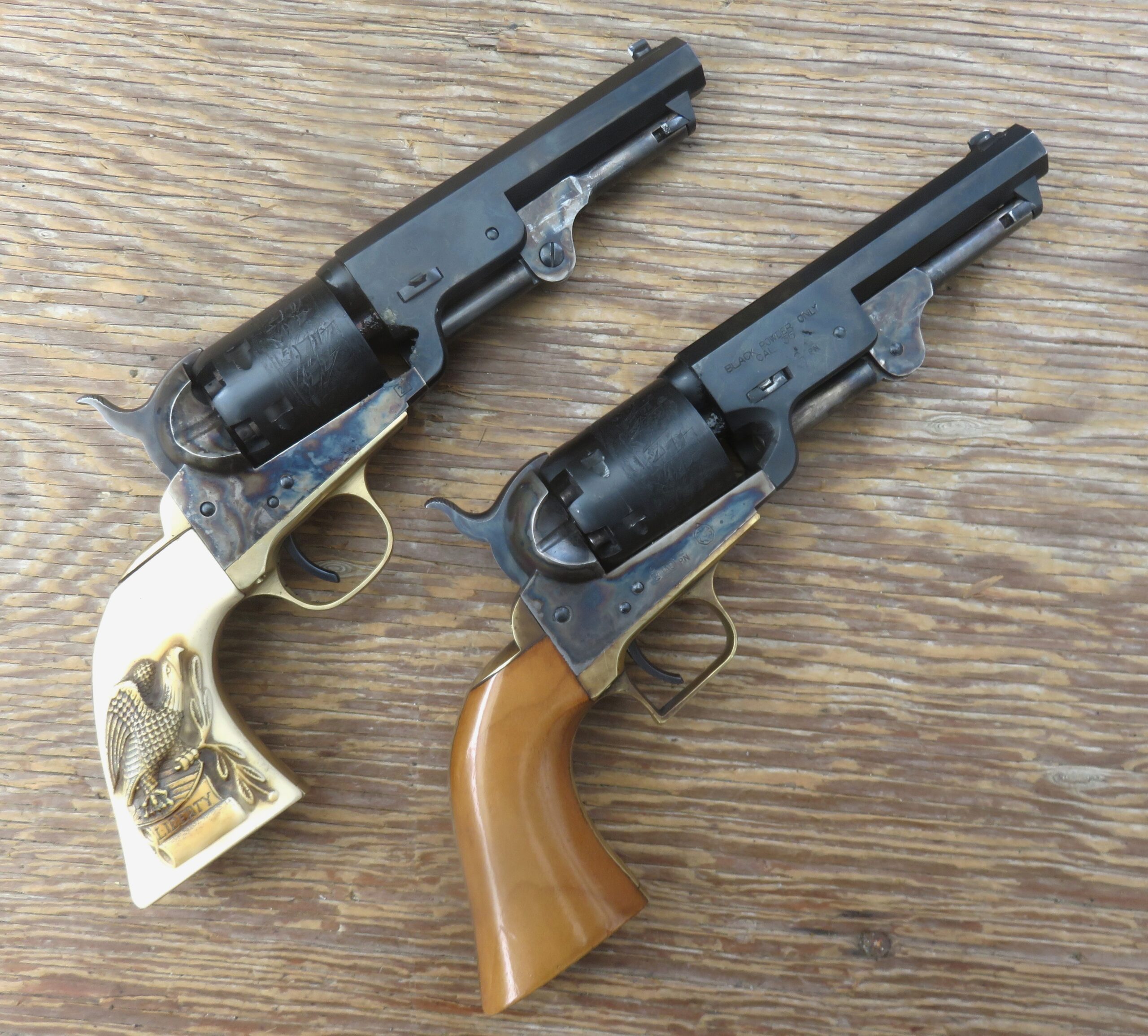
Having a holster is certainly a very good idea. At the club where we do our shooting, having a holster is simply part of the club rules. You don’t need the holster for just shooting on the range but a holster is required for using the cap & ball revolvers on the trail-walk. Those rules ask the shooters to load their revolvers, every chamber, before starting out on the walk but the nipples are not to be capped until getting to the first shooting station. At that point, all of the nipples are capped and the shooter can then take the first shot. After that shot is fired, unless the shooter intends to shoot at that first target again, the revolver is simply placed in the holster without pulling the hammer back. That means the hammer is “down” on a fired chamber, and in that way can be carried very safely.
Then the shooter, whether alone or with a small group of shooters, can walk to the next shooting station, draw the gun from the holster, cock the hammer and take another shot. Following that shot, the gun is simply returned to the holster again. The shooting in this manner can continue until the gun is empty, when it can be reloaded but not capped until the shooter is standing at the designated shooting station. After the nipples are capped, the shooter fires the next shot, then returns the revolver to the holster again, and then proceeds down the trail.
The reason for capping all of the nipples, instead of just capping the nipple on the chamber that will next be fired, is because having non-capped nipples with the chambers loaded can lead to chain-fires where chambers next to the one being fired will also be ignited. Having the nipples capped on charged chambers is a safety precaution.
I know of at least one other club that does not have the “holster” in their rules for the black powder pistol trail-walk. At that club, which offers no recognition for cap & ball revolvers, the gun can only be used as a single shot. In other words, load just one chamber with powder and ball, plus some lube over the bullet, but do not cap the nipple until at the shooting station. While I do prefer to use the revolver as a repeater, loading and shooting the gun as a single shot would still be a way to get some safe shooting practice.
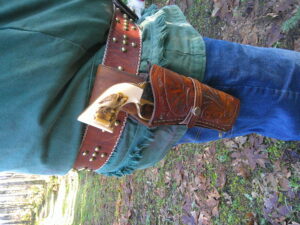
Getting a holster for a Colt-style Navy or Army revolver is rather easy. Any holster for the Colt Single Action Army with an appropriate barrel length will fit. I like to carry my .36 Navy with the 5-inch barrel in a cross-draw holster. That keeps the gun handy but also out of the way in case I’m also carrying a rifle on the same trip down the trail.
After we shot the Gunfighters Shoot-Out Challenge a couple of months ago, which was reported here on Oct. 30, our group of shooters put minds together and “designed” another match just for the cap & ball revolvers. We decided to have our challenging match on the trail-walk, shooting at existing targets, but with special rules just for the cap & ball six-guns.
Ideas for this new match were already mentioned in the Cap & Ball story published on Nov. 11 but now we were getting closer to the match day and practicing increased. Some final considerations for running the match were also given thought.
The Actual Match Setup
Here’s what we came up with. The match would require either ten or twelve shots, so the guns would need to be reloaded about halfway through the shooting. The targets on the trail were the same targets which we used for the black powder cartridge revolver match, which is held every year at Buffalo Camp, but with the cap & ball revolvers all shots would be taken with a one-hand hold. In the revolver match at Buffalo Camp, where a cap & ball revolver could be used, all but two of the shots on that trail can be made with a two-hand hold. Requiring one-handed offhand shots does make the match tougher.
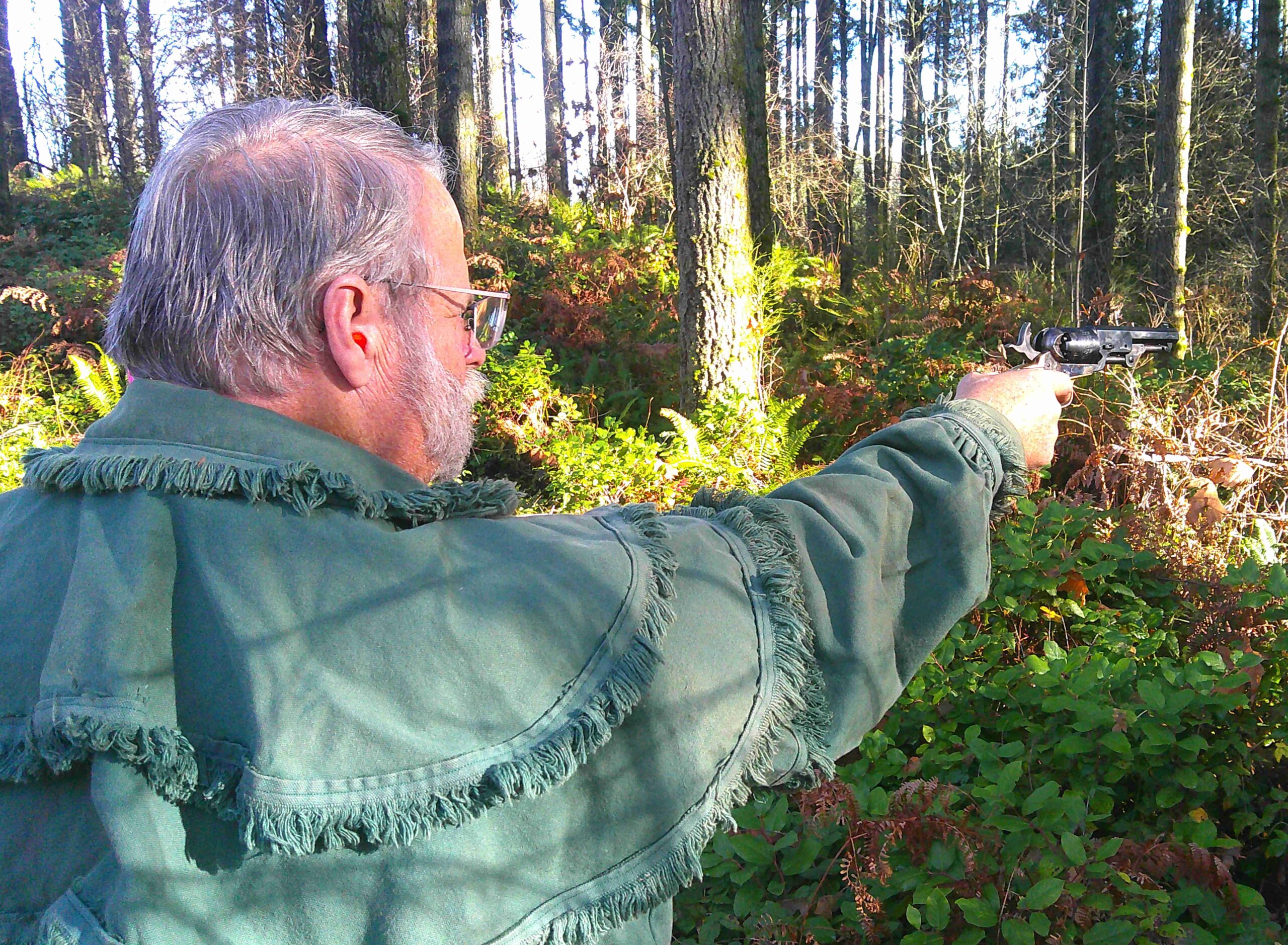
So, we’ve been practicing our one-hand shooting. For me, shooting my short barreled .36 Navy, the difference in my targets, one-handed compared to two-handed, is not terribly huge, although the targets shot with a two-hand hold are certainly better.
To be prepared for this challenging match, most of us were also practicing our reloading. Perhaps that shouldn’t need practice but reloading a percussion revolver on the trail can be quite a bit different from doing the same reloading while standing at a bench. With the bench, you’ve got a table-top to put all of the accessories on but on the trail all you might have is your pockets. That can certainly make a difference.
For my own reloading, I prefer to use powder poured from the flask, as usual. Then I load a round-ball into each chamber, following the powder charge, and ram that ball down with the gun’s rammer. After each chamber is loaded, I’ll smear grease over the bullets. To have all of the needed accouterments handy, I’ll carry everything in a canvas pouch at my side. With the gun’s chambers reloaded, all I need to do is to step to the next shooting station and cap the gun’s nipples, then fire my next shot.
Most of the other shooters who will join me in this match have decided to use paper cartridges. Those paper cartridges are certainly good and using them does simplify the reloading process. Just load the paper cartridges from the front of the cylinder, then cap the nipples once the chambers are all loaded. With the bullets already greased, by dipping them in melted patch lube, nothing else needs to be done before the shooting can start.
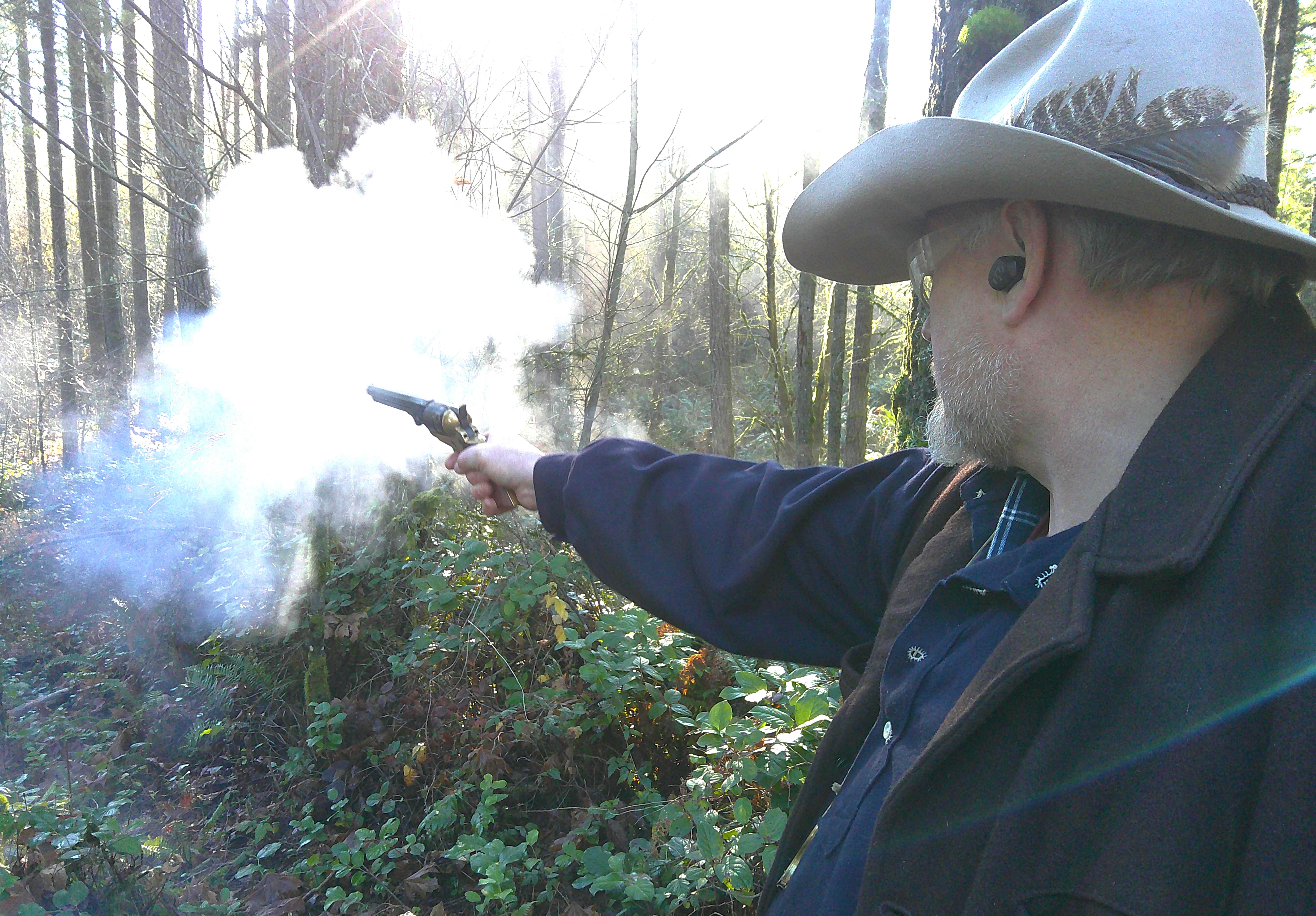
My decision to use the round-balls loaded over powder from my flask was made because while practicing I found the round-balls to be more accurate than the conical bullets. Yes, I could make paper cartridges with round-balls for bullets but at this point in the game, I’ll just use the loose balls loaded in the gun’s chambers.
And, while still speaking about reloading on the trail, another shooter, Tom Witt, had the ultimate answer, he just carried two revolvers. Those were both 1860 Colt styled guns in .44 caliber. However, the most that carrying two guns did for him was that after the match, he had two guns to clean.
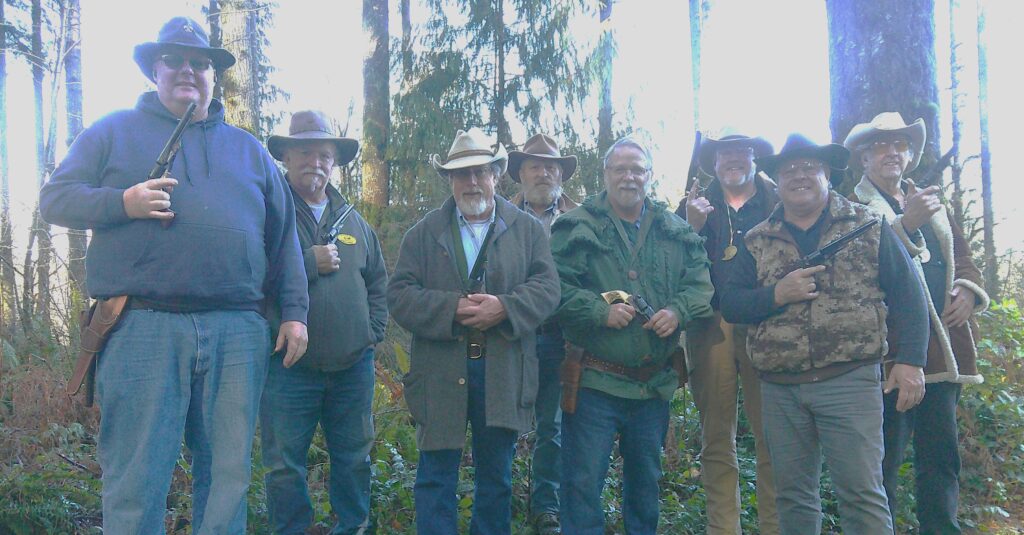
With several other events going on at our Lever-Gun Trail Camp, we decided to hold the Cap & Ball Six-Gun Challenge on a Saturday afternoon. That was when a large group of us headed for the trail, with our guns in holsters. I had loaded my gun in advance but waited until at the first shooting station to cap all of the nipples. Then, at target #1, which was a small hanging acetylene bottle, that bottle rang like a bell, loud and clear; I had made a good hit.
Most of us found out that we weren’t really as well prepared as we had hoped to be. Getting good hits turned out to be more difficult than expected. Perhaps it was our rule to only use the one-hand hold on the guns because we generally use the two-hand holed on our revolver trail with the exception of just two targets where the one-hand hold is required.
The first of those two targets, the rabbit, was next. As my usual habit, I held the sights just on the bottom of that rabbit’s belly, a six o’clock hold, and fired. The .36 caliber ball, powered by the 20 grains of 3Fg, found that rabbit quite nicely and I scored my second hit.
Following that, I missed both the squirrel and the rabbit, targets which I was really trying for. Those “animals,” of course, are steel silhouettes cut in the shape of such critters.
Next was a crow and just after the shot, I thought I had missed. But Jerry Johnson was watching me shoot and he told me that he saw some lead flash right at the top of the crow’s back when I shot. The crow target did jiggle just slightly so I took his word for it and scored that as a hit. That gave me three hits out of five shots.
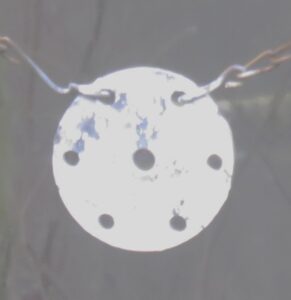
Target number six is what we call the “Mini Moon,” a fairly close circular “silhouette.” That one is always shot with a one-hand hold with our revolvers and I was ready for it. My shot gave me a good hit, almost too good because there is a hole in the middle of the target which I have shot through before. If the target doesn’t move, you can’t score it as a hit.
Following the Mini Moon is the antelope, not quite full size. This target is down in the gully, so you’re shooting downhill. Shooters before me had been missing it. Once again, I aimed for the bottom of the belly and squeezed that .36’s trigger very carefully, which rewarded me with a hit. The antelope silhouette was jumping up and down for a moment, which told of the Navy’s ball making impact.
Next is our full-size black bear, on all fours, out at about 70 yards. I’ve had good luck hitting that target with my revolvers, but not with this .36 Navy and, once again, I missed. My missing continued with the next target, a round Trade Gun target for our muzzleloader matches, and with the dreaded chicken which was the last target for this match. I missed all three, one after the other.
Others in our group didn’t do any better. My score was five hits for the ten targets and Mike Moran got the same score while shooting his .44 caliber cap & ball six-gun. But shooter Russ LeFevre won the match with his Ruger Old Army, his score of hitting 6 out of the 10. Russ had shot earlier, while the rest of us were shooting the trail with our lever-guns in a different match. So, hat’s off to Russ, and he won the $$$ which we had set out for this match.
This new Cap & Ball Six-gun Challenge Match will be shot again. We might even be doing it more than just once per year because it was too much fun to not do more than that. And it is rather eye-opening to see how many shots are being missed, especially when the shooters are so used to shooting with a two-hand hold. Shooting the targets on the trail is much more difficult than taking shots at a posted target, where the distance is well known. On the trail, each target is at a different and un-specified distance, some uphill and others downhill, more like a hunting situation. That’s what makes it such a challenge.