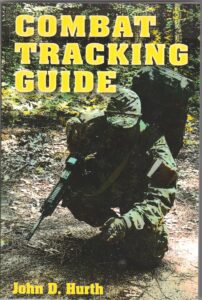
By John D. Hurth
Soft cover 276 pages
$19.95 + $5.09 shipping
Available from: Globepequot.com.
1-800-223-2336
Tracking is one of man’s most basic survival skills. Whether it is tracking a deer or an enemy patrol in wartime the same basic skills are employed.
Today we find hit and run tactics widely employed yet the answer to them has always been to not let them disengage and escape. This is where tracking skills are indispensable. No one can move without disturbing the ground underneath him and a skilled tracker reads this like a book. There is no disappearing into thin air when skilled trackers are on the trail.
Of course tracking something that shoots back takes a different organizational set up than tracking game and the proper methods of deploying tracking squads and keeping them as safe as possible are delineated.
The author is a retired Special Forces soldier who earned the Bronze Star. He is to be commended for passing on this information. I have never understood why men that served in WWII and Korea did not pass their combat experience onto their sons and teach them the skills they needed to survive in combat. A long row of body bags returning to them is the predictable result that has resulted from this when their sons had to fight their own war overseas. A lot of those body bags would have remained unused if the boys had been taught what their fathers had learned the hard way.
Many of the skills taught by this book can be directly applied to hunting game while others provide a broader background knowledge of the broader field of tracking.
The book begins explaining the use of trackers when the troops are in contact with the enemy. Basic visual tracking is then covered and the lessons here are directly applicable to deer hunting. The next chapter deals with the specifics of tracking men covering their gait, tracks and the interpretation thereof. This is followed by a chapter on organization and tactics which is invaluable to the wilderness tracker having to adapt his skills to a modern combat scenario as is the next chapter on operational deployment.
Remember that being a good tracker in the hunting field does not seamlessly transition into a military tracker any more than standing on the firing line at Camp Perry is the same as shooting under fire in combat. Some of the things you encounter in combat that kill a lot of unprepared men are counter tracking, mines, and booby traps. These are covered as well as any book can but be forewarned. A lot of these need experience actually seeing them to become proficient at their detection in time.
The chapter on tracking with limited visibility will be invaluable to many deer hunters. Tracking when the trail leads into urban areas and the proper use of K-9 tracking teams in all environments as well as pursuit and encirclement tactics will also be of use to law enforcement as will the section on identifying tire and track marks although they will have to substitute the prevailing civilian vehicles for the Warsaw Pact ones shown.
This book broadens the knowledge of the game tracker and better prepares him to transition his skills to wartime use as needed. Much of it is directly applicable to game tracking while other parts are important to keeping you alive in combat. This is a very worthwhile book.—Jim Dickson