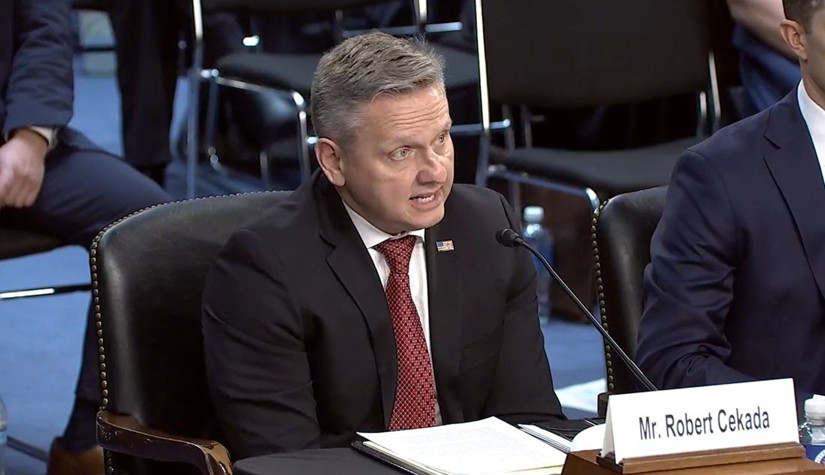
(Lee’s note: Tate Adamiak recently wrote a letter to ATF’s new Director, Rob Cekada. Here it is, completely unedited. Tate makes some great points.)
May 8, 2026
If I could speak directly to ATF Director Robert Cekada, I would begin by acknowledging that what happened in my case occurred prior to his leadership at the ATF, under then-Director Steven Dettelbach. I recognize that distinction. I also recognize the tone he and Attorney General Todd Blanche have recently set, and it is one that gives me reason to write this.
If I could ask for one thing, it would be this: clear lines, consistently enforced. No American should have to guess where legality ends and a felony begins, especially when the consequence can mean decades of imprisonment and the permanent loss of constitutional rights.
The ATF holds extraordinary authority over how complex, technical firearms laws are interpreted. That authority demands not only expertise, but restraint and consistency. What I experienced reflected neither.
On April 11, 2022, four days after my arrest, President Joe Biden stood beside Director Dettelbach and acknowledged pushing for new rules because legislation could not be passed through Congress. Weeks earlier, the Department of Justice had already initiated an enforcement surge targeting privately made firearms, allocating additional prosecutorial resources and intensifying focus.
That context matters because my case aligned with that moment.
I was charged based on items the ATF classified as “firearm receivers,” items that had freely circulated in open commerce for decades. I was arrested before the rule redefining those items was publicly announced. That is not clarity. It is enforcement applied ahead of definition.
So, I continue to ask: how does something that did not meet the legal definition of a receiver at the time become the foundation for a federal prosecution? How does a collection of parts become a narrative carrying decades of exposure?
I have spent years asking those questions from a cell.
When I listened to Director Cekada and Attorney General Blanche speak about restoring clarity, aligning regulations with statutory authority, and eliminating ambiguity that leads to inconsistent enforcement, I heard something I had not heard in a long time: recognition that these problems exist. If those principles are to mean anything, then cases like mine should be examined carefully.
Because what occurred here was not simply strict enforcement. It was enforcement operating without a stable, publicly understood boundary. When legality depends on reconstruction, reinterpretation, or evolving internal standards, the law ceases to function as a guide and begins to function as a trap.
I hope that, from one gun enthusiast to another, that distinction is clear. I hope my case is recognized as an example of regulatory creep driven by vague, shifting, and subjective interpretations.
That reality does not affect only me. It extends to every collector, hobbyist, and citizen attempting to navigate the law in good faith.
I would respectfully ask Director Cekada to examine how technical determinations are made and presented. If an item is only deemed unlawful after modification, assembly, or theories of constructive possession and “readily convertible” status advanced by the government, then the issue is not solely the item. It is the standard being applied. And a standard that shifts from case to case is indistinguishable from no standard at all.
I would also ask that my prosecution be reviewed as a case study.
The investigative approach, as I experienced it, began with efforts by a paid criminal informant with pending charges to induce the creation of an illegal item that did not exist. When that effort failed, the focus shifted to an alternative theory aligned with a broader enforcement initiative. An object that did not meet the ATF’s own regulatory definition at the time was ultimately classified as a machine gun to support a warrant.
The testimony used to support that outcome is where the record becomes especially difficult to reconcile with ordinary expectations of law enforcement clarity.
The lead case agent testified that everything I possessed constituted illegal firearms. Yet he also admitted he had “only ever seen many of these items in video games,” and that he could not distinguish between a real firearm and a replica by sight alone. That raises a fundamental question: if the enforcing agent cannot make that distinction, how is an ordinary citizen expected to know where the line is?
He also testified that altering evidence is against agency policy while acknowledging that government experts nevertheless modified multiple items during examination.
On required filings, he suggested I should have completed a Form 1 application before acquiring certain components, while overlooking that such forms require serial numbers from those very components and are not applicable in the way he described. He further implied that approval would allow one to then assemble the item, despite the fact that I never assembled anything into a functional configuration.
The Firearm Enforcement Officer’s testimony added another layer of concern. He stated, “My understanding is the original definition of a firearm receiver did not fit 90-some percent of frames or receivers the way it was written.” In other words, he acknowledged that the regulatory definition in 27 C.F.R. § 478.11 did not align with how certain components were being treated, an issue later addressed through updated rulemaking. Yet in my case, conclusions still relied on interpretations that predated or extended beyond that framework.
He also described sheet metal components, M240 80% side plates, as having “reached a stage of manufacturing in which they are clearly recognized as plates for a M240 machine gun, therefore are machine guns as defined,” relying on internal policy language that did not publicly exist at the time of seizure.
In another instance, inert RPG training aids were described in a manner that treated a single component as though it constituted a destructive device, despite the statute and case law requiring a combination of parts and functionality that did not exist in my possession (United States v. Blackburn).
And perhaps most strikingly, an ATF Firearms Enforcement Officer testified that “a Sharpie marker in the correct location for a sear pin hole would be enough to classify an element as a machine gun receiver.”
Under that theory, lawful possession of otherwise ordinary items, combined with something as simple as a marker, could be reframed as constructive possession of a machine gun.
These were the classifications and opinions presented by the individual responsible for evaluating nearly every item in the case.
These are not abstract disagreements over technical language. They are the difference between lawful possession and decades of imprisonment.
I raise these points carefully and with respect for the agency’s mission of combating violent crime. But they lead to a necessary question: is this type of application aligned with that mission? Is there a meaningful distinction being maintained between a collector attempting compliance and an individual engaged in criminal conduct that threatens public safety?
There should be.
What followed was not only a legal outcome, but a complete disruption of my life. My career ended, my property was seized, and my family was subjected to a traumatic experience based on interpretations of items that were not functional and could not operate as alleged.
I was ultimately portrayed as a weapons trafficker based on items that have existed in various forms for decades, all of which remain in circulation today.
At trial, the ATF spent four days arguing that MAC flats were illegal machine guns, a theory later proven false, though only after the verdicts had already been returned.
If I may ask for one thing beyond review, it is clarity, and specifically correction of what I believe remains an unresolved factual dispute between what was presented in court and what the government still maintains about these items. The goal should not simply be winning cases, but getting it right.
Despite the evidence and the actual physical condition of the items, the position advanced by the prosecution and reflected in the record continues to treat them as illegal machine guns, receivers, or destructive devices when they were not. In other words, I remain in a position where plainly non-functional, incomplete, or legally exempt items are still being characterized as contraband weapons.
That is not a technical disagreement. It is the foundation of the case that upended my life.
For clarity, I respectfully request that the following be reexamined, accurately characterized, and communicated to the U.S. Attorney’s Office so the record may be corrected:
Semiautomatic Pistols Presented as Machine Guns
Seven semiautomatic pistols were standard, lawful Title I firearms, not machine guns, and were purchased lawfully through ATF Form 4473 transactions. ATF Rulings 82-2 and 82-8 expressly exempt these firearms from NFA classification, yet the court continues penalizing me for them based on ATF FEO testimony.
Toy STEN Submachinegun
A Denix STEN was a non-firing replica. It lacked the capacity to function and was never designed to do so. It is nevertheless being counted against me.
Alleged Machine Gun Receivers
Twenty-five items described as machine gun receivers do not meet the regulatory definition under 27 C.F.R. § 478.11. They were incomplete or demilitarized components that did not house the required elements. Despite this, they continue to be treated in the record as regulated machine gun receivers.
Multi-purpose Launcher Components
These were receivers only—purchased lawfully through ATF Form 4473 transactions—with no barrels attached, no bore, and no destructive device. When configured, they used lawful 37mm flare barrels, which are expressly exempt under ATF Ruling 95-3. The government’s theory relies on combining separate, legal parts into a configuration that never existed.
Inert RPG-7 Training Aid Dummy’s
These were inert training devices, clearly marked and physically incapable of firing. Critical components were missing, and both were permanently damaged with drilled holes that make use impossible and unsafe. They are not weapons, not missile launchers, and cannot legally be classified as destructive devices. (United States v. Blackburn)
These distinctions are not technicalities. They are the difference between lawful possession and decades of federal exposure. When those lines are blurred, the consequences are not theoretical. They are permanent.
I offer this letter with respect for your position and the responsibility it carries. I also offer it with the hope that my experience serves a purpose beyond itself, reinforcing the necessity of clarity, consistency, and restraint in the exercise of such extraordinary authority.
Because when those elements are absent, the cost is not abstract.
I am living it.
Tate Adamiak
Patrick Tate Adamiak #95252-509
Federal Correctional Institution Fort Dix
PO Box 2000
Joint Base MDL, NJ
08640

The Second Amendment Foundation’s Investigative Journalism Project wouldn’t be possible without you. Click here to make a tax-deductible donation to support pro-gun stories like this.