By Dean Weingarten | Contributing Writer
This correspondent has been considering a trip to Canada to do some research.
The current Canadian government has stopped all importation of handguns for the foreseeable future.
However, Canada does not classify antique guns as firearms. The requirements to qualify as an antique are strict. The handgun must have been made before 1898. The handgun may not be chambered for any of a list of common centerfire cartridges or .22 rimfire. Two of the models which meet the requirements are the Reichsrevolver models of 1879 and 1883.
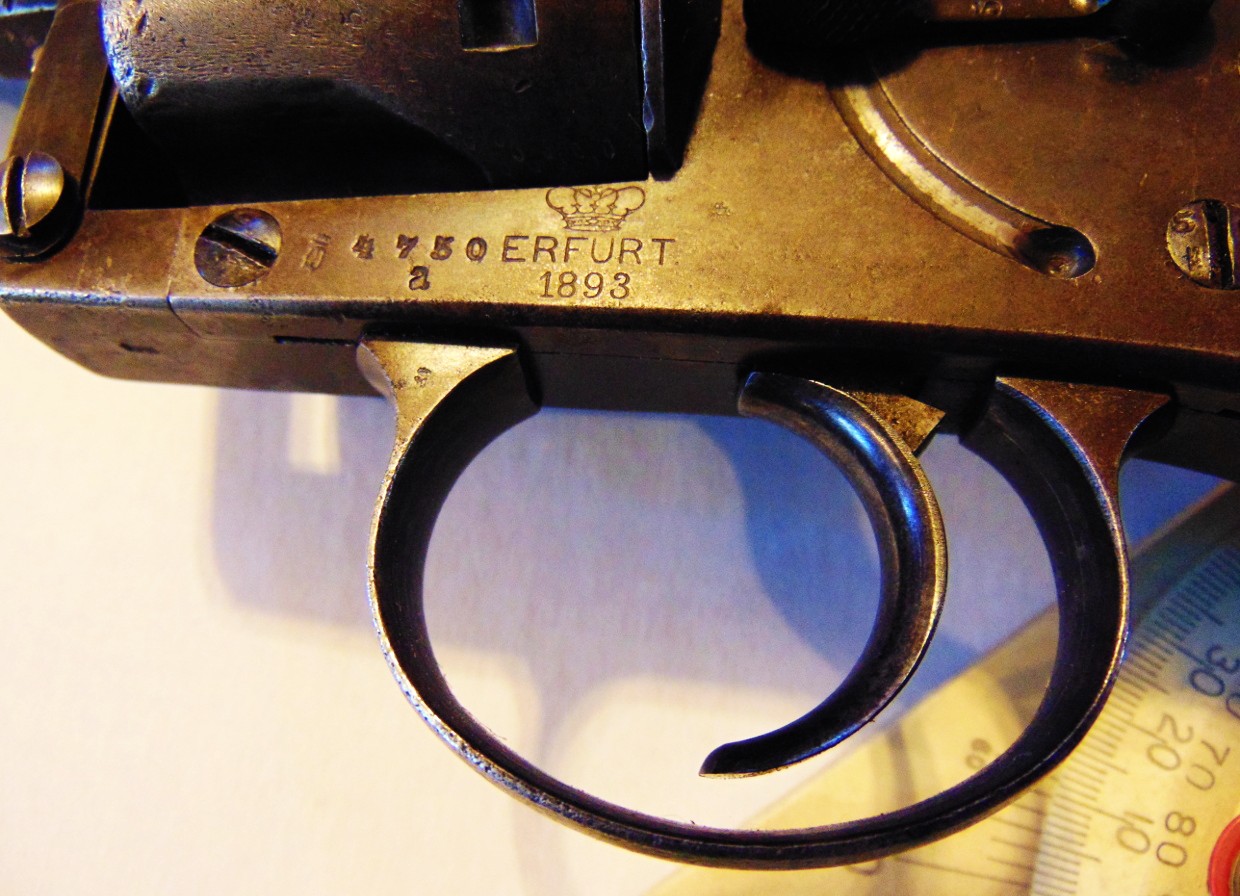
I found an 1883, which had been manufactured in 1893. Someone had fitted a non-standard cylinder pin and cylinder pin retainer. This brought the price down by half. The cartridge made for the revolver is the German 10.55 x 25R.
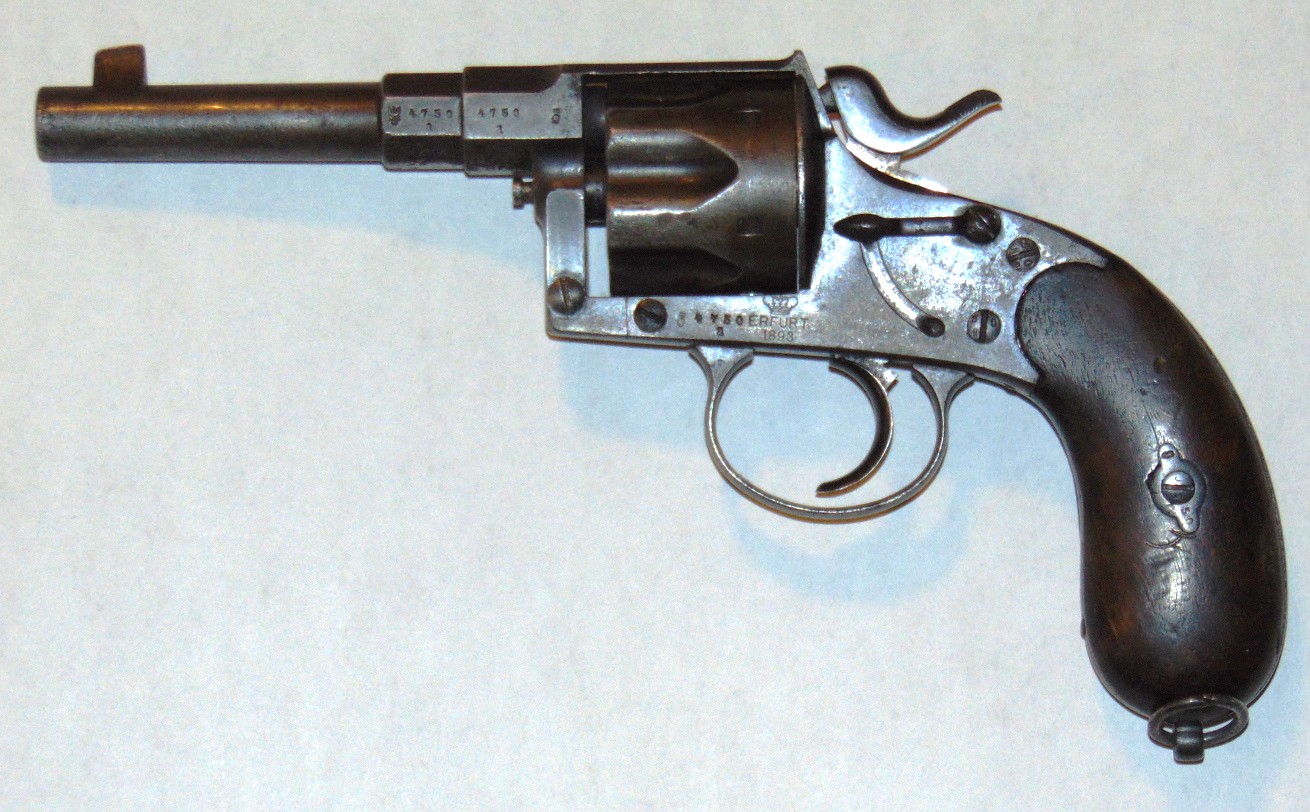
The cylinder pin and retainer shown above were non-standard replacements when purchased. Just below the hammer is the safety lever. When the hammer is in the safety notch, the safety locks the hammer so it cannot move forward or backward.
Cartridges of the World lists the service load as a 262-grain bullet at 700 fps. The cartridge uses a regular inside lubricated bullet just as we have come to expect in modern revolvers. In Donnelly’s Handloader’s Manual of Cartridge Conversions, to make 10.6 x 25 revolver cartridges, you need only to trim .44 Magnum or .44 Special cases to length. The length is the same as .44 Russian cartridge, which can be considered the grandfather of all modern centerfire handgun cartridges, because it eliminated heeled bullets, using inside lubricated bullets.
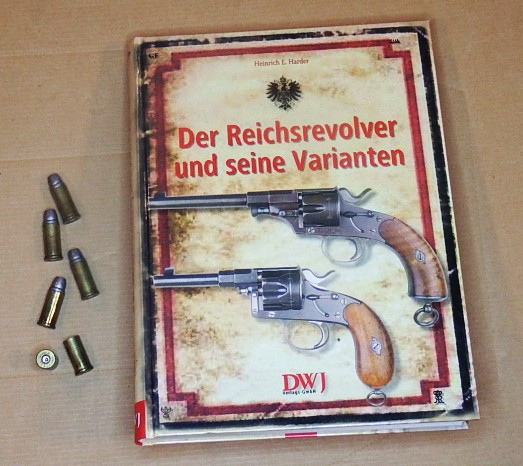
In 1873, the Prussians were already producing .44 Russian cartridges for Russia. According to Heinrich. E. Harder, in Der Reichsrevolver und Seine Varianten, in December 1874, the Germans received 40 Colt Single Army revolvers chambered in “the Prussian caliber”, (10.6 x 25), and 7,000 cartridges. The cartridge was slightly different from the .44 Russian, and the bullet was a bit heaver and longer. These Colt revolvers and cartridges were distributed to regiments for field trials.
The Germans decided to make their own revolver. The single action Reichsrevolver produced in 1879 was about the size of a Colt SAA with a 7 ½ -inch barrel, but was about 5 ounces heavier. Complaints resulted in a relatively quick upgrade to the 1883 model, with a 4 5/8-inch barrel, improved grip and lightened frame. The cylinder release was improved, but the action was the same. The weight was reduced to 33 ounces, about 3 ounces less than a Colt SAA with a 4 ¾-inch barrel.
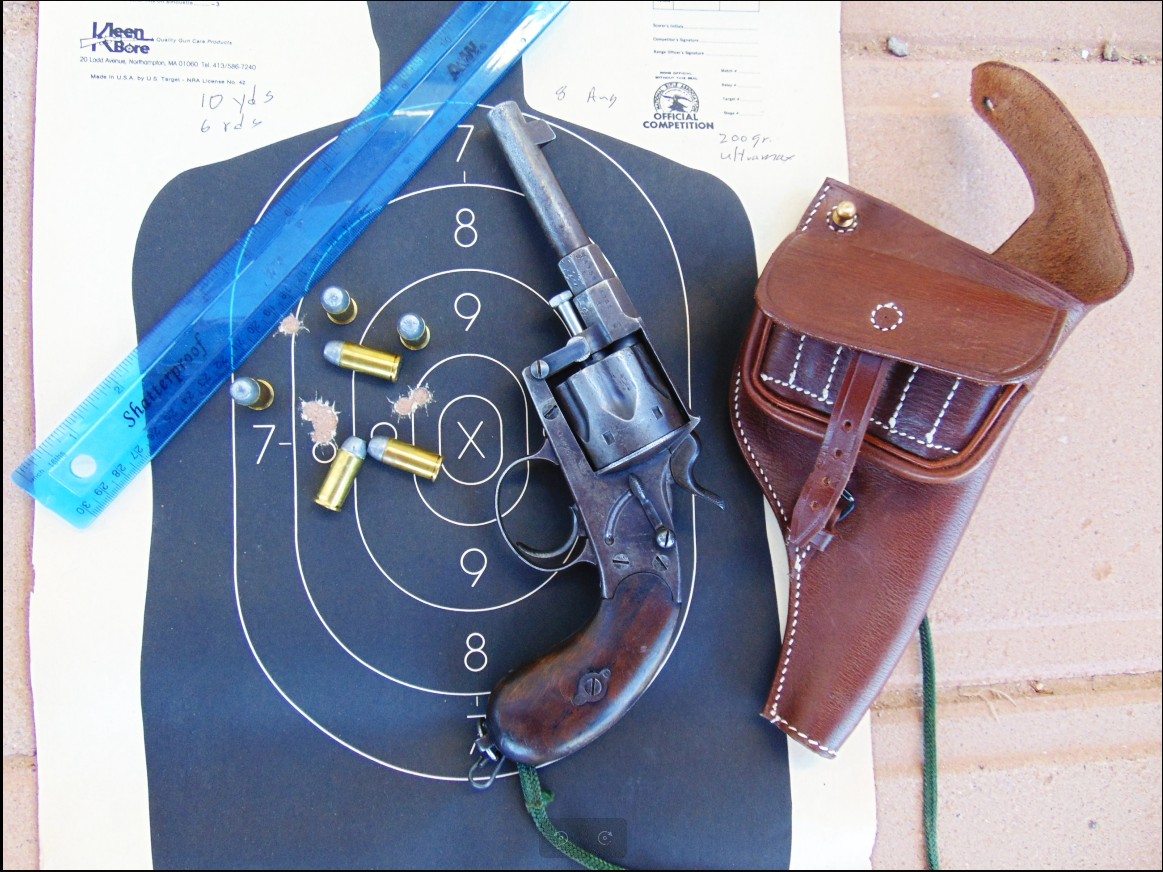
I was able to obtain some .44 Russian brass and loaded 3.8 grains of Accurate #2 with a 240-grain lead bullet. The results were a decent group for a 133-year-old revolver. Velocity averaged about 690 fps.
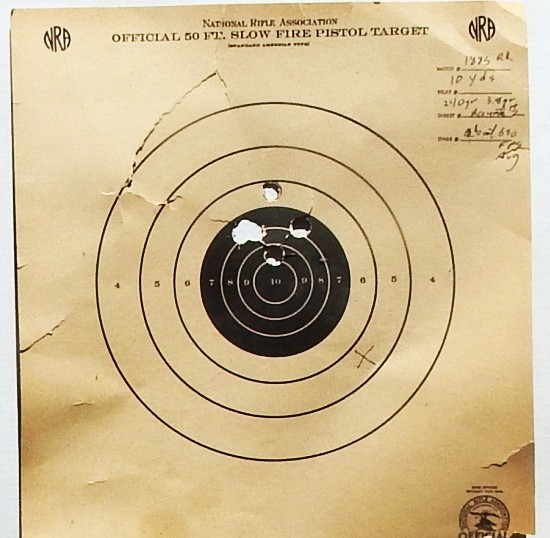
The sights are fixed and very sturdy, and the single action trigger pull was crisp, but a bit heavy, measuring about 7.5 pounds on my Lyman electronic trigger gauge. Common adjectives used for these revolvers are “robust”, “tough”, and “reliable”. They have a reputation of going bang when the trigger is pulled.
While the revolver is reliable, the replacement cylinder pin was not. Every three or four shots, the retainer would come lose and parts would fall to the ground. This was not acceptable.
I am not a gunsmith, but I do a little “gun plumbing” now and then. I can replace parts, and even fashion simple substitutes when necessary. The results may not be pretty, but they work.
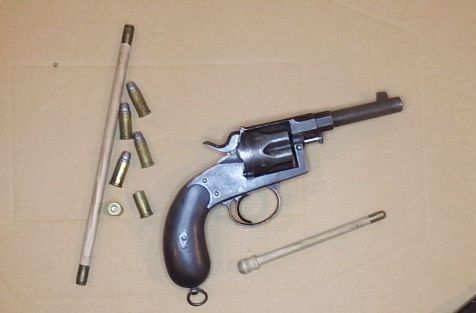
With a couple of hours work with drill press, a near correct hex bolt, and files, a better replacement system for the cylinder pin was produced. No metal was removed from the revolver. The replacement parts were fitted. They work well.
The major weaknesses of these revolvers as combat handguns are frequently cited. They are: It is single action; The safety lever is unnecessary; the ejector rod is separate and can be lost; and it is slow to reload. These are valid when considering modern revolvers. In this correspondent’s opinion, the Reichsrevolvers are sturdier than either the Smith & Wesson #3 top break or the Colt Single Action Army, both single action revolvers. The Germans opted for a reliable six shots, a big step up from the 1850 Prussian Cavalry model muzzle loading pistol. The grip, “cannon” barrel muzzle ring and sights of the 1879 are remarkably similar to the 1850 Prussian cavalry percussion single shot pistol. The 1850 model did not come with a ramrod attached.

With a few minutes practice this correspondent was able to reduce the reload time to 35 seconds, using loose rounds and an ejector rod in a front pocket. A dedicated belt drop box, as was popular in the 1950’s, holding six cartridges, could make reload speeds below 30 seconds common. Ejecting the cartridges took time; more time than ejection was required to obtain fresh cartridges. A little bit of practice showed using the replica holster cartridge loops to be much slower than loose ammunition. The flap had to be unbuckled, and the cartridges extracted individually. About 75 seconds were required, more than double the time for loose cartridges. A magazine can be switched in less than a second. With practice, revolver speed loaders can be used in under six seconds. 35 Thirty-five seconds sounds slow, but it was a reasonable speed to reload a percussion single shot pistol, and you only got one shot. Many better combat pistols and revolvers are available today.
Fast reloads beyond six shots are seldom necessary in wild country, such as the backwoods of Canada, or Alaska. These old revolvers are sturdy and reliable for six shots. The Canadian research trip has not come together yet. The old revolver may yet travel north of the border, following all the legal requirements.