By Dave Workman
Editor-in-Chief
The Biden administration looked at federally licensed firearms dealers, the firearms industry and American gun owners as sources that “were contributing to more guns being put into the hands of criminals.”
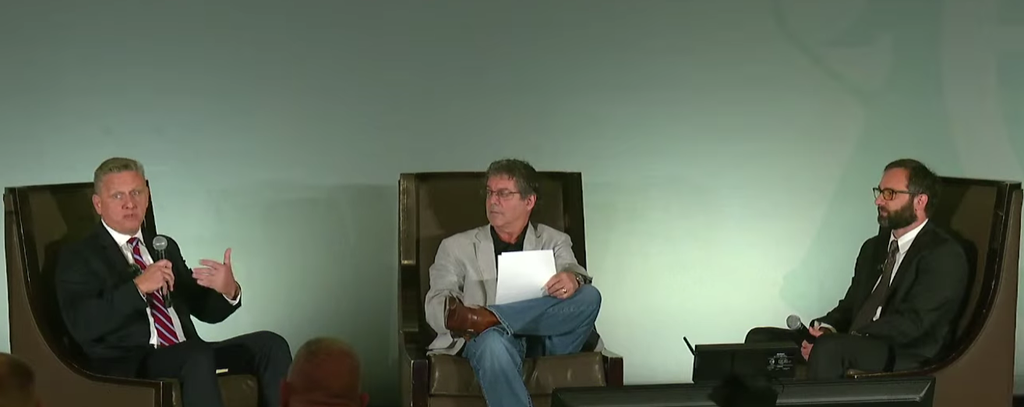
That candid observation by Robert Cekada, director of the federal Bureau of Alcohol, Tobacco, Firearms and Explosives (ATF) during a “fireside chat” at Saturday morning’s segment of the 41st annual Gun Rights Policy Conference in Dallas was not lost on the audience of Second Amendment activists from across the country.
“Instead of focusing on criminals and working hard to put criminals in jail,” Cekada said, “they went the easy route…We fell off the tracks in the last administration based on their efforts to over-regulate the industry and put burdens on the FFLs to include zero tolerance”
It may have been one of the most important 45-minute conversations GRPC history, and the mere fact it occurred at all was historic in its own right, according to moderator Mark Walters, host of the nationally-syndicated “Armed American Radio.”
Cekada was joined by Robert Leider, ATF chief counsel, who told the audience, “We take the Second Amendment very seriously and it is at the forefront of all of our regulatory efforts.”
Both officials stressed the importance of voting for politicians who adhere to the Second Amendment. Cekada advised gun owners to listen when they hear political candidates who consider replacing the Second Amendment with a right to universal health care.
“When people tell you things like that,” Cekada said, “pay attention!”
“Elections matter,” Leider added. “If people who are hostile to the Second Amendment repeatedly get elected, that will get cashed out in terms of a Congress that is hostile to the Second Amendment, an executive branch that is hostile and ultimately a judiciary that is hostile.”
Cekada, who took over at ATF earlier this year, said the agency is focusing now on people who commit violent crimes. He drew applause when he observed, “Every criminal that commits a violent crime with a firearm hurts the industry and hurts the American people being able to honor our Second Amendment rights.”
Then and Now
Leider acknowledged that in the early days of the ATF, “the Second Amendment was considered a collective right and effectively a dead letter.”
“So gun control went as far as Congress wanted and sometimes even further than Congress wanted,” Leider said, “because ATF would push the boundaries of regulations and nobody considered the Constitution as providing any sort of backstop.
“Today it’s entirely different,” he added, “as we are drafting regulations we have to consider whether our regulations accord with the Second Amendment.”
This is because of Supreme Court rulings in Heller, McDonald and Bruen, all of which defined and upheld the Second Amendment as protective of an individual right to keep and bear arms not contingent with service in a militia.
“We’re no longer in the business of stretching the regulations to cover what we think public policy requires irrespective of what Congress did,” Leider noted.
All of this underscores the importance of having judges who respect the Second Amendment, and electing a president who respects the Amendment and appoints judges who also respect it, “versus having judges who are hostile to the Second Amendment.”
With the national midterm elections only about five weeks away, this advice was not lost on the audience.
Under the last administration, Cekada recalled, there were two years in a row which saw 1,400 FFL revocations. He said 1,200 people “lost their businesses because they surrendered their licenses in lieu of a revocation because they couldn’t afford a lawyer to defend them.”
But now, under the Trump administration, the situation has reversed.
“We’re here to bring people into compliance,” Cekada said, “not to put people out of business.”
Gone is the Biden-era “zero tolerance” policy, which critics have asserted was specifically designed to put FFL dealers out of business. In its place, ATF has returned to a posture of working with industry and individual FFLs to help them comply with the regulations.
“FFLs were great partners in the past,” Cekada recalled.
That all changed under Biden. But he and his people are gone, at least for the time being, and if gun owners turn out to vote in November, things will likely continue as is.
When it was over, and Walters regretted he had run out of time with lots of questions still to ask, Cekada and Leider received a standing ovation from the GRPC audience. That has never happened in the past, primarily because the head of ATF has never before attended a conference of this sort.