By Mike Nesbitt | Contributing Editor
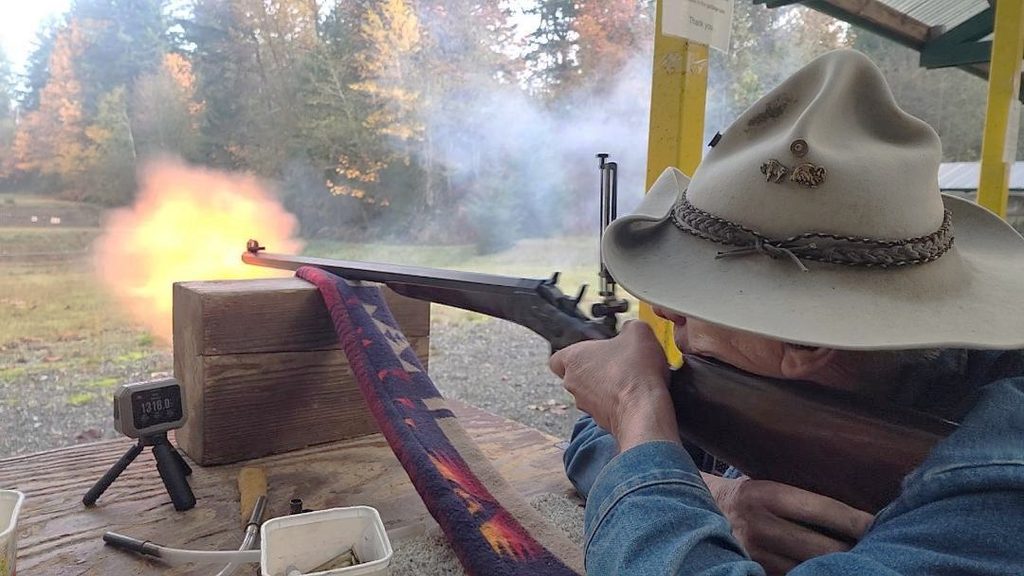
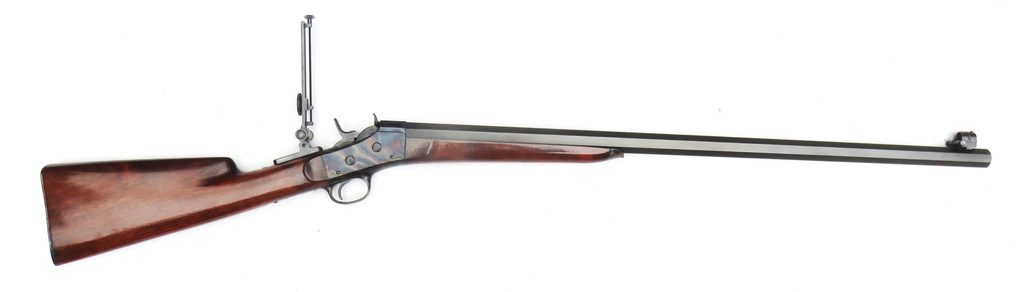
My Remington rolling block in .44-77 caliber is not an old original Number 1 Sporting Rifle. I wish it was…
That would make it a very desirable antique, perhaps worth quite a bit. At the very same time, I’m just as glad that it isn’t an old antique because I re-built this gun to be a shooter and did it in the old-style configuration that I wanted. Finding an old original in the configuration, and condition, of my rifle would be hard, at best. Those facts, both on the plus and minus sides of the story, help to keep me pleased with this rifle.
One thing that I really like about this rifle, as I was recently reminded, is the comfortable fit of the shotgun butt to my shoulder. When I shot rifles right-handed, recoil didn’t seem to bother me. Now that I must shoot my rifles left-handed, recoil has become a factor with certain priorities and I have to wear a shoulder pad when shooting rifles with high recoil. I’ll admit that I’d rather not wear the shoulder pad and with this .44-77, I don’t need to. The shotgun butt simply rests very well against my left shoulder and that makes shooting this single shot rifle more inviting.
Recoil, of course, is a product of more than just the shape of the gun’s butt plate. Bullet weight and velocity are major contributors of recoil. With more than that in mind, I’m using 410-grain bullets, which are on the light-side for bullets used in the old .44 Sharps calibers.
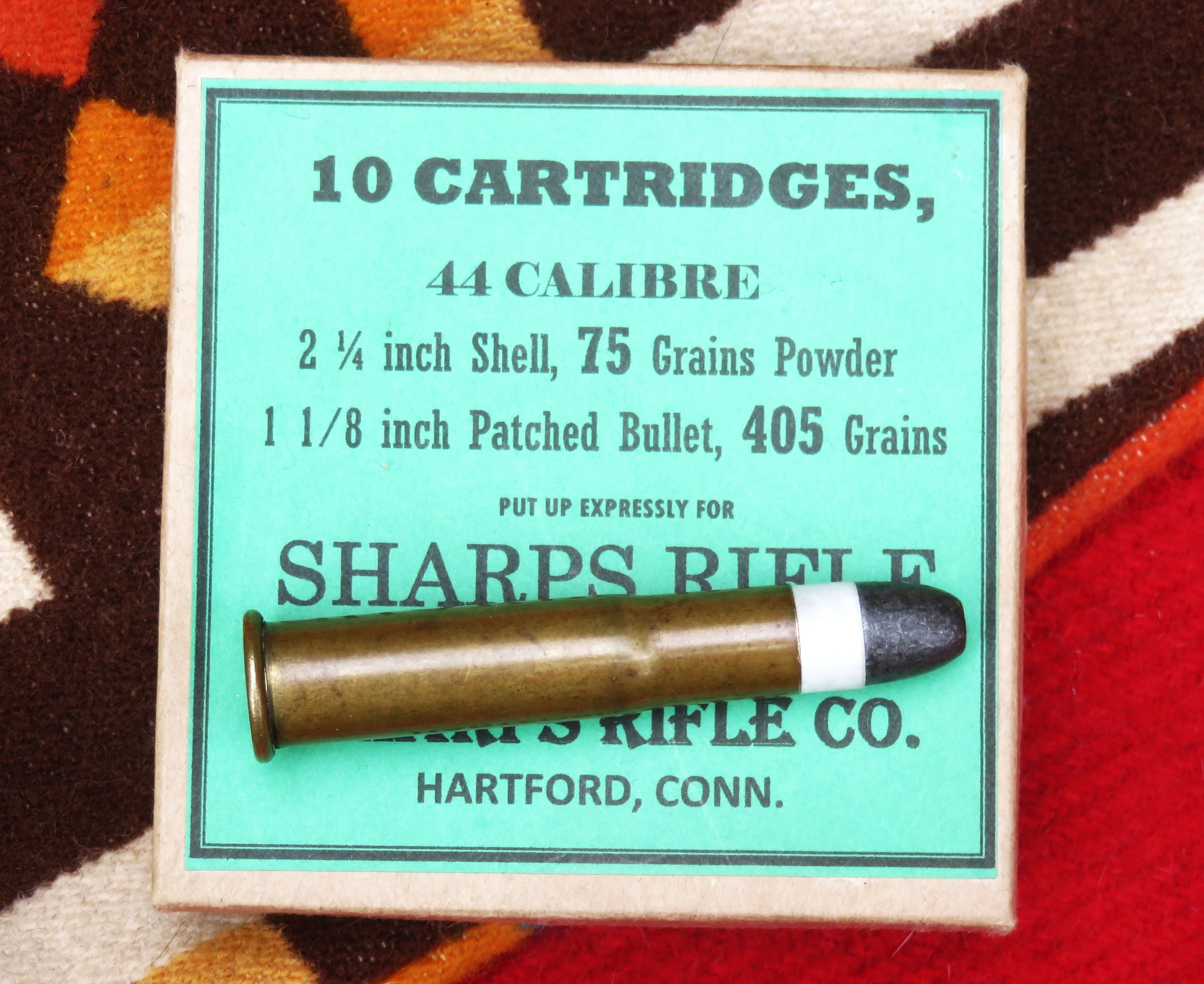
What I meant by “more than recoil in mind,” I’m referring to the old original Sharps loadings for the .44-77 which used 380- or 405-grain bullets in front of 70 to 75 grains of powder. The “77” in the cartridge’s name came from a UMC loading which used 77 grains of powder, identical to the .43 Spanish loading, and that name stuck, even though the correct name for this cartridge is the .44-2 ¼-inch Sharps. And the loading I’ve settled on, maybe just for now, is 72 grains of Swiss 1Fg powder under the 410-grain paper patched bullets.
A Little Background
There is a bit of background to my working-up that load. A few years ago, I had the opportunity to take an original old UMC .44-77 cartridge apart in order to see what it really had in it. Those old cartridges are desirable collectors’ items but this particular cartridge had the paper patch torn away from it which certainly reduced its value. So, in a nutshell, I was able to pull the bullet, then the wad and lube “cookie” under the bullet as well as the powder that was in the old load.
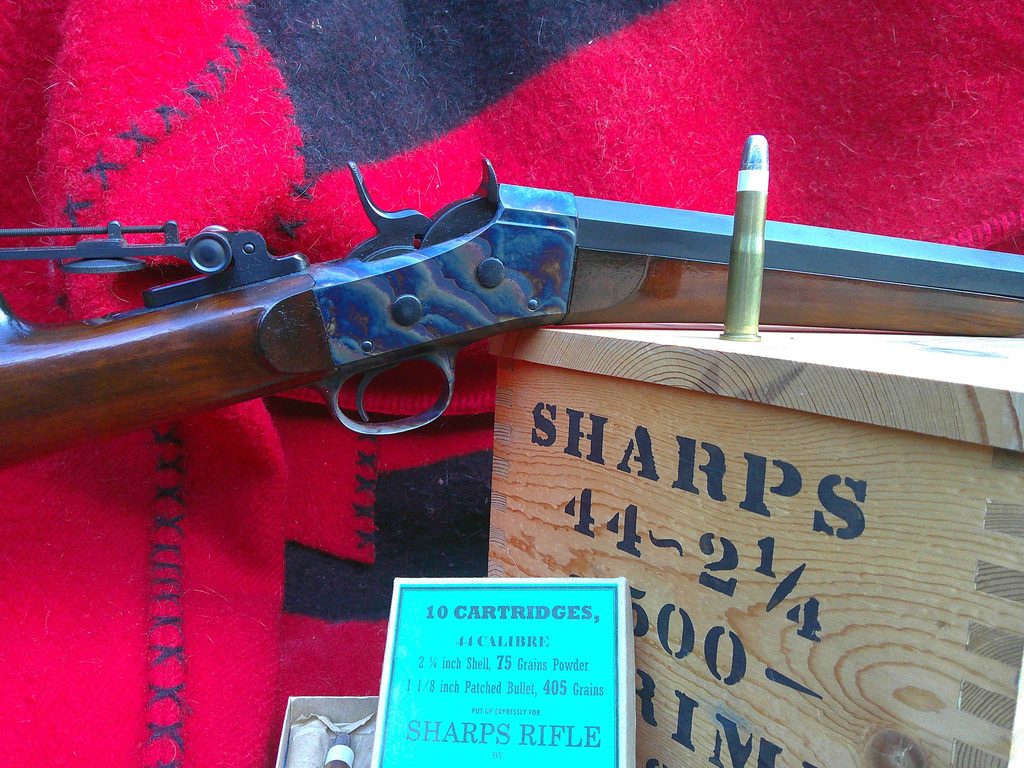
Those items were carefully measured before the old bullet was re-patched with new paper and the cartridge was re-assembled. Today it sits in my cartridge collection.
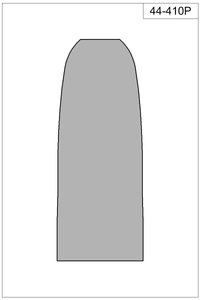
The bullet was tapered, as many paper patched bullets are, with a diameter of .438” at the base. That was larger than many of today’s paper patched bullets for the .44-77 and I almost immediately contacted Accurate Molds to have a close copy of that bullet made. The result was their #44-410P, a dual-diameter bullet with a diameter of .438” at the base.
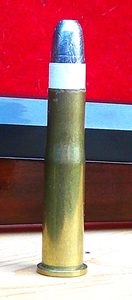
Appearance-wise, this bullet satisfies me very well because it looks so much like the original bullet when loaded in the .44-77 cartridge. One little difference is that the original bullet had a cup base while the bullets cast from the Accurate mold are plain based. Franky, I don’t have a real preference between the cup base bullets and those with plain bases as long as they shoot well.
Settling, so far, on the 72-grain powder charge which was simply one of my tries. At first I tried just 70 grains of the Swiss 1Fg powder. That powder was selected because it is the slowest burning of the Swiss black powder family and therefore gives the bullet the slowest acceleration while traveling down the gun’s barrel. I’ve tried other granulations of powders before and have not had the luck I’m enjoying now with this coarse-grained Swiss powder. While the 70-grain load was encouraging, it actually encouraged me to try 71 gains of powder. That was followed by the 72-grain loading which is the best so far. In fact, I’m not completely through such testing and some loads with 73 grains of powder and maybe more, perhaps up to 75 grains, will be tried soon. All shooting, at this time, has been done at 100 yards.
Rifle Details
Now for some words about the rifle. The old and very fine Remington Number 1 Sporting Rifle interested me quite a bit, especially in its more “deluxe” forms which were often target rifles, such as those used at the world-famous Creedmoor matches. In those matches, such as the match between the Americans and the Irish team in 1874, the rolling blocks shared the spotlight with the Sharps rifles. It is interesting to note that while the calibers of those rifles were listed as being .44-90s, they still used the .44-2 ¼” case, simply with the 90-grain powder charge under a bullet which weighed up to 520 grains which was seated very shallow in the cartridge case’s neck. There was no lube in this load and during the match shooting; the rifles’ barrels were always wiped between shots. While I did desire a rifle which followed the lines of a sporting rifle, some of the Creedmoor characteristics did find their way into my rifle.
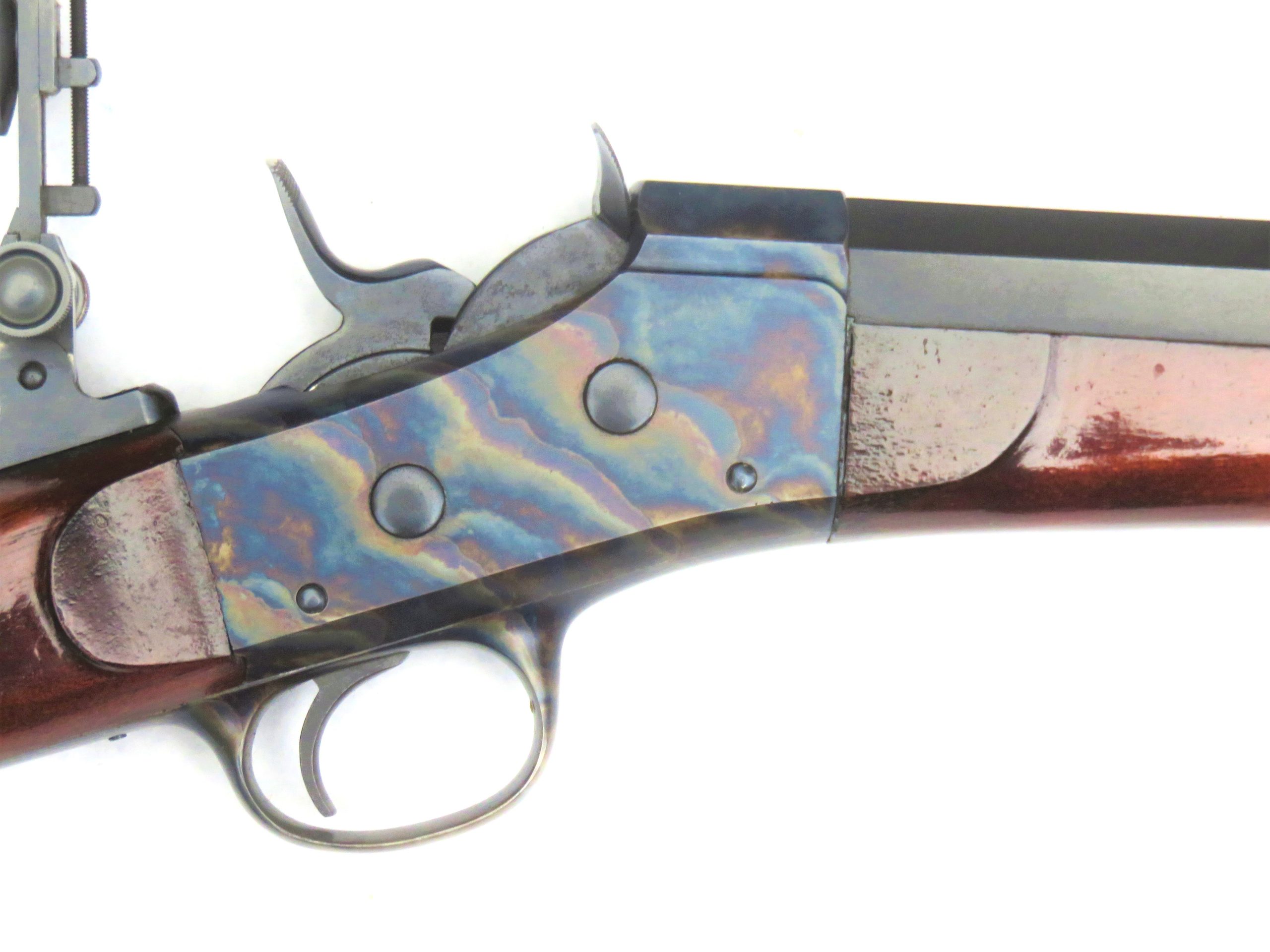
What I did was to take a military rolling block action, rework the hammer and the “lever” on the breech block to look more like a sporting rifle by making both of those pieces much thinner. A special 32-inch octagon barrel was ordered from Oregon Barrel Company, through The Gun Works in Springfield, Oregon. The forearm and butt stock were ordered from Treebone Carving and those pieces came supplied with the cast metal nose cap and the steel butt plate. If you might be interested in re-building a rolling block of your own, I recommend looking for an action at Kenn Womack’s Remington Rolling Block Parts.
Kenn goes through the old actions and fits them with new screws and perhaps other needed parts so they can work like new.
When I re-worked this gun, all I really had to go on was a picture of a “Creedmoor-ish” rolling block which had a pistol grip. Later investigations show that the Creedmoor rolling blocks were also offered with straight grips, which makes my gun just a little closer to a Creedmoor model.
One area where my rifle will not qualify as a Creedmoor gun is in its weight. My rifle weighs 11 ¾ pounds while a true Creedmoor from the 1870s had a maximum weight of just 10 pounds. That’s fine with me, the extra almost two pounds simply adds a bit to the comfort at the shoulder.
At the time when I assembled this rifle, I was using a .44-77 quite a bit. That was my ’74 Sharps by C. Sharps Arms, and this rolling block was made to possibly do more shooting at longer ranges. To go along with the long-range idea, the rolling block was fitted with a long-range tang sight and it is one of only two rifles I have which wear the long-range sights. And I must admit, I’ve never shot this rolling block at a long-range target.
In Competition
But the only time I used this rifle in competition took place in 2016, and it was not my first choice even then. The match was done at one of our Old West Centerfires shoots and I had been urging longtime friend Mike Moran to join us. He didn’t have a buffalo gun of his own and I offered to lend him a rifle and supply the ammo if he just gave the sport a good try. He finally agreed. Then I asked him what rifle/caliber he wanted to shoot. I didn’t have everything, far from it, but I did have a couple of rifles to choose from. Mike immediately said he wanted to shoot my .44-77 Sharps. That, and you can probably guess, was the rifle I intended to shoot in the match. But no problem, I’d lend my Sharps to Moran and shoot beside him with my .44-77 rolling block.
The match was held in January 2016, on a good chilly Saturday morning. I’ll admit to not wanting my “pilgrim” friend outshooting me so I was trying hard, concentrating on my sight picture and trigger squeeze, while missing the set trigger that the Sharps had. (Even so, my .44-77 rolling block does have a fine trigger pull.)
These Old West Centerfire matches are short-range matches, with targets at just 100 and 200 yards. Mike Moran is an old hand by now, with buffalo rifles of his own, but this was his very first black powder cartridge match and he was off to a pretty good start. We both shot at our 100-yard targets first and Mike’s score was an admirable 92-2X, shot from the sitting position while using cross-sticks.
We were spotting for each other and I do (faintly) recall checking my target’s score with the hopes of turning in a better score than my pal. And I did. My target, with its ten shots, held a score of 93-2X, just one point better.
And I really needed that one point. After our 200-yard targets were shot and scored, we tied at that longer distance with scores of 75 each. My target did have another X at that longer distance so we weren’t completely tied. Our total scores for the day were 168-3X to 167-2X, pretty close. That was a good match, I placed 4th and Mike placed 5th, so we went to the prize table almost together. The good thing about that match was how Mike was hooked and he now has Sharps rifles of his own in both .45-70 and .50-70 calibers. And he has outshot me several times over the years with his own rifles.
Why I didn’t continue using the .44-77 rolling block must remain a good question, although that was about the time when I got “Hefty Hannah,” my 15 ¼ pound Sharps in .44-77. That heavy Sharps was my “go to” gun for quite a while and a lot of my other rifles rested in the gun racks while I was using the “big one.”
We can say “it’s about time” that I got back to shooting my rolling block. And now that I’m shooting left-handed, the stock on the rolling block is more comfortable than the Sharps. I notice recoil on the left shoulder far more than I ever did on the right side, so a more comfortable rifle becomes very inviting. One other tiny factor, my eye sees the sights on the rolling block better than on several other guns. All of these little things add up to doing more shooting with the rolling block.
You might think this is being written as I go along with the shooting and that’s exactly right. I’ve just finished doing some shooting with this gun while using the 73-grain powder charge with the paper patched bullets. That load was speed-checked with an average velocity of 1331 feet per second out of the 32-inch barrel, with an extreme spread of only 5 fps over the five shots recorded. That is very good.
But the load tweaking continues. A batch of bullets was just cast using 16-1 lead and tin to try a harder bullet. The bullets I had been using were close to a 30-1 alloy and those did give me good hits, although I’d like to see if my group size could be improved. There is more shooting to do and I’m certainly looking forward to doing it.