By Mike Nesbitt | Contributing Editor
Cimarron Fire Arms has an impressive array of replicas of the Winchester Model 1873 in both rifles and carbines.
For the past several years I have been doing a lot of shooting with one of their “Long Range” models in .44-40 caliber and that gun has certainly won my heart. My use of that rifle also led me to want another version of the ’73.
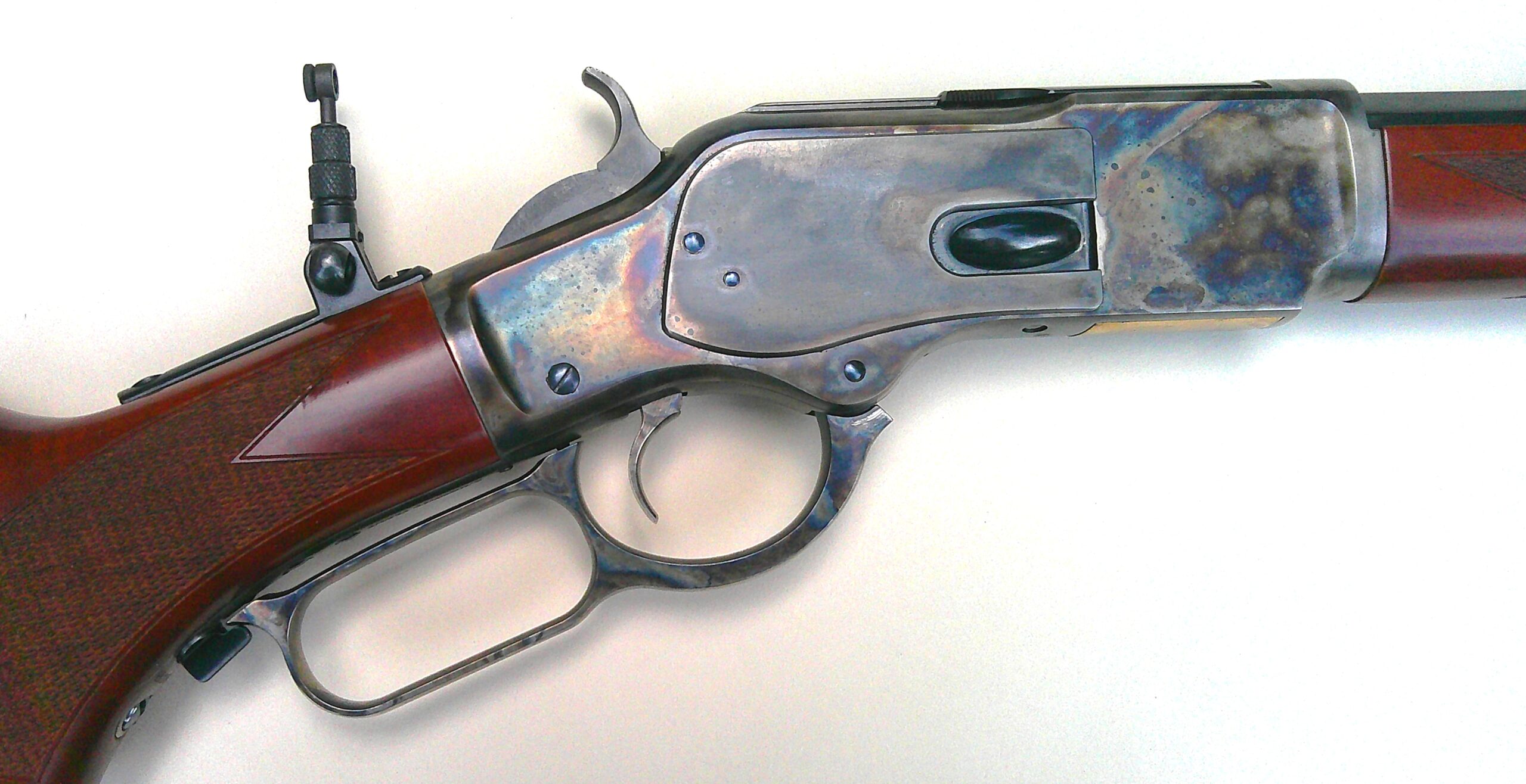
A Model 1873 Short Rifle with a full magazine and a 20-inch octagon barrel was a version that I didn’t have. Questions often rise about the authenticity of the ’73 Short Rifles by Cimarron and let me assure you, they are very authentic. But because all of the short rifles were special order guns, they generally do not appear in the old Winchester catalogs. Where I learned about the old Short Rifles was in THE WINCHESTER BOOK by George Madis and in that book at least three Model 1873 Short Rifles are shown.
One of those Short Rifles is a deluxe version, with a pistol grip. The complete description of that gun must include the 20-inch-long octagonal barrel, rifle forearm with the rifle-style nose cap (and not the carbine-style barrel band) and the rifle-style crescent butt plate. Its caliber is not stated but because it has a large magazine tube, it must be a .38 or a .44 caliber. One little difference between that original gun and the version that Cimarron offers is that the old gun is stocked in burl walnut which is not checkered. While the wood is not checkered, the gun’s action is engraved. Checkering was certainly an added cost option on the old ‘73s, so getting checkering on the new guns from Cimarron is authentic as well.
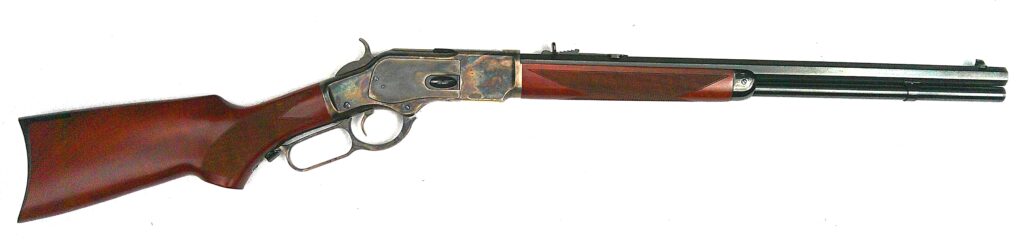
In fact, authenticity is rather important to me and it was that picture in Madis’s THE WINCHESTER BOOK that spurred me to get this new Model 1873 .38-40 Short Rifle. Now I’m going to give it every chance to become my favorite lever-gun.
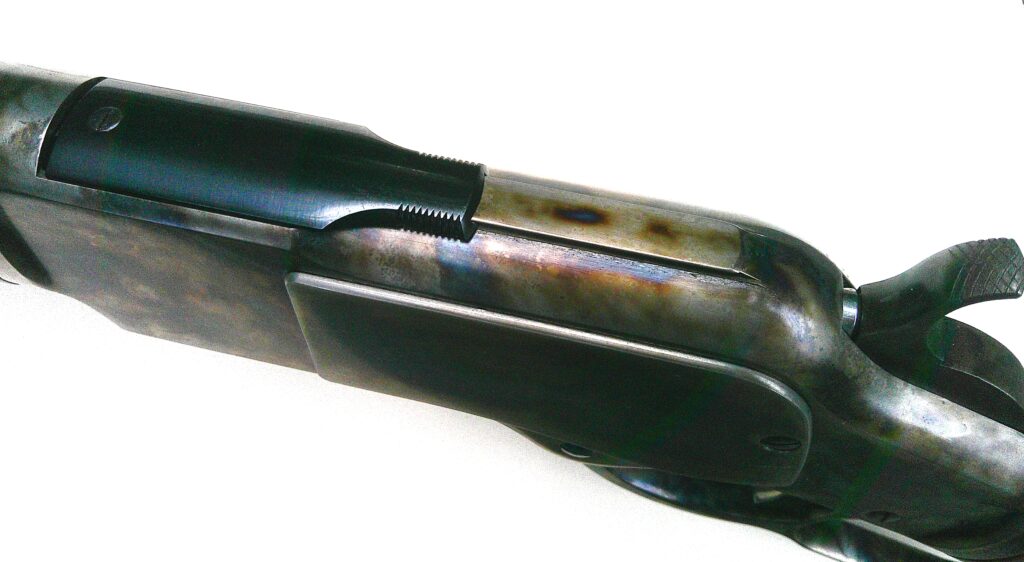
The Cimarron versions of the 1873 rifles are well-made copies of the third model of the old ’73. Those are identified by the “rail” for the dust cover which is an integral part of the receiver. Another identifying feature is how the hammer and the trigger both rotate on internal pins instead of on screws which enter from the outside of the receiver. The third model is the last and, in my opinion, the best version of the Winchester ’73.
Of course, getting the new rifle was only the beginning because I needed a bullet mold, reloading dies, brass, and a cast bullet sizing die. Those were all acquired, actually before they were really needed, and when I got the .38-40 home, I was just about ready to shoot it. Actually, I used to do a lot of shooting with guns in .38-40 caliber but my dies, bullet molds, and other equipment were sold when I thought I wouldn’t need them anymore. Yeah, right!
A Little History
The old .38-40 cartridge was introduced in the Model ’73 Winchester back in 1879, although some say it was added to that rifle just a few months after the ’73 was introduced. For those first six years of production for the ’73, Winchester was very busy just producing the gun in .44-40 caliber and the .38-40 was added in ’79 as production records indicate.
Why it was called the “.38-40” is somewhat of a curious thing. The general powder charge for this cartridge is 38 grains instead of 40 grains like the .44-40, and the caliber or bore size is actually .40 instead of .38. So, it would be more proper to switch those numbers and use “.40-38” as the cartridge’s name, which would certainly be more descriptive? But the .38-40 it is and there would be no point at all in changing the name of this historical cartridge now. And its official title is the .38 W.C.F. with the initials for Winchester Center Fire.
My first shots fired with this new rifle were with handloads using Starline cases, charged with 33 grains of Swiss 2Fg powder under 180-grain cast bullets purchased from Buffalo Arms Company. Those bullets were cast with a Lyman or Ideal mold, #401043, and sized to .401” diameter while being lubed with SPG black powder lubricant. That load was just a guess, for the first try, but I’ll probably stay with it for a while.
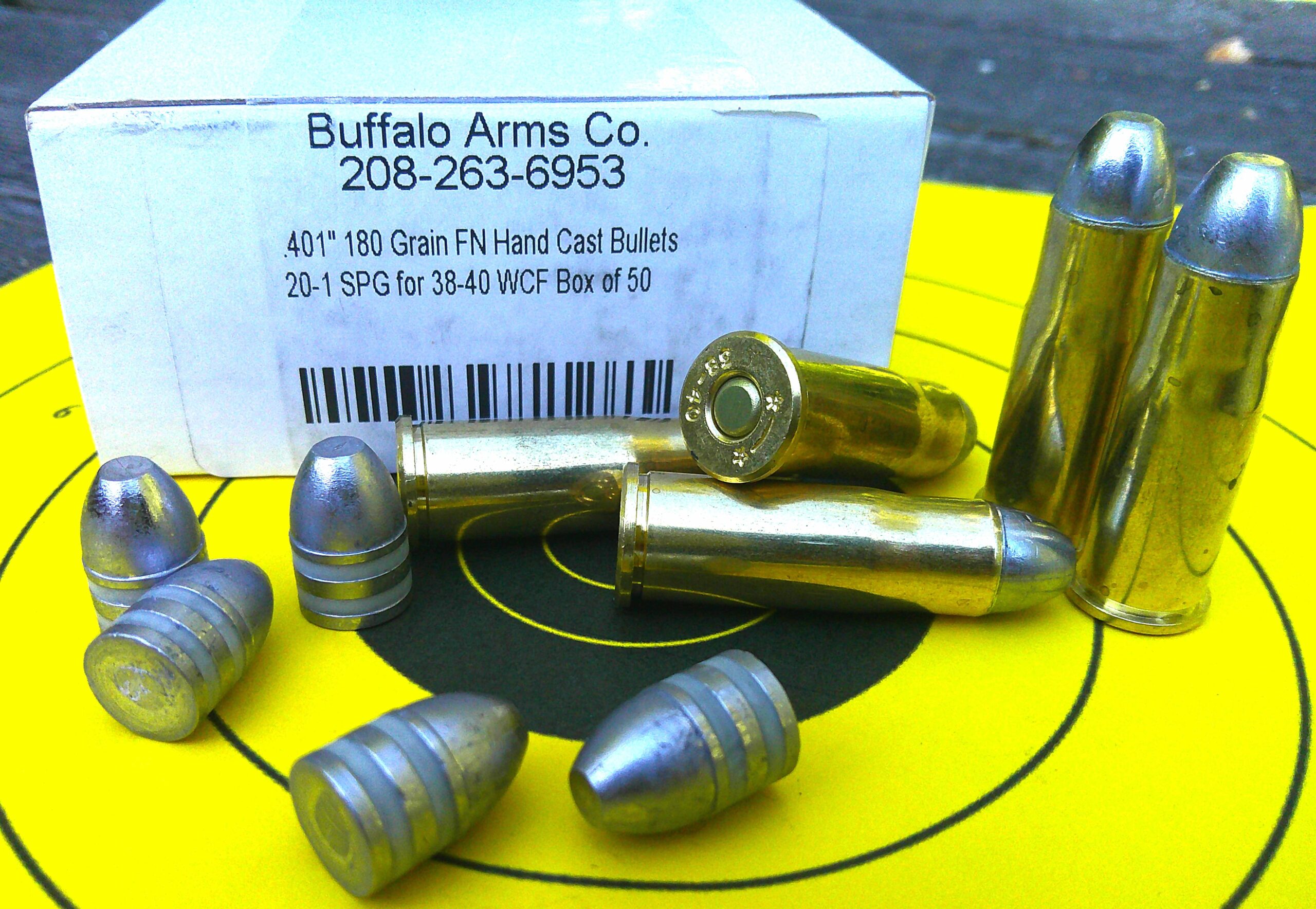
The first ten shots were checked with a chronograph and they averaged 1,335 feet per second out of the 20-inch barrel. That was actually a little bit faster than what I expected. Now I wish I had another rifle with a 24-inch barrel just to see how much faster that might be. Perhaps in a while a rifle with the 24-inch barrel might come along and maybe that question can be answered. For now, it is just comforting to know how fast those bullets are leaving the muzzle.
Before those first shots were fired, however, I took the new rifle to Allen Cunniff’s shop to have a Lyman #2 tang sight mounted. Allen gave me priority for that job and the gun was ready less than two hours later. I’ll always think that Allen gave me such a priority because he wanted to shoot the new gun, too.
Breaking In
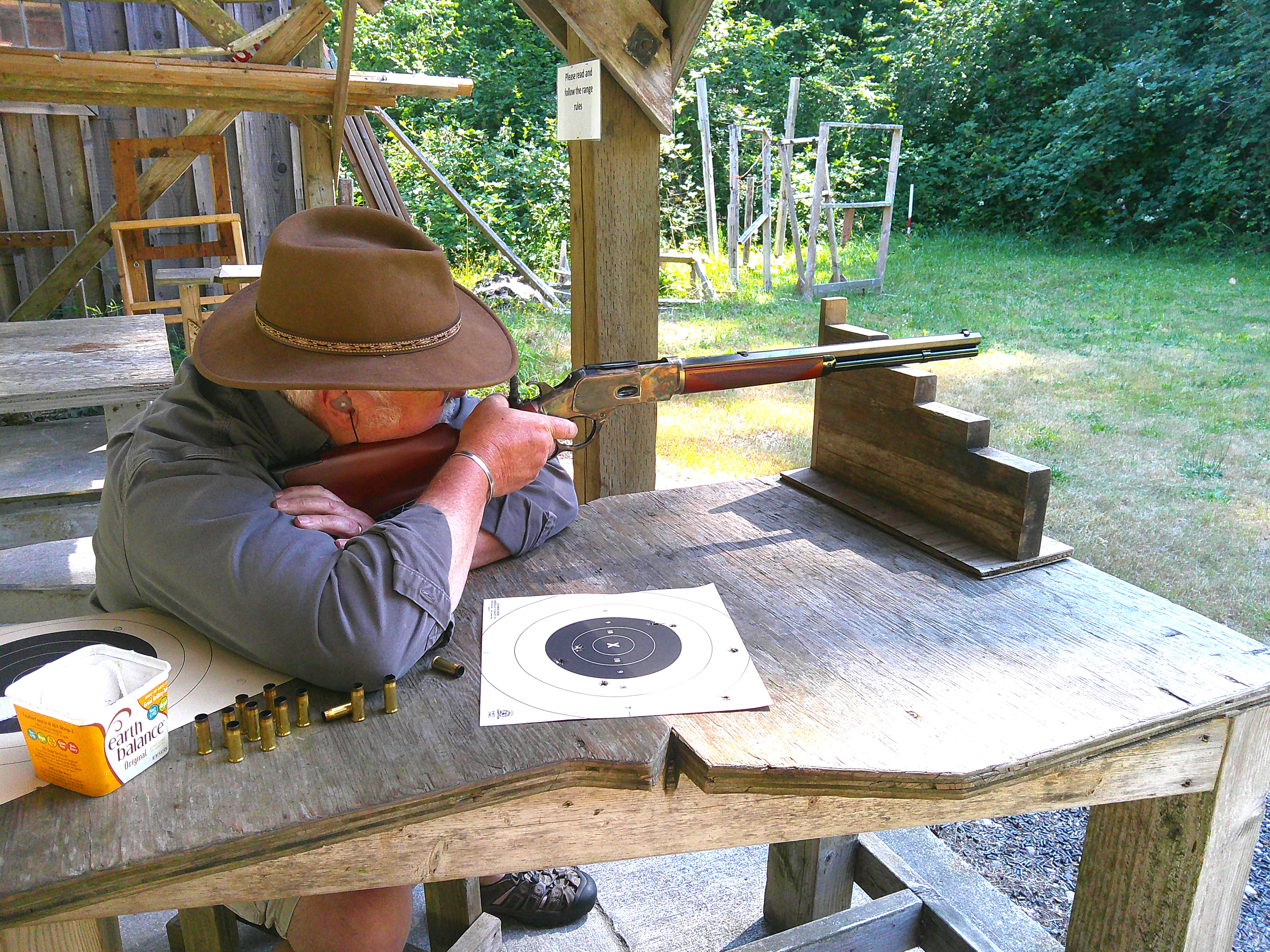
With the sight in place, and a slot blank taking the place of the original open rear sight on the barrel, Allen met me at the shooting range and the first shots were taken. The first ten shots were taken slowly because I wanted to break-in the new barrel to black powder loads. That simply means the barrel was wiped between shots for those first ten rounds. With those ten shots done, the breaking-in of the barrel is not complete but that is the big first step.
Those shots were fired at a small bullseye posted at just 25 yards. After all, we had no idea of where the gun would be hitting, so getting shots on a close target is easily the first thing to try. After five shots, which grouped a bit high and to the right, the front sight was adjusted to the right to move the group to the left, and the second five shots were fired “for effect.” That group was still high but the windage was much better.
After the first ten shots were fired, cleaning the bore between shots ended and the next ten rounds are usually fired while wiping the bore after every two shots. I was getting a little impatient but the bore was still wiped after every three shots this time. The reason for wiping the bore between one or two shots is so the interior of the bore can be “seasoned” with the black powder lubricant. Wiping the fouling out between shots, or between every couple of shots, allows the lube on the bullets to be allied to the bore’s interior instead of on the fouling of previous shots.
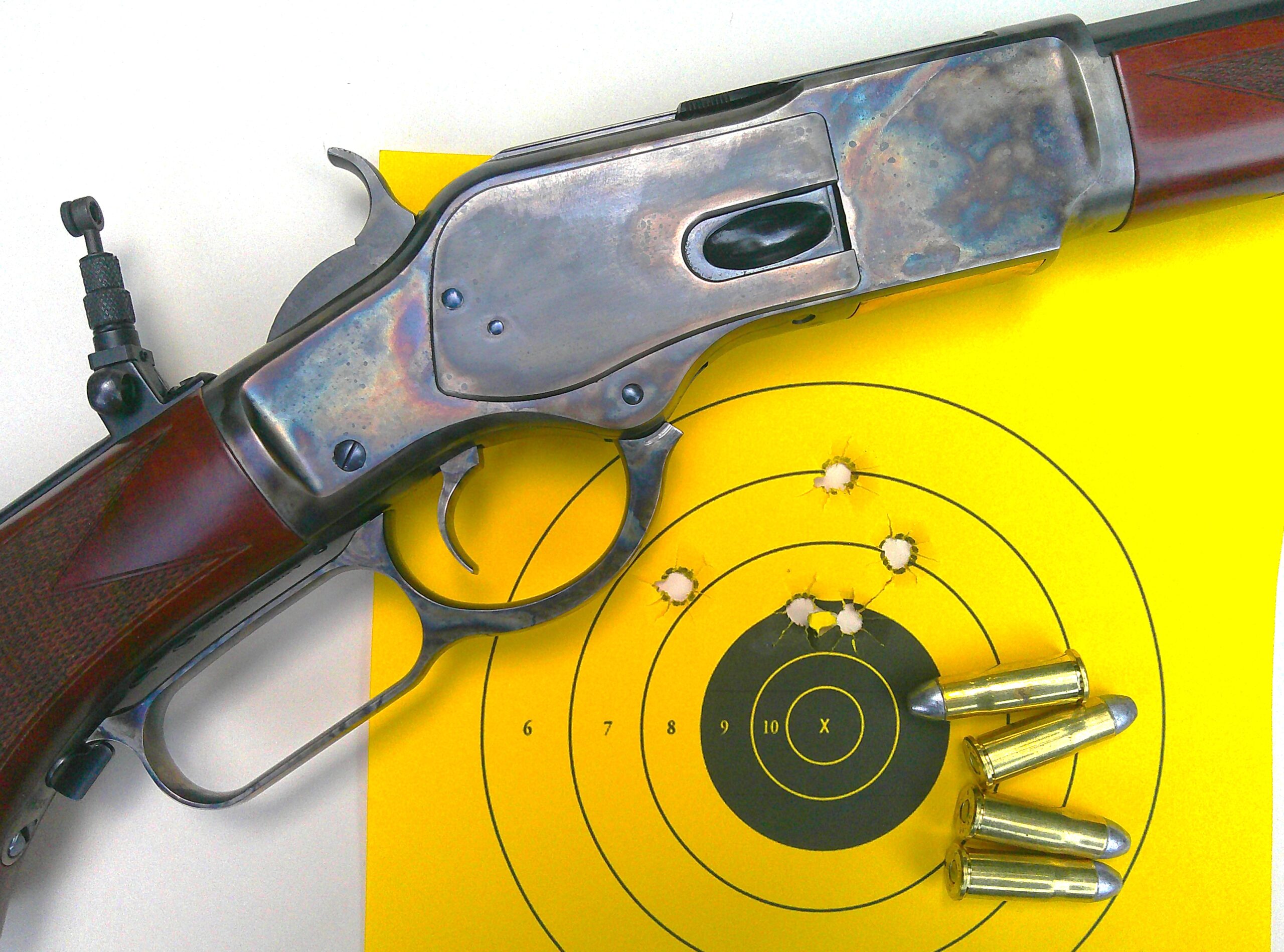
Believe me, that does make a difference, especially in cleaning the rifle after a good day of shooting. With a broken-in barrel, after a full day of shooting, the bore can be cleaned with just two patches. This .38-40 is not completely broken-in as yet, it took four patches to clean after the shooting that I’m telling you about. On the other hand, my long-barreled .44-40, which has much more experience, does come clean with just two patches, used with Three Rivers Black Powder Solvent, available from The Gun Works.
Talking about breaking-in the barrel and then cleaning them has gotten ahead of my story about the shooting. After shooting the second group, some targets were tried at 50 yards with Allen doing the shooting for at least one of them but perhaps shooting those targets was too soon for this gun. All of the shots hit the paper, no doubt about that, but they did not group as well as I expected and some more shooting as well as possible tweaking of the loads might be in order.
So, we fell back to 25 yards to shoot one more target. The tang sight was adjusted to lower the point of impact and five more shots were taken. That was the last target shot for this outing and it was actually the best target, although it might not look that good. Five shots were fired and the last two shots went through the same bullet hole, in the 9-ring at just a touch lower than 3 o’clock. Allen was spotting my shots through the scope when those last two shots were fired and that’s why only four bullet holes are visible.
While we were doing the shooting with this new .38-40 rifle, we were also chatting about the gun’s performance. Allen and I both shoot .44-40 rifles in our club’s competition, the Lever-Gun Matches, and we both do rather well. The level of performance we achieved so far with this new .38-40 is easily not what we expect to see, perhaps just shortly “down the trail.” We both agreed that our .44-40 rifles did not perform as they do now when we fired them for the first time. And our shooting which you were told about was the very first time this .38-40 had been fired, with a total of only 33 rounds being shot.
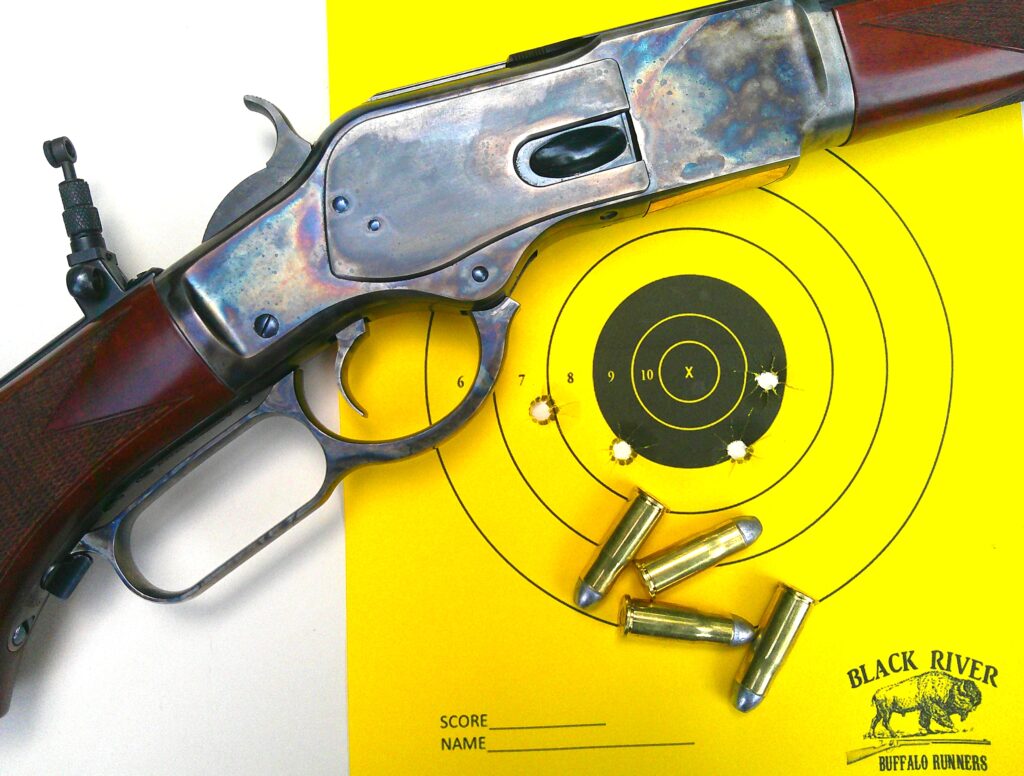
But don’t let me make you think we were disappointed, we certainly were not. The shooting we had done must be considered a good stepping stone, with preparations for the next round of shooting. Loads can be changed, or “tweaked,” and new bullets can be tried.
For the shooting just done, the new Cimarron Model 1873 Short Rifle functioned very well. I’m very pleased to get it and it will become a trusted friend along with my long barreled ’73 in .44-40. I’m also pleased with the .38-40 caliber and noting the differences, as slight as they are, between it and the .44-40. Of course, writers have been comparing the differences between the .44-40 and the .38-40 ever since 1879!
To get more information about these 1873 Short Rifles and other versions of the ’73 Winchester replicas, go to Cimarron’s web site at www.cimarron-firearms.com.
This .38-40 caliber ’73 Short Rifle from Cimarron is definitely in need of more shooting and this story will certainly be continued.