
By R.K. Bob Campbell | Contributing Editor
When I was working to add color and technique to the latest book, Red Dot Sights For Modern Handguns from Gun Digest, I drew upon extensive experience with semiautomatic pistols and the PMO. Revolvers have been essentially left out of the field compared to other types of handguns.
What I tested was interesting. It isn’t likely a maker will introduce a new type of automatic that doesn’t include an optics ready slide. At the moment non MOS Glock handguns are going begging in pawn shops.
The Glock V in particular is a hard sell. Pistols that have a more difficult mounting system and in which the mounts are more expensive are at a disadvantage. Even the traditional 1911 and Hi Power pistols are optics ready in some versions, although still dogged by expensive mounts.
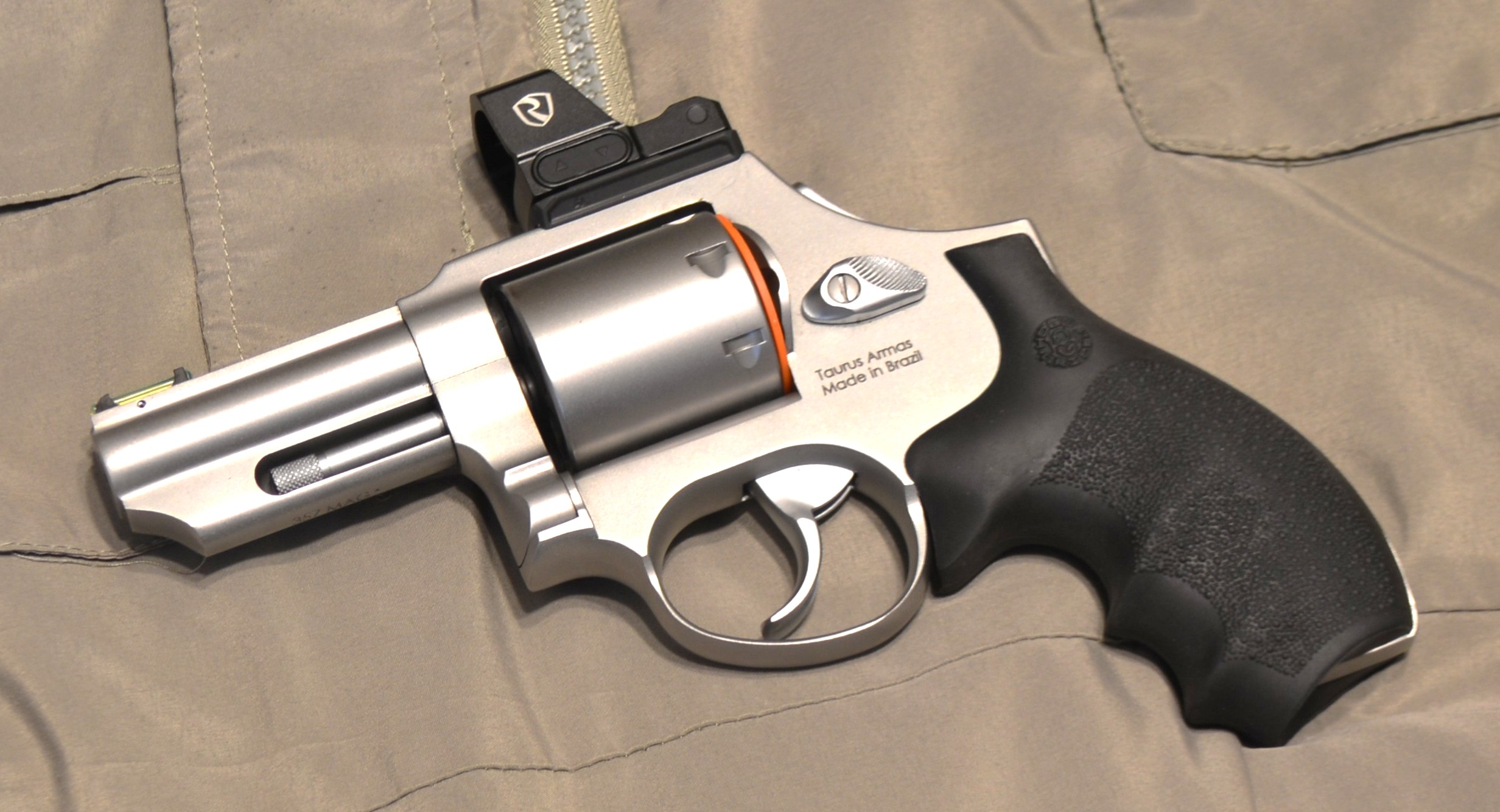
Revolvers are definitely not at the same level, however, they are not that complicated to set up for optics when the procedure is properly addressed.
Among automatics the field has become so broad with many good options we concentrate on trigger action and accuracy concerns as we should. With the revolver the field is limited but the options available are very good.
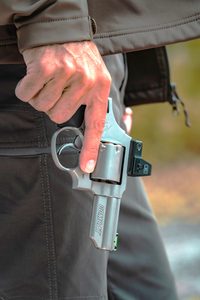
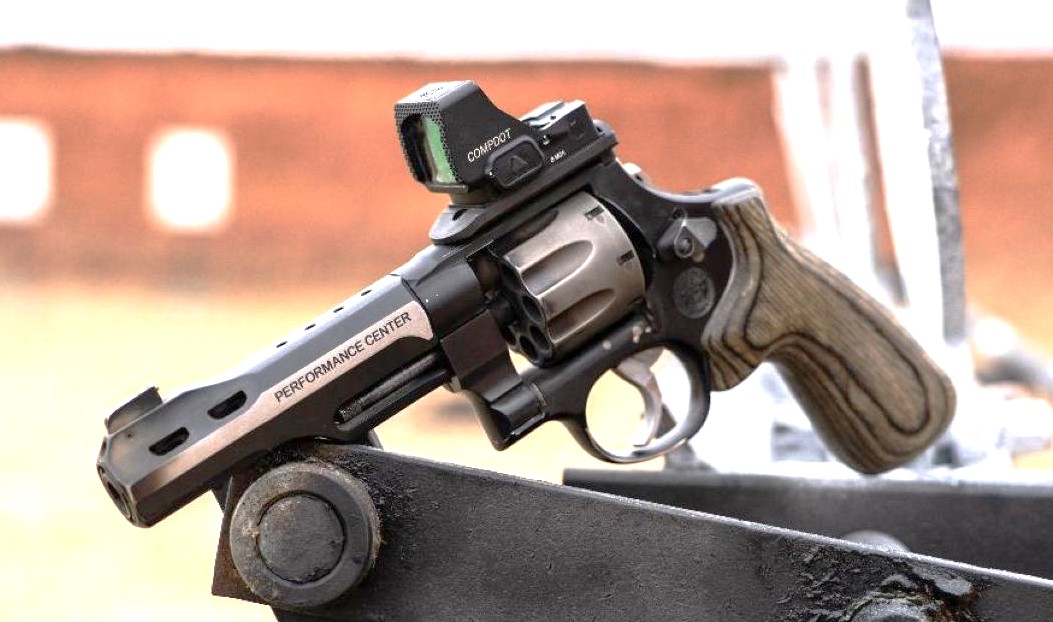
For many years top gunsmiths such as D&L Sports have been supplying red dot conversions. These have performed exceptionally well in competition and proven durable. Taurus offers a range of small to large frame revolvers in their Taurus Optics Ready Option line up. They recent introduced the 66 Combat. Smith & Wesson offers Performance Center competition grade revolvers.
If a PMO is good for a Glock then it should be good for a revolver shouldn’t it? It depends on the mission. My front pocket .38 won’t wear an optic. Neither will the Colt Detective Special on the ankle. But if your revolver is in a position of being a primary carry piece or home defender then a carry optic will improve your hit probability.
Are the advantages of the PMO the same with a revolver? Perhaps even more so. The ability to fire with both eyes open and quickly use target focus and lay the dot on the target while maintaining situational awareness and more- yes, the red dot sight is leagues ahead of the fixed sight for those that train and practice. Another advantage of the double action revolver is that the smooth rolling trigger break helps combat flinch. You don’t anticipate recoil as much and an advantage of the revolver is that we may use the powerful .357 Magnum cartridge. This makes for a greater incentive to use the red dot sight.
Revolver geometry grip angle and overall conformation to red dot use is different in most aspects than the automatic. A revolver trigger both cocks and drops the hammer hence the term double action. The hand or pawl and trigger springs must be fitted properly. The main parts—barrel, cylinder, crane, and sometimes the grip frame—are attached to the receiver. This type of handgun cannot be designed much differently. (Although the Chiappa Rhino gives it a unique turn.) The more compact the revolver the lighter, the larger the heavier and that is about all we may accomplish in revolver design.
High Bore Axis
A revolver has a higher bore axis. This is simply the height of the center line of the bore above the hand. The higher the bore axis the more leverage for the muzzle to rise during recoil. There isn’t a great deal of difference you can make with different grips. The sweet spot for a fast handling defensive revolver is the K frame with the L frame type a close second. These are medium frame revolvers. You do not wish to make a revolver much larger or much smaller and expect it to shoot well.
With the red dot sight the revolver’s good qualities are super charged in a meaningful way. For many years revolver men have known that a three-inch barrel revolver shoots better than a two-inch barrel revolver, a given. A Colt Detective Special outshoots a J frame every time. The red dot sight is a much greater increase in effective accuracy.
Revolvers have many advantages but the bore axis is not one of them. The revolver is simply a different mechanism than the automatic with inherent plus and minus points. I find little difference in round butt or square butt designs when it comes to enhancing the bore axis. The higher bore axis results in a red dot that is considerably higher in relation to the back strap than most red dot sights and the automatic.
It takes time, dry fire, and live fire drills to get into the swing of the red dot mounted revolver. It is worth the effort but there is time and expense involved. Like most of you, I fire and enjoy both automatics and revolvers. The difference is there, but if you have trained to find the dot quickly, the technique is valid with either. It involves a learning curve to do so.
It is no secret to iron sight shooters that a longer distance between the sights (sight radius) is more forgiving in sight alignment and sight picture. A shorter barrel length revolver may be very fast into action but not as great a shooter at longer distances.
The PMO phases out reliance on a long sight radius for accuracy. While heft and balance are still a concern sight radius is not. The PMO is quite easy to sight in. Most come out of the box quasi zeroed, not far off the mark at short range and require only slight tuning. The red dot is easily sighted in for any useful bullet weight. This is far superior to iron sighted revolvers.
While custom makers offer RMR footprint plates on larger revolvers, Taurus introduced the T.O.R.O. drilled top strap and plate system to line up with the compact RMSc footprint. In common with the thin compact pistol slide the revolver top strap is best served with a RMSc footprint in a defensive handgun.
Recently, Riton Optics introduced an innovative upgrade on the RMSc size sight. The MPRDXL features the compact RMSc footprint allowing it to fit on a narrow mount. The sight window is large like an RMR. This makes for improved hit probability and visibility. Riton built three reticle options—a dot, a circle, and a dot within a circle—into the sight. The Riton optic features a battery saving shut off but also a shake awake sensor; just draw and aim and the sight comes to life.
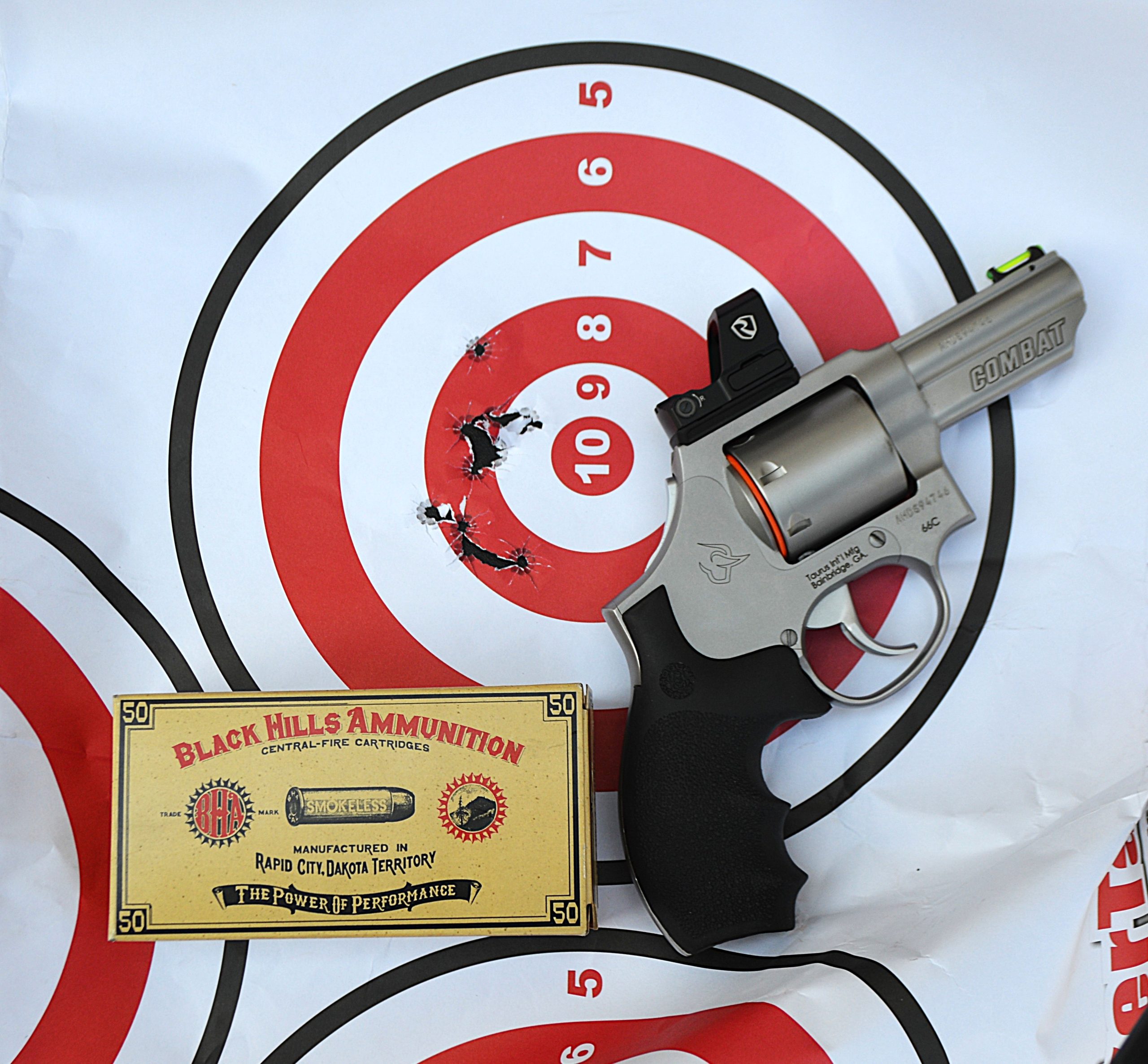
The 4 TACTIXX MPRD XL features ten brightness settings. The dot is green. For some shooters green wavelengths work better than red. With the Riton sight there are no complaints concerning a small sighting window or fewer options. I mounted this sight on the Taurus 66 Combat. With the Taurus mounting system all that is needed is to screw on the mounting plate and then bolt the red dot sight in place. There is an obvious concern, there is no co-witness for backup sights. This is as big an issue as you make it. While I prefer a backup sight set up, modern PMOs are very reliable.
The Riton optic tested features a rudimentary back up sight. Sight picture and sight alignment no longer depend on a sharp front sight and a blurred rear sight and target. Put the dot on the target and keep both eyes open. As for long range shooting I have done a good bit of shooting with the Taurus 66 Combat and Riton combination. Results have been good to excellent. A revolver front sight will cover a good portion of the target at 25 to 50 yards. Some front sights are so wide they subtend the target making accurate shooting problematical. On the other end of the spectrum red dot sights are viable in dim light and dark conditions. The dot doesn’t disappear in a dark home during a defensive encounter. A real advantage comes when red dot sights are mounted on defensive revolvers as most of these revolvers feature a fixed sight. A simple groove cut into the top strap isn’t the best choice for fast reactive shooting. Top of Form
In revolvers, close range advantages are not negated by a red dot sight. Simply press the revolver muzzle into a threat’s body and fire time after time if need be.
Animal attacks are common. They come on quickly and the muzzle in the body tactic has proven successful. A red dot sight doesn’t interfere. Speed is increased proportionately more in the revolver than the automatic compared to non PMO type handguns in my opinion. In firing the Taurus 66 Combat extensively as an example the fact that the optic is fixed and does not reciprocate with a slide seems an advantage. In tracking the target after each shot the red dot comes back into view much more quickly. There is no downside to the PMO revolver in shooting terms. With the evolution of the optics ready holsters carrying the revolvers isn’t difficult. I have carried the exceptional Taurus 66 Combat in a ANR Design (Anrkydexholsters.com) IWB .
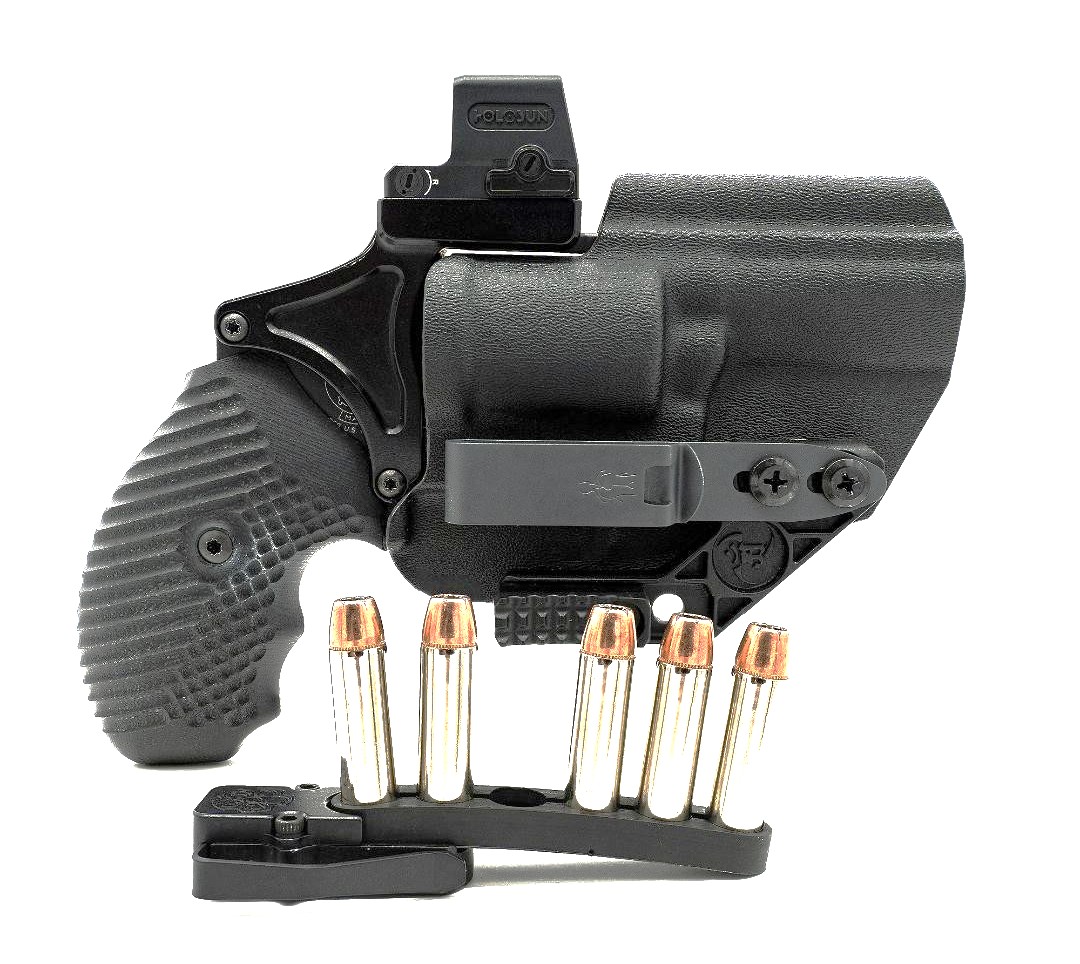
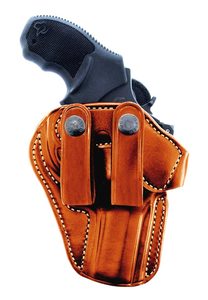
There is no downside in concealed carry. The draw is sharp and the optics ready holster is properly designed for a sharp draw. Good quality Kydex makes an efficient load bearing device for these revolvers. Galco offers the Hawkeye for small frame Taurus revolvers- and many small automatics.
Drawbacks and tradeoffs with the revolver red dot are similar to the automatic pistol’s considerations. In automatics, I adjust red dot focus by bringing the muzzle of the pistol down and with some revolvers I bring the muzzle up. Another concern is that an optic makes the revolver’s height greater. A pocket gun isn’t the place for a red dot, but then we don’t mount a dot on the slick slide Glock 43 either. A downside at present is that not every revolver we really like is optics ready.
D&L Sports offers services to made your revolver optics ready. Taurus offers the factory T.O.R.O. It isn’t inexpensive to add a red dot to an existing handgun considering the need to drill and tap the top strap and the price of a red dot sight but this isn’t revolver specific. In the end it is up to the user and their preferences.
As for myself the factory optics ready Taurus 66 Combat is my choice, and a great—even fantastic—choice. A final concern that I don’t think is viable is how some feel that .357 Magnum recoil may be hard on an optical sight. I don’t think that this recoil is as hard as the impact of a reciprocating slide. Carefully consider your needs and you may find the red dot revolver is at the top of your list.