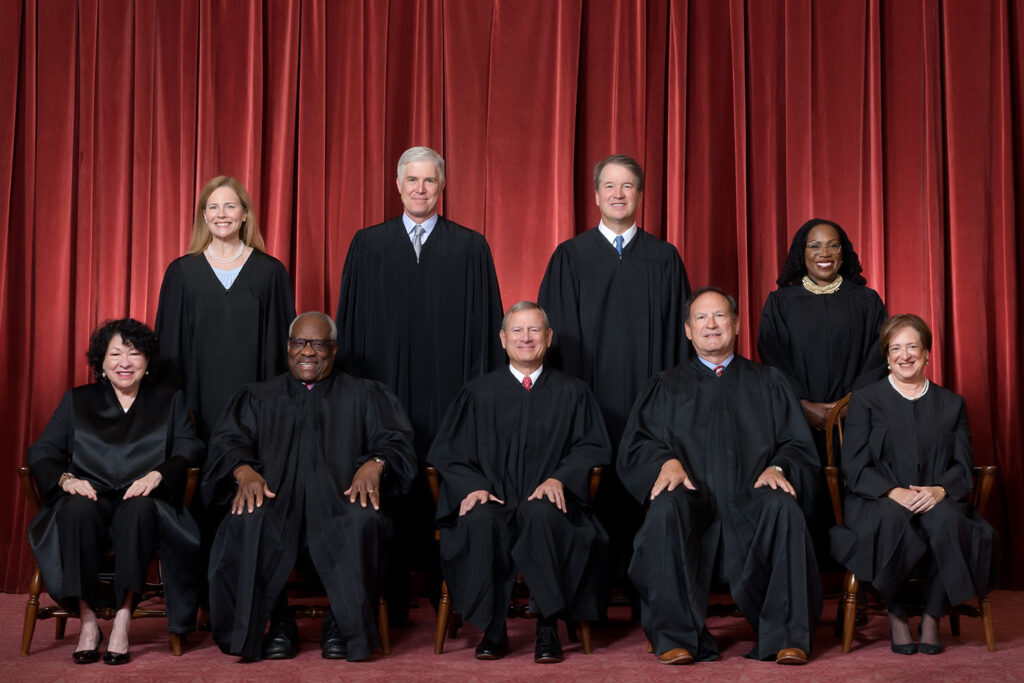
Standing from left are Justices Amy Coney Barrett, Neil M. Gorsuch, Brett M. Kavanaugh, and Ketanji Brown Jackson. (Credit: Fred Schilling, Collection of the Supreme Court of the United States)
By Dave Workman
Editor-in-Chief
The U.S. Supreme Court on Monday denied to review a case challenging the Illinois law prohibiting legally-licensed citizens to carry firearms on public transportation, including buses, trains or any other type of transportation supported by public funds.
The case is known as Schoenthal v. Raoul. As a result, Illinois lawmakers—and legislators in other states—have essentially gotten a green light to expand so-called “sensitive place” designations in an effort to disarm as many people as possible, at least in some areas.
The case had been supported financially by the Second Amendment Foundation.
According to KTEN News, attorneys representing the three plaintiffs in the case wrote, “There is no historical tradition of banning law-abiding citizens from possessing firearms in crowded public locations where they may be more vulnerable.”
Writing at SCOTUSBlog last month, Alex Rivenbark noted, “Many states and municipalities have regulations restricting the carrying of firearms in a variety of locations, including places of worship, parks and zoos, public transportation, and places where alcohol is consumed. These cases thus highlight two interrelated questions: what, exactly, qualifies as “sensitive,” and why?”
For the time being, that question will remain unanswered.
The high court has been reluctant to take several hot button Second Amendment cases including challenges to bans on semiautomatic rifles and original capacity magazines.
“According to the gun owners who brought the lawsuit,” Rivenbank wrote, “history demonstrates that individuals retain their Second Amendment right of self-defense in public spaces unless the government decides to bear the burden of securing them (typically by supplying things like armed guards and metal detectors) – therefore, only places where the government has assumed such a burden may be deemed ‘sensitive.’”
The case dates back to 2022, and over the course of the past four years, SAF officials have maintained that the prohibition violates the Second Amendment.
“There simply is no historical support for the idea that all modes of public transit are ‘sensitive places’ where carry can be banned,” SAF Executive Director Adam Kraut stated previously. “Lower courts have struggled with understanding what a ‘sensitive place’ actually is and how limited their scope must be under the Second Amendment. This case is a great opportunity for the Court to clarify the proper unifying principle and correct the circuit courts that have gone astray.”
“This case asserts the Illinois Public Transportation carry ban cannot stand unless it is consistent with the historical tradition of firearms regulation at the time of the ratification of the right to keep and bear arms,” noted SAF founder and Executive Vice President Alan M. Gottlieb at the time. “It is abundantly clear the defendants can’t provide such information, and in their response, they have failed to offer any Founding-era evidence supporting the ban.”