
By Mike Nesbitt | Contributing Editor
Recently Mike Holeman and I shot side-by-side in one of the Lever-Gun Matches put on by the Black River Buffalo Runners at the Capitol City Rifle & Pistol Club near Olympia, Washington.
Those matches are a whole lot of fun, shot with lever action rifles, most often in .44-40 caliber, and loaded with black powder under cast or swaged lead bullets. We try to hold one of these matches per month and they are a whole lot of fun, usually completed before noon on a Saturday morning. A very friendly and yet still competitive shooting match.
At this particular match, we shot at paper targets for what we call an aggregate match. We hold six of these aggregate matches per year. At the end of the year, the best five match scores per shooter are added up to determine the placements for the yearly aggregate. Only five matches are tallied so shooters can miss a match and still be in the running. For shooters who have shot in all six matches, their lowest score can be deducted so they use the best five scores out of the six events. That’s just another way to add to the fun.
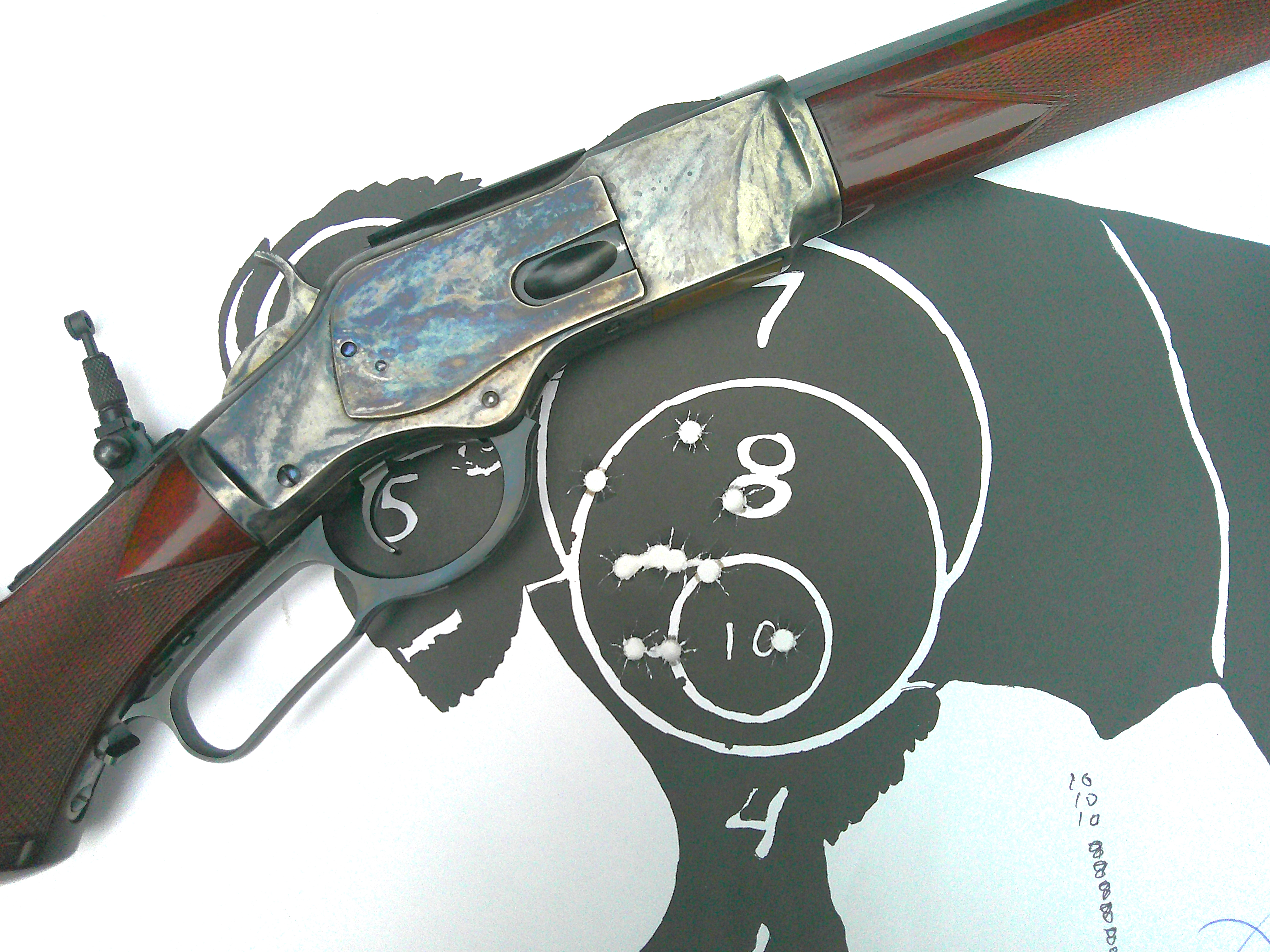
The rifle I’ve been using in these Lever-Gun Matches for the last few years is my Uberti 1873 (copy of the Winchester ’73) in .44-40 caliber with the 30-inch barrel. These were ordered and imported by Cimarron Fire Arms and I do trust and really like this rifle. Holeman’s rifle is basically a twin to mine and we both admire the performance those .44-40s deliver.
Specific Loads
Both of us were using our .44-40s with our favorite black powder loads, throwing 205-grain cast bullets which were seated over 35 grains of Swiss 3Fg. Those bullets were well lubed. I was using Vigilante #1 and Holeman used a very similar home brewed lubricant. And ignition was supplied with large pistol primers (which are standard for the .44-40).
While our rifles did not let us down, both of us shot targets which declared that we were shooting a bit to the left. My “buffalo” target, for instance, which is shot at from just 50 yards, from a sitting position while using cross-sticks as a muzzle rest, held a rather good score of 86-X for ten shots. But even though the grouping of my shots did please me, only three of those ten shots were 10s. The other seven shots were all 8s, there is no 9-ring. If my group was just a bit more to the right, it would have added up to a higher score.
Holeman was somewhat in the same boat, he also needed to re-sight-in his Model 1873, another .44-40, in order to see about getting higher scores on his targets. With those higher scores in mind, we met at the rifle range with our lever-guns to make those slight changes in the windage alignment of our gun’s sights.
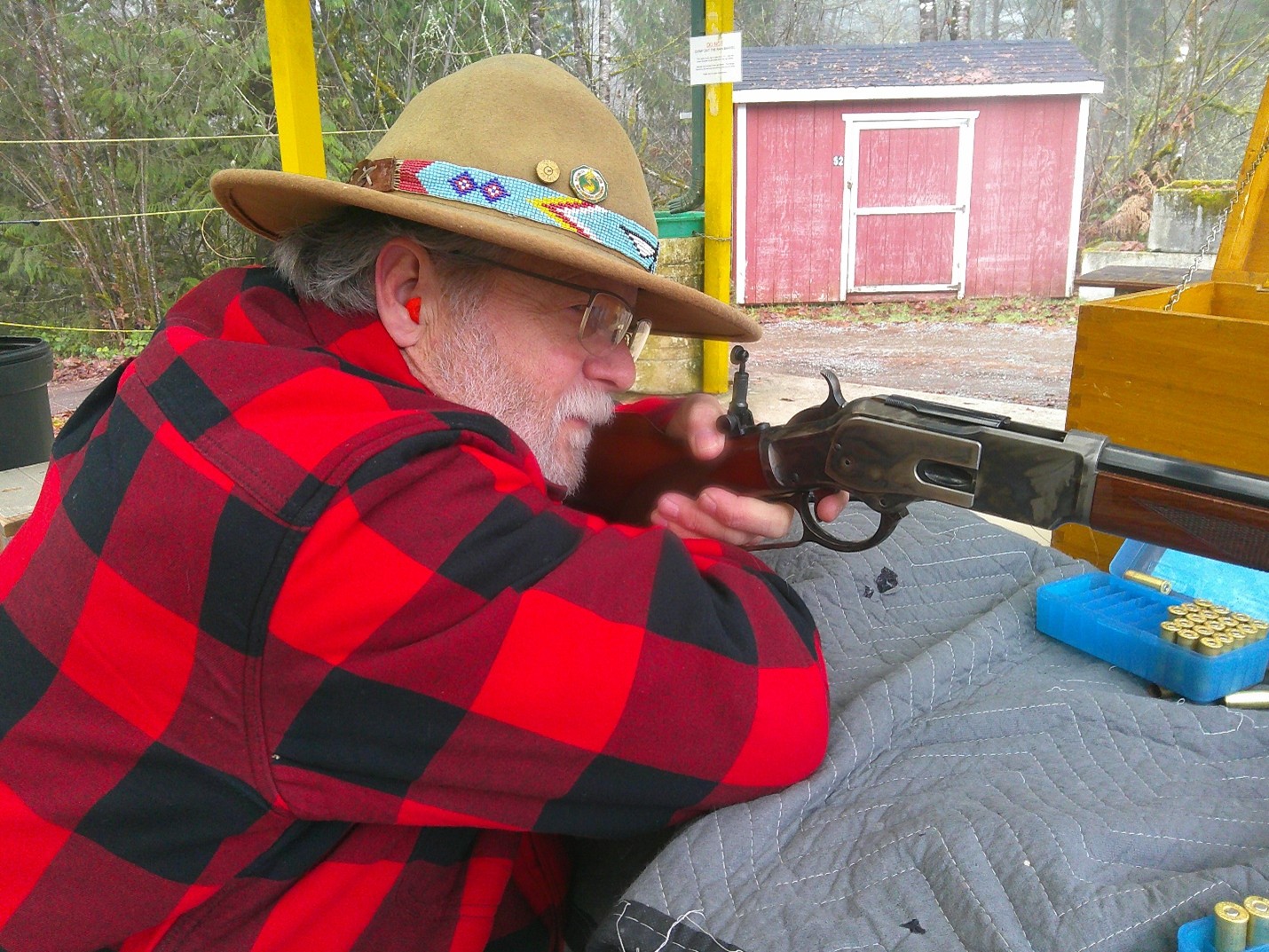
The January morning we picked to do some shooting was simply not the best. It was cold! Not terribly cold but, for me, very uncomfortably cold. I was quickly reminded that “old” and “cold” rhyme in a chilling way. On top of that, it was foggy, with fog thick enough that a couple of our shooters who wanted to shoot targets out on the 200-yard line simply gave up and quit. Not for Holeman and me, we were just going to shoot at 50 yards, so we pressed on.
Even though Holeman and I had similar tasks to accomplish, we had to go about it in different ways. The reason for that is because our rifle’s sights are not the same. My ’73 is equipped with a Lyman Number 2 tang sight which has no windage adjustment. One way to made a windage change with the Lyman sight is to shim it on one side, which is done by loosening the sight at the rifle’s tang and adding some shim stock underneath the sight’s base so the sight will lean to the side desired. That will make a change and I needed my bullets to strike more to the right.
Sight Adjustment
Another way to adjust the windage with a rifle such as mine with the Lyman rear sight is to drift the front sight in the dovetail in the opposite direction, move the front sight to the left to help the bullets to strike the target more to the right.
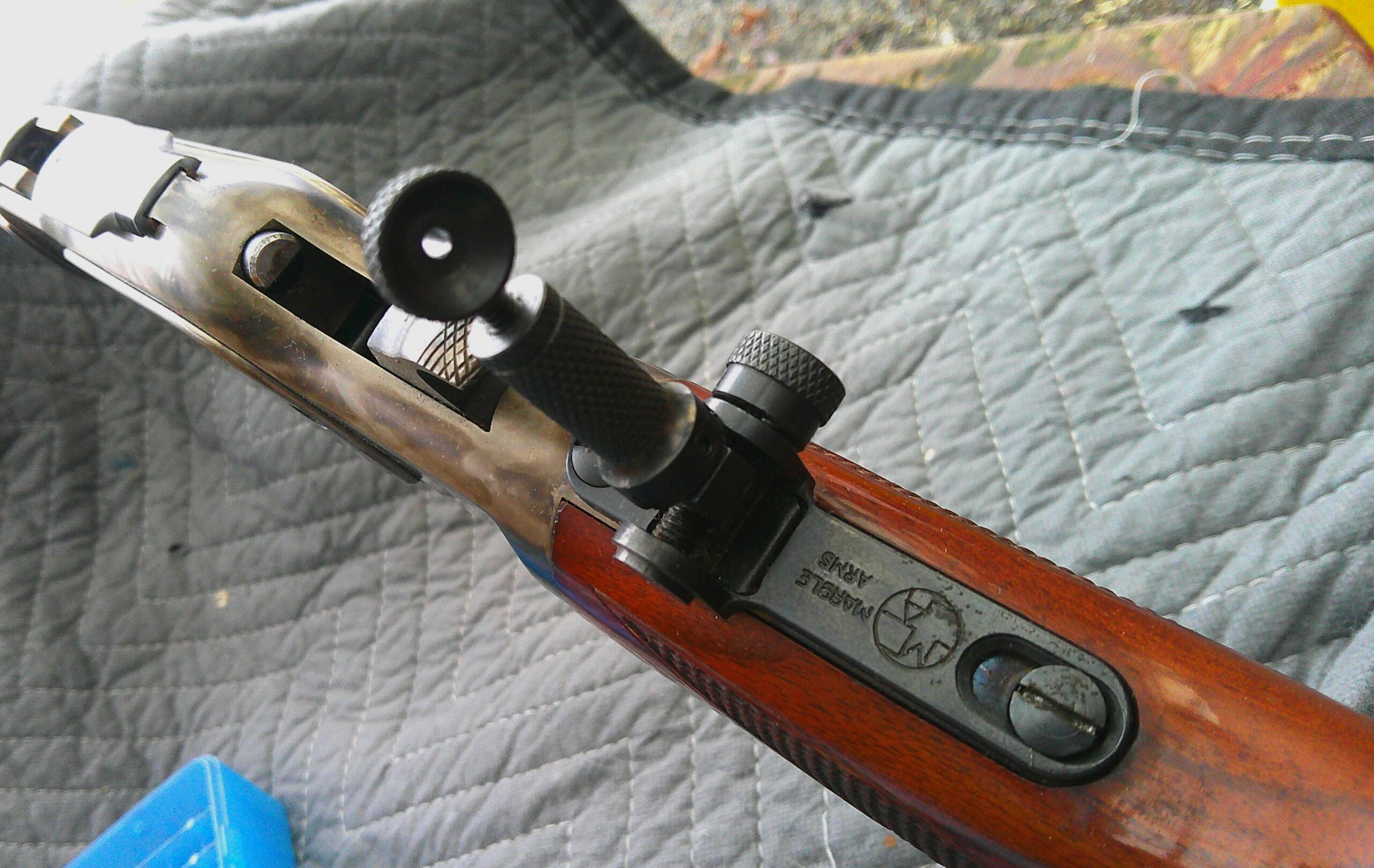
Holeman’s Model 1873, on the other hand, is equipped with a Marble’s tang sight, one of the new sights by that manufacturer, and those tang sights do have windage adjustments. So, for this task, Holeman had it easier than I did, all he needed to do was to adjust his rear sight a click or two to the right, and then shoot the rifle to see if that was enough. He had it good and was soon finished with his sighting-in while I was just getting started.
For me, it was a longer process and I began, shortly after getting to the range, by asking Holeman if he had any “blacksmith tools.”
He looked at me funny and said, “Well, yes but I don’t have them here.”
I had to explain that “blacksmith tools” is a slang expression for the tools needed to adjust barrel/dovetail mounted sights, commonly called “iron sights.” Usually a hammer and a drift, for moving those sights to the right or left. “Oh, yes!” Holeman replied and he quickly handed me a small screwdriver plus one of the newer Wyoming Sight Drifter tools. Those fixed me up because I had decided to move my gun’s front sight to make the windage adjustment.
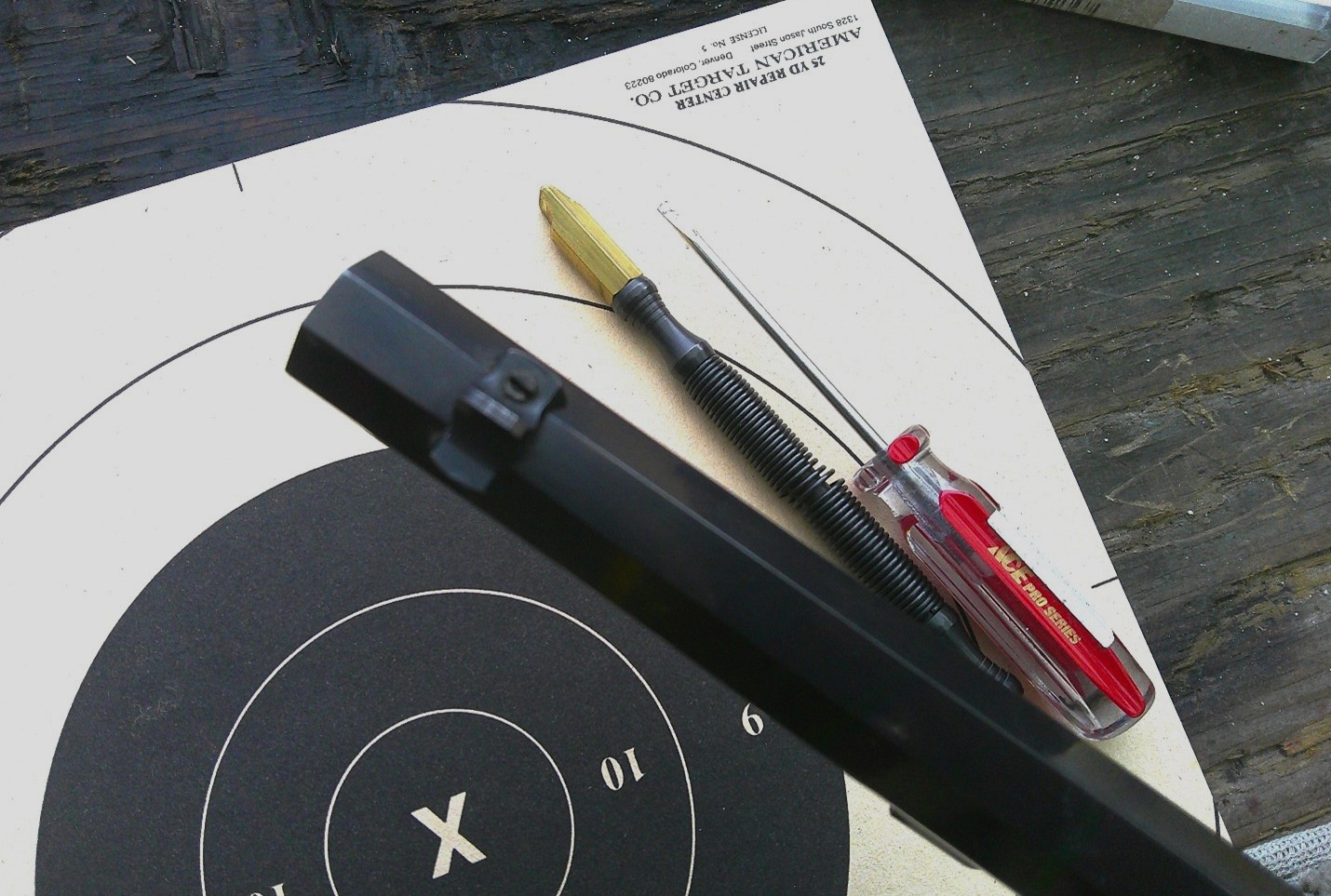
The small screwdriver was needed because the front sights on the Uberti lever action rifles, not the carbines, have a set screw which really should be loosened before trying to drift the sight right or left in the dovetail. (I have those tools as well but at that moment they were in my pistol shooting bag which was not with me that morning at the range.)
So, the set screw on the front sight was loosened and the Wyoming Sight Drifter was used to move the front sight to the left. That would move the bullet’s impact on the target to the right. As most always happens, that sight was moved too far. This was quicky determined by shooting three shots at a target, out at just 50 yards, firing the rifle from the bench. The bullets did impact to the right but too far to the right.
If the rear sight was to be moved to adjust or correct the windage, it would need to be moved in the direction that the bullet’s impact was wanted. In other words, to move the point of impact to the right, move the rear sight to the right. In the case of my ’73 in .44-40, it was easier to move the front sight than to shim the Lyman rear sight.
And it was just as easy to move the rifle’s front sight back to the right just a little bit. Once that was done, three more test shots were fired, on the same target. That was better but still a bit too far to the right, so it was drifted another tiny bit to the right, to bring the group just a little way back to the left. Again, three more shots were fired and those looked pretty good. With that done, the set screw on the front sight was tightened once more and the rifle’s sights should be in a very good alignment.
Another Target
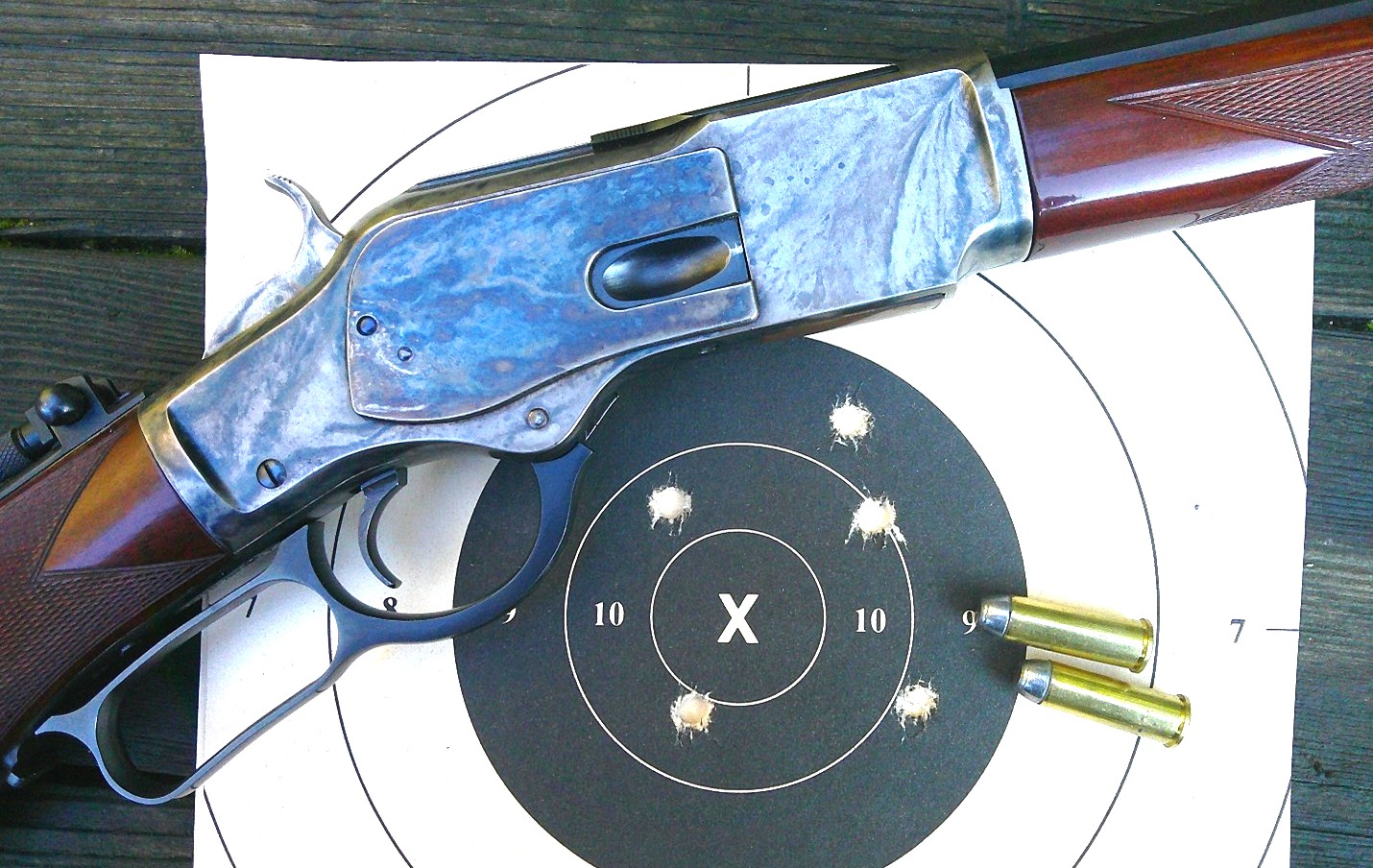
In order to prove that, another target was posted at 50 yards and five shots were fired at it from the shooting bench. Those five shots, I hope you will agree with me, do show that the sight alignment is pretty good. I did expect a tighter group and I don’t know if shooting in the morning fog played tricks with my eyes or if I was simply shivering from the cold which was mentioned earlier. At any rate, the fairly wide group with these five shots are rather well centered and not all to one side of the bullseye.
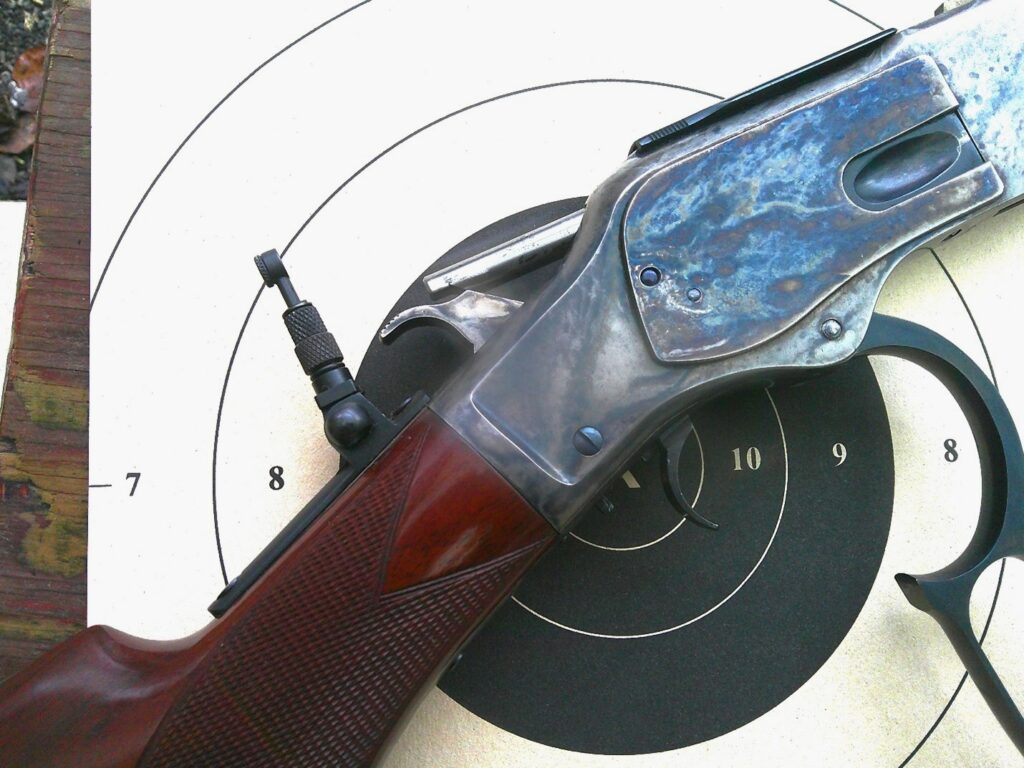
Let me continue this story just a little more by admitting that I did shoot five more shots at another target, trying to get a better group than what is in the photo. Those five shots were trying to fall into a tighter group, at least three of them were. Two of the shots were rather wide but still in the black. But the results were not what I had hoped for and no photo was taken. By then I was even colder and a hot lunch was much more inviting than more shooting. On that last point, Mike Holeman completely agreed with me.
This short tale was written mainly to describe the methods for adjusting the sights on those good shooting lever-guns. Also, because it has been so long since I’ve seen written directions on how to align iron sights by drifting them in the barrel’s dovetails. It isn’t hard to do, especially with the Wyoming Sight Drifter. While it isn’t hard to do, so many shooters will try to move the sights in the wrong direction, which, of course, only makes things worse.
Adjusting the sights on any rifle is certainly necessary for good shooting. For me, new rifles seldom hit where I want them to with the first try. And, like I tell so many shooters who have a recently acquired rifle to shoot, “don’t be afraid to adjust the sights.”