By Mike Nesbitt | Contributing Editor
It might be difficult to believe that anything new could be said about the .44-40 in revolvers because this “rifle” cartridge has been chambered in the Single Action Colt, as well as other revolvers, ever since 1878, nearly 150 years.
So, actually, it isn’t my main intention to say something really new about this old combination (rifle & revolver) caliber but I will certainly be saying some old things over again. The reason I say it that way is because this look at the .44-40 in revolvers will be focused on black powder loads, with lead cast or swaged bullets. In a way, that makes the .44-40 rather special and, in my opinion, it shows the .44-40 in a six-gun at its best.
The .44-40, of course, is a very historical cartridge. So, it is best that we start with a little of that history. This cartridge was introduced by Winchester in 1873, along with their Model 1873 lever action rifle. It was the very first centerfire cartridge designed for a repeating rifle. But it actually had a rather slow start and only 18 of the new guns were sold before that year ended.
One of the problems which had to be overcome, as I understand it, was that cartridges were firing while in the tubular magazine. Let’s remember, back at that time the .44 Henry rimfire cartridge was commonly loaded with pointed bullets. If those pointed bullets were tried in the centerfire .44-40, that would lead directly to having ammunition detonated in the magazine, either from the jarring effect of the rifle being fired or even more likely when the action was cycled which allowed cartridges in the magazine to move back quickly, under the magazine spring’s tension, when the cartridge elevator accepted another cartridge. That problem was solved with the development of the flat-nosed bullets for use in the Winchester’s tubular magazine.
After that rather slow start, the .44-40 in the Model 1873 Winchester began to really catch on. Sales grew and the rifle was very popular. That was when revolvers in the same caliber were considered.
Colt added the .44-40 to their Single Action Army revolver in either late 1877 or in 1878. Some have said the .44-40 in the “Frontier Six Shooter” was added in 1874 but we can easily expect that Colt was much too busy filling government orders for their new .45s to think about adding other calibers that early. My personal view of this introduction is to put it in 1878 just to be sure of things.
Lots of Sixguns
Several other revolvers were also chambered for the .44-40. Some, like the Smith & Wesson New Model Number 3 single action, were not popular and only a few were made. Curiously, the Smith & Wesson Number 3 double action was more popular in .44-40 caliber.
Likewise, the Colt Double Action Army of 1878 was also rather popular in .44-40. Remington had their single action revolvers, the Models of 1875 and 1890, which were both made available for the .44-40. I’m not going to try to put the numbers of the guns made in this story but these revolvers and more made the .44-40 “wheel guns” more than available in the Old West.
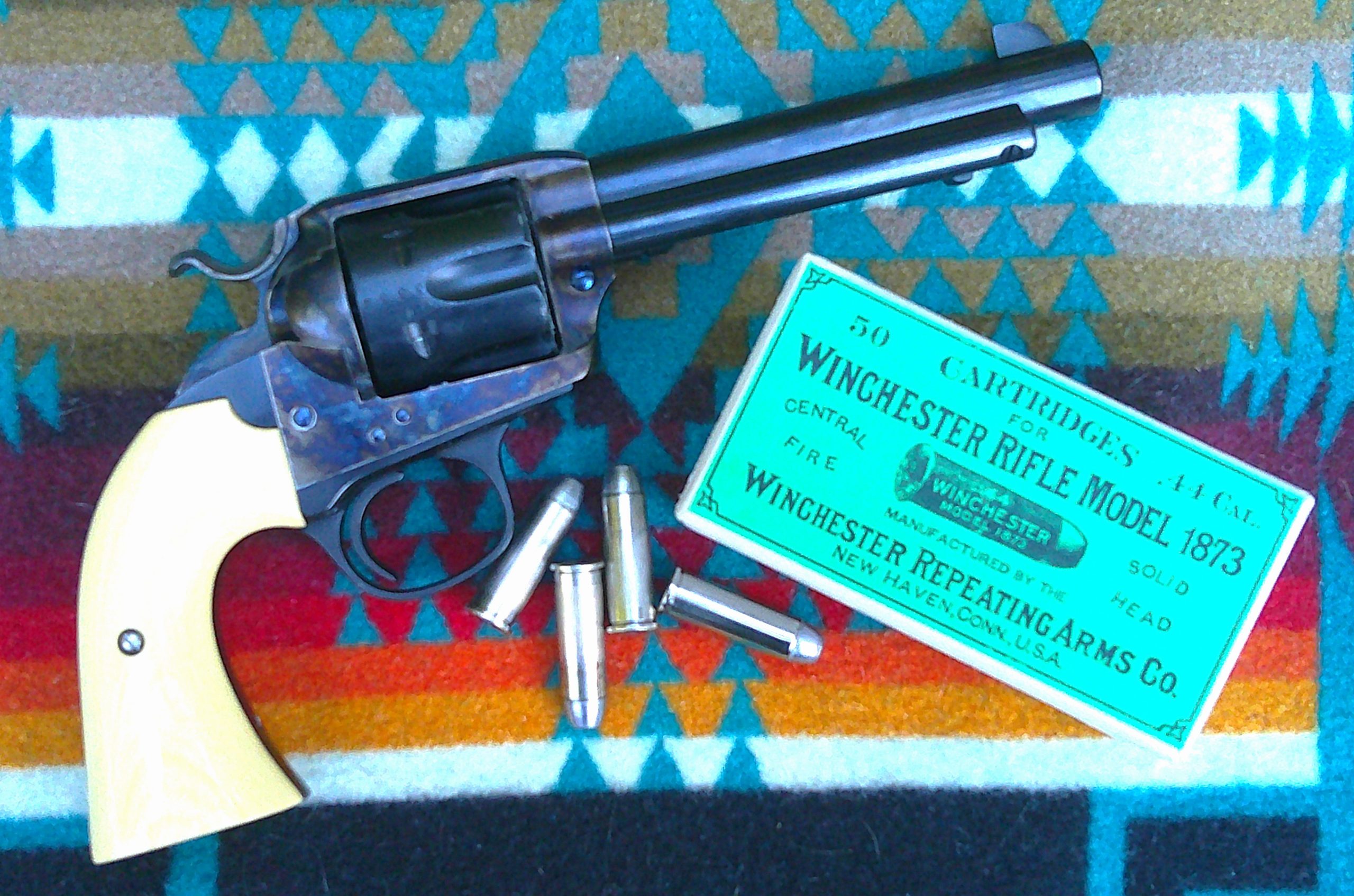
Later revolvers, and we’ll include the Colt Bisley among them, continued to chamber the .44-40. Those included the Colt New Service revolver and a few .44-40s were made by Smith & Wesson in their Triple Lock, the first N-frame revolver. Even later S&Ws, mostly commemoratives, have been made in .44-40 caliber but not as a standard chambering.
After a recess of about 40 years, Colt brought the .44-40 back to their third-generation Single Action Army. I bought one of those, with a 4 ¾” barrel, and I still have and treasure it. That gun rode my side for several years and I made a number of memorable shots with it.
Today there are several revolvers available for the .44-40 and perhaps we can thank Cowboy Action Shooting for that. All, or at least most all, are replicas of the guns from the 1870s and 1880s, single action revolvers. Those include two versions of the Smith & Wesson #3 six-guns, the American and the Schofield. In a way, that surprises me because neither of those two S&Ws were originally made for the .44-40. The old New Model #3 did have a .44-40 version, the frontier with the extended frame and cylinder, but that one is not replicated today. Taylor’s & Company did have the top-break frontier version in .45 Colt and in .44 Special but that one is not currently offered, I really wish it still was.
There is a way for the shooters of the imported top-break .44 Russians to convert their six-guns to .44-40 caliber. The way to do it is to simply buy a .44-40 cylinder meant for the Schofield and put it in the #3 Russian Model. The new cylinder should fit right in although a final fitting might be required. The new cylinders are available from VTI Replica Gun Parts (VTIGUNPARTS.com).
The most popular of the .44-40 revolvers available today are certainly the copies of the Colt Frontier Six-Shooter, otherwise called the Colt Single Action Army. And among those, if I might say so, the very best was the Flat-top target version as made by Uberti and offered by Dixie Gun Works. That model is no longer available, simply not in stock. I asked Dixie if more would be coming and no answer has come back, so I’m afraid that gun might be “off the list.”
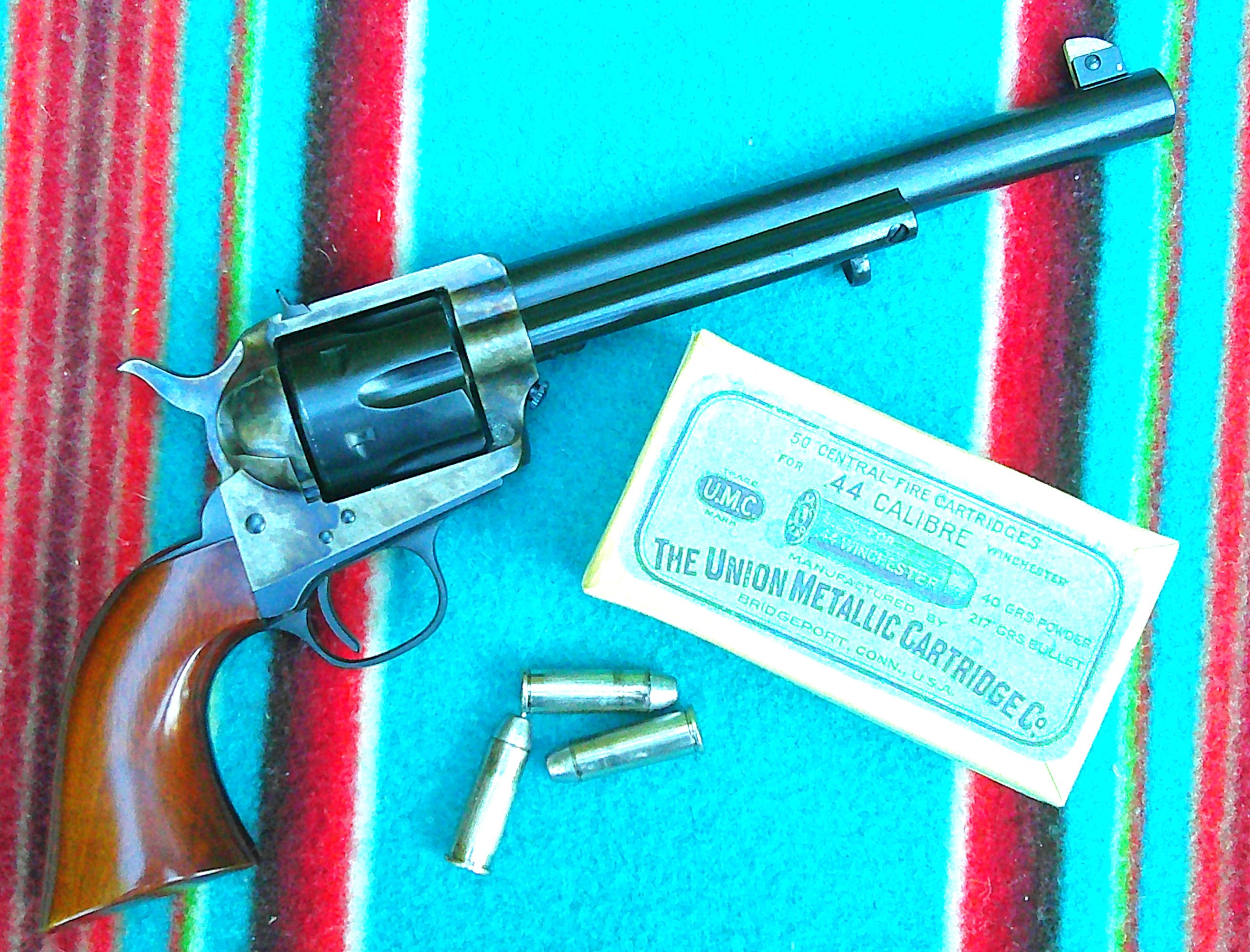
That was the best because of the adjustable sights, both fore and aft, with changeable windage on the rear sight and elevation with the front sight, and for the wide trigger, which was made just for that gun, as it was for the original Colt Flat-tops. I have one of those Flat-tops in .44-40 caliber, and .45 Colt was also offered, but I bought an extra cylinder for .44 Special and most often shoot mine with black powder loads in .44 Russian brass.
‘Cowboy Loads’
While I have given credit, at least some of the credit, to Cowboy Action Shooting for the return of the .44-40 to the revolver market as we know it today, comment must be made about the cowboy action loads for this old companion cartridge. Those cowboy loads are required to be below a certain velocity and, as a result, they are very “soft” when compared to full black powder loads. The “full-ness” of the black powder loads was recognized many years ago and at one time there was a reduced loading available, most probably for revolvers.
That was the “low velocity” black powder loading which was marketed by UMC in the very early 1900s which used a black powder charge of 28 grains under the standard 200-grain lead bullets. Very little literature is available about this loading, and it was not popular enough to be continued. So, it died a quiet death and disappeared from the ammunition lists. At this time, we can generally assume that the 28-grain loading was intended mostly for revolvers.
I tried a few handloads using 28 grains of Swiss 2Fg powder under a 205-grain cast bullet in my Cimarron Bisley Model. In my opinion, the reduced load was not reduced enough to be worthwhile. It still roared. Another factor is the gun’s recoil with black powder loads and the 28-grain loading did not have a real noticeable reduction in the gun’s kick.
There was, however, a certain reduction in the bullet’s velocity. Those loads crossed the chronograph at an average of 821 feet per second which is substantially lower than the velocity obtained with full black powder loads.
Accuracy Counts
For an excellent example of accuracy with the .44-40 in a revolver, I’ll call on my friend Allen Cunniff. He shoots one of the .44-40 flat-top replicas made by Uberti with a 7 ½-inch barrel and he does remarkably well with it while using full black powder loads. Allen is a bit younger than I am, his hands conduct a steadier hold while shooting, he has better vision than I, and on top of all that, he’s certainly a better shot.
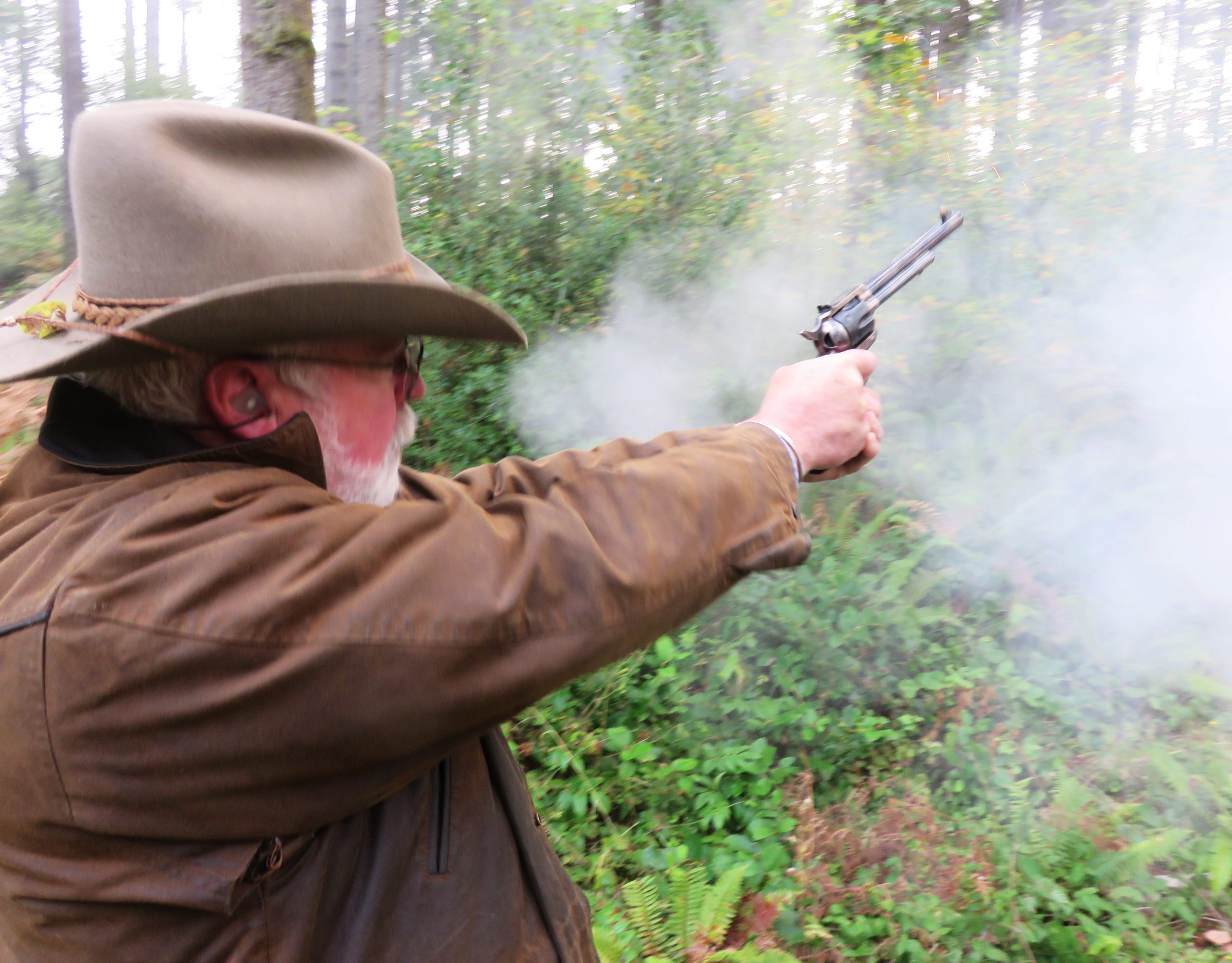
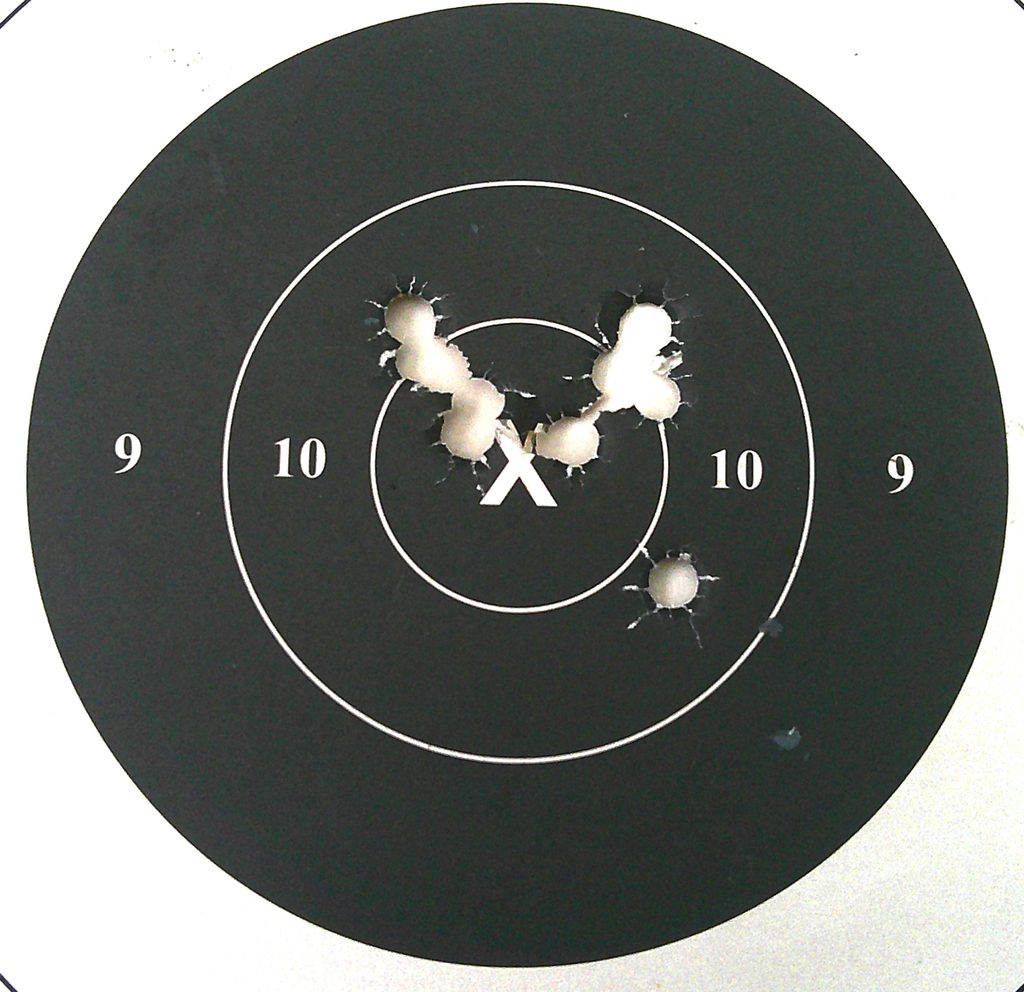
Our club recently enjoyed a shooting match with our revolvers using black powder loads. Allen entered that match with his .44-40 and swept away all competitors with his score of 100-7X on the bullseye target. This match needed ten shots, fired offhand at just 10 yards. We can say that distance is rather representative for a handgun match and my own score, shot with my accurate .36 Navy, was a 99-3X which satisfied me but it was certainly a distant second place.
Allen’s load used the 215-grain bullet, from Accurate Molds’ #43-215C, over 34 grains of Swiss 2Fg powder. That has enough muzzle blast that other shooters give Allen more space when he is on the firing line. And the accuracy of that load cannot be criticized.
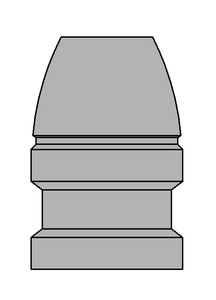
When Allen was asked for some comments about shooting his .44-40 revolver with those full black powder loads, he replied with the fact that there is a tendency for case splitting after a number of times being reloaded and the nickel-plated cases do not seem to last as long as the brass Starline cases. He added that the brass cases seem to go on forever. And he says the 215-grain bullet is a must, for both rifles and revolvers. Other than that, the .44-40 is a fun cartridge to play with.
My own shooting with the .44-40 in a revolver has been on the upswing lately, using my copy of the Bisley Model with the 5 ½-inch barrel and the ivory-like grips. That gun, I’ve mentioned before, needed the front sight lowered, which was done slowly with a file, in order to bring the hits up to center. That was done with another cylinder while using .44 Russian loads but following that the .44-40 cylinder was put back in and the shooting has continued.
The load I like using is the same load that is favored for my Model 1873 rifle which uses the 215-grain bullet that Allen favors but mine are loaded over 35 grains of Swiss 3Fg powder. Over the years, I have used a chronograph to speed check my loads several times but had never checked the speeds of either the 215-grain bullets or the powder charge using Swiss 3Fg from a six-gun, so that was done shortly before this story was concluded.
While I do mention “full black powder loads” those do need a short explanation. The original full loads used 40 grains of black powder. But those were in balloon-head cases. Those are hard to find these days and the solid-head cases have less powder capacity. My loads with the 35 grains of Swiss 3Fg generally chronograph faster than the old, published ballistics when fired in my .44-40 rifles. Therefore, I do believe they deserve the description of “full loads.”
For a good speed check, ten new Starline nickel-plated cases were loaded with the 35-grain charge of Swiss 3Fg powder, a card wad, plus the 205-grain bullets. (The 205-grain bullets are just a little shorter in the nose than the 215-grainers.) The new Starline cases were used simply for consistency and the powder charges were all individually weighed. Those were taken to the range and fired in the Bisley with the 5 ½-in barrel. The average velocity for those ten shots was 980 feet per second. Highest velocity recorded was 1006 fps and the lowest of these ten shots was 956 fps, for an extreme spread of 50 fps. That is good performance from any revolver, black powder or otherwise.
The roar, muzzle blasts, and recoil from a .44-40 revolver using full black powder loads is certainly manageable but it is also more than what most shooters expect. The .44-40 makes a big six-gun, keep a good grip on it when you shoot. It will really do the job and don’t be surprised if you like it.