By Dave Workman
Editor-in-Chief
The late Elmer Keith, who passed away more than 40 years ago, is widely recognized as the father of long-range hand shooting having proven beyond doubt—in front of witnesses—that it is entirely possible to hit a distant target with a revolver.
He didn’t just do it with a .44 Magnum, either. He managed to hit targets well beyond a hundred yards with wheelguns of other calibers, and I was especially impressed with his account of a caribou hunting adventure in far western Alaska as part of a polar bear hunt, and he used a pair of Smith & Wesson .41 Magnum sixguns to knock over a couple of animals. These were the first production N-frame revolvers in that caliber, according to his autobiography, Hell, I Was There.
Fortunately, a lot of folks picked up on Keith’s habit of banging away at far-off targets, and companies including S&W, Ruger, Colt, Taurus and Dan Wesson introduced models over the years with adjustable rear sights, good triggers, proper grips and very good barrels. As a result, a couple of generations of handgunners have continued a tradition of “dialing long distance.”

So, what calibers have emerged as the top choices for this sort of marksmanship? I think the .44 Magnum is probably tops, followed closely by the .41 Magnum. The .500 and.460 Smith & Wesson are in the running, and I’d have to say the .480 Ruger belongs on this list. Likewise, the .475 Linebaugh has earned a spot, and the .357 Magnum is certainly popular.
Over the years, I’ve had the opportunity to fire handguns chambered in most of these calibers, and since I don’t prefer to pound my palms with brute force, my personal choices would be the .41, .357 and .44, in that order, depending upon the particular revolver.
My recommendation is to use a double-action revolver fitted with a target-type grip, while a single-action can be fitted with a Pachmayr synthetic, which sucks up a lot of recoil.
Set Your Goal
Now, the next thing is to set your personal long range goal; that is, what would be your maximum effective range? I have personally hit targets out to about 300 yards, using a Model 57 S&W in .41 Magnum with a 6-inch barrel. The load, as I recall, consisted of a 210-grain Nosler JHP propelled by 20 grains of H110, ignited by a CCI 350 Magnum Large Pistol Primer. I’ve been assured I once hit a target at much longer range, having walked my shots out to that distance.

Hitting a long distance target is no small feat. I’ve spent time with guys who have demonstrated the skill necessary to do it, and they were very disciplined in their endeavors!
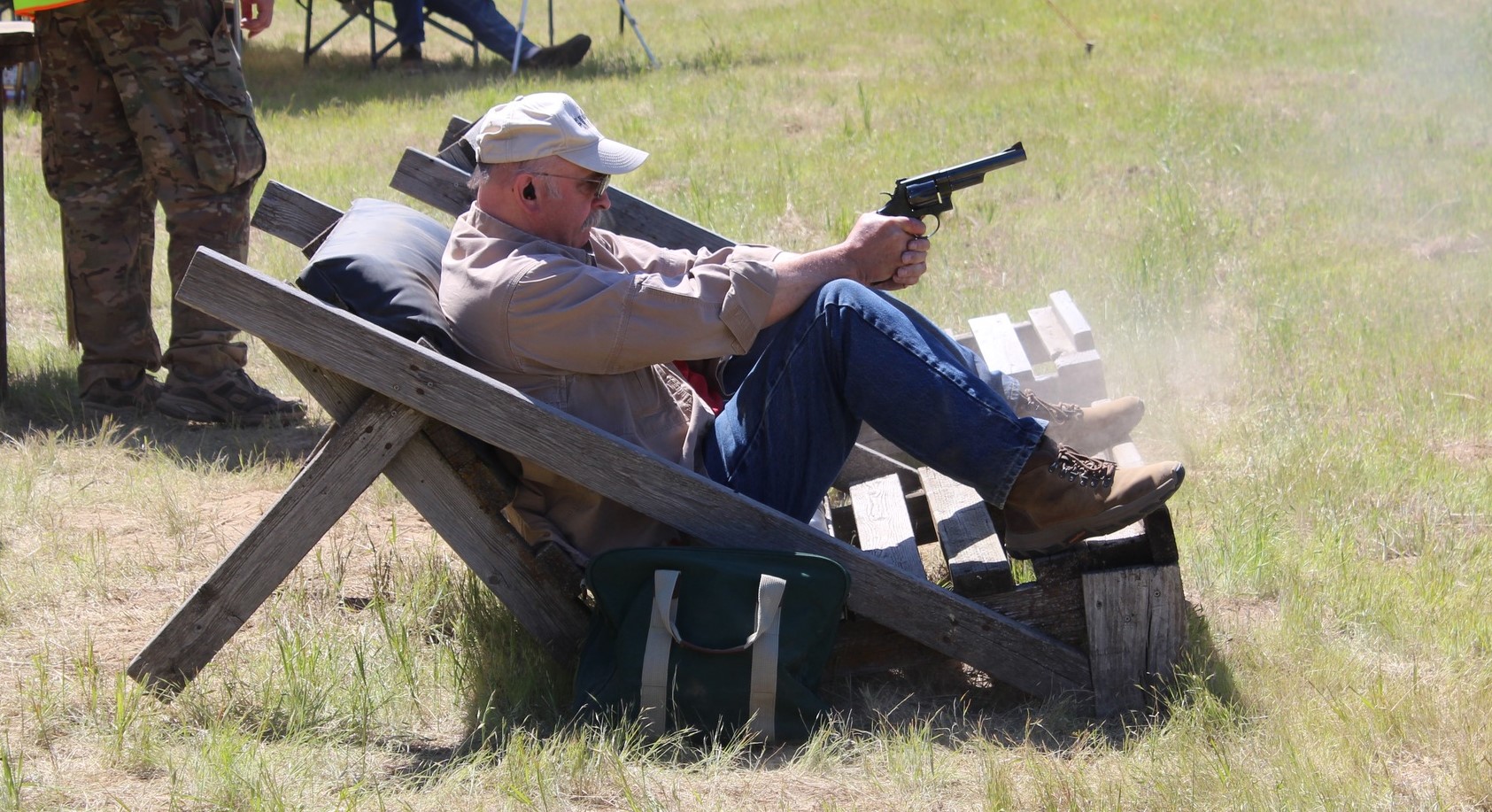
Start practicing at shorter ranges, say 50 or 75 yards, shooting off a good sandbag rest. Do this enough to learn where your bullets will actually strike on a target, at or near your actual point of aim. Say you’re firing at a 50-yard target and your point of aim is dead center, while your bullets are striking consistently 3 inches low and about four inches to the right. This is actually an easy fix, but do it in increments so you don’t over-adjust your rear sight. For starters, click up three or four clicks and left about eight clicks. Fire five for effect, and continue adjusting accordingly.
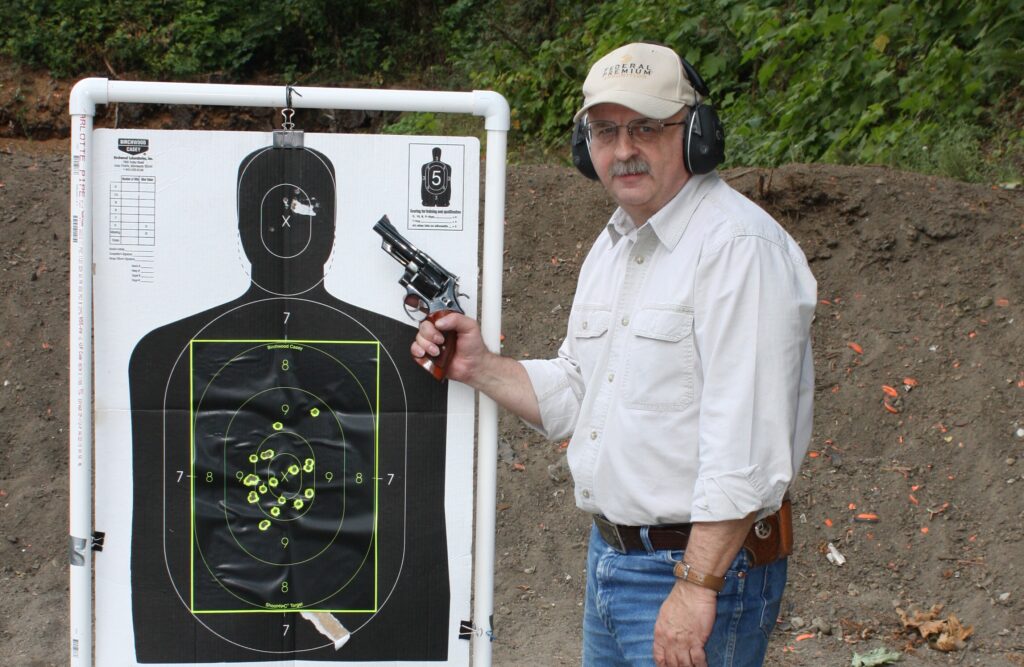
The adjustment formula is simple: to elevate the rear sight, turn the elevation screw counter-clockwise. To move the sight left, turn the windage screw counter-clockwise. To lower the sight, turn the screw clockwise, and go clockwise as well to shift the rear sight to the right. This works on Smith & Wesson, Ruger and Colt revolvers.
You should notice how the point of impact shifts in your favor, and all it takes is fine tuning.
I like to use a Caldwell sandbag rest, but you can make sandbags with the cut-off legs of old jeans. Stitch them together at one end, then fill a gallon-size plastic bag with a zip lock, seal it and stuff it inside the denim cover, then stitch that end shut. Instead of sand, some folks will use sawdust, and it seems to work just as well. The key is to have a comfortable rest.
Stick With One Load
If you’re going to shoot at long range, experiment with different loads, settle on the one which produces the most consistent results, and stick with it. If you reload brass, about every third time through the sizing die, you should check the OAL of the empty case and then trim to the length recommended in your loading manual.
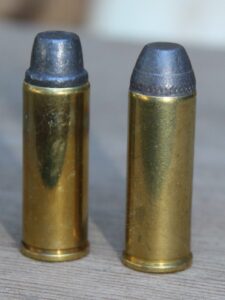
Clean the primer pockets! This is something I got turned onto years ago, and it really has resulted in a noticeable improvement when running brass through my progressive press, and on the range for positive ignition. I’ve got a pal who says his preferred long range wheelgun has never fired a jacketed bullet downrange. He uses nothing but hard cast lead SWCs, and I’ve fired a few. His particular load recipe is different than mine, but having seen him shoot, it definitely works in his revolver.
I’ve also seen the results of mixing loads, and it’s not going to do any favors for your precision to monkey around. Sometimes, you just get flyers.
About three years ago, I pulled my Colt Python out of the safe and started shooting a new magnum load using 158-grain JHPs instead of the 125-grainers I had used for years. Naturally, the point of impact changed with the new load, but I spent an enjoyable hour at the range making the necessary adjustments, and now I can confidently use that gun and load.
Wheelguns really do deliver the goods, but performance is really up to you. No sixgun can adjust its own sights, or pick its “best” load. That’s your job, and a fun job it is!