By Dave Workman
Editor-in-Chief
Name your poison, pardner: Single or Double action? Or would you care for one of each?
It’s a dilemma for which there may be no correct answer, other than to acknowledge there are pluses and minuses in each category, and depending upon your likes, wants and needs—with needs being highest on any list—it just might be one of the toughest choices a handgunner will ever make.
In my case, the solution was arrived at decades ago when I simply bought more than one, and mixed my caliber choices to include, not necessarily in this order, .38 Special, .357 Magnum, .41 Magnum, .32 H&R Magnum and .45 Colt.
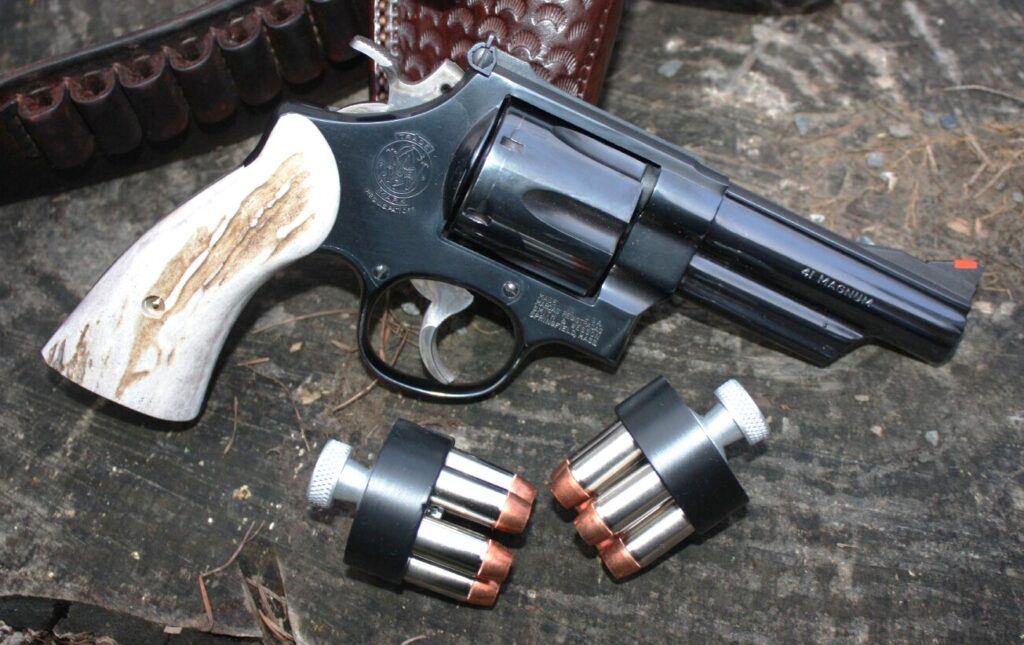
What, no .44 Magnum? Not just “no,” but (at the risk of being accused of blasphemy) “Hell, no” and for the simple reasons that the fabled .44 Magnum, the caliber championed by the late Elmer Keith and others among the “.44 Associates,” amounts to suffering a sometimes nasty recoil for the benefit of launching a bullet which is only 0.019-inch larger in diameter than the .41 Magnum, which actually lives up to its caliber designation by using projectiles measuring 0.410-inch. The “.44 Manum” is, in reality, the “.429 Magnum.” Clint Eastwood, eat your heart out.
The .44 Magnum’s case length is 1.285-inch while the .41 Magnum’s case is 1.290-inch. Yeah, I was willing to trade off having “the most powerful handgun in the world, which can blow your head clean off,” for a slightly flatter-shooting round with slightly less recoil, which could just as much damage with comparable loads, and enjoy being something of a maverick in the process.
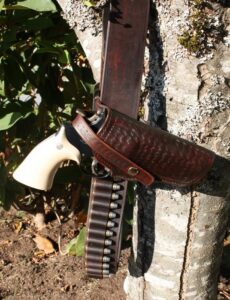
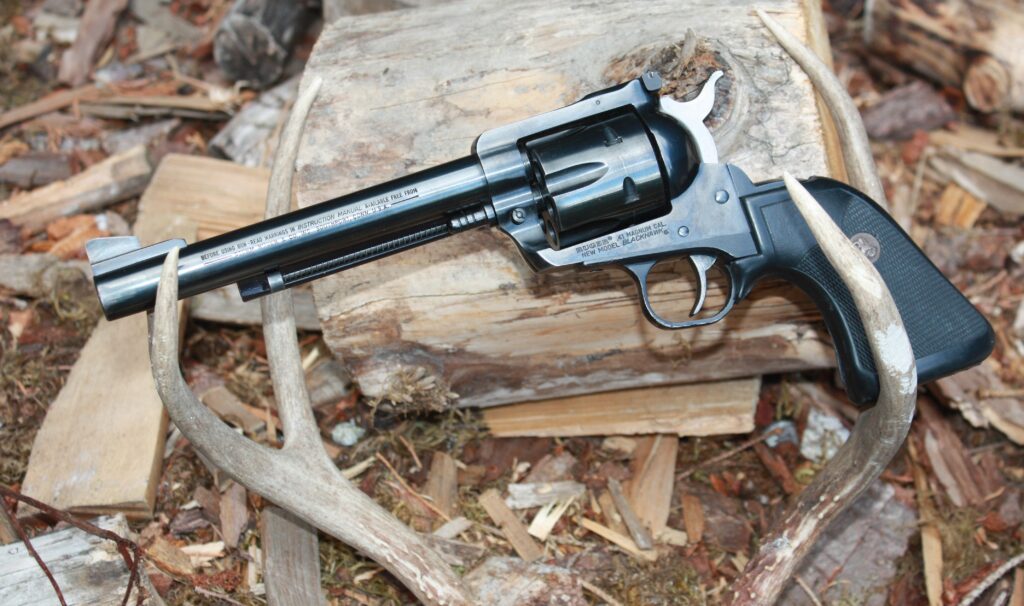
Moving right along, the single-action might be a better choice for wilderness/hunting adventures, perhaps with a slight taint of nostalgia tossed in. I happen to enjoy packing a single-action sixgun in a leather holster carried on a leather cartridge belt with each loop occupied, and there have been one or two occasions when the presence of a big bore sixgun seemed at the time to have been a deterrent to misbehavior.
On the other hand, it is widely known I’ve knocked around the back country with a double-action .357 Magnum or .41 Magnum from Smith & Wesson, and never really felt out of place. Of the two calibers, the .357 admittedly earns more favor, as more people can handle it comfortably, and for most jobs—whether defense against animals or two-legged predators—it has proven itself wonderfully capable.
When I was a kid reading Outdoor Life and Field & Stream, or was it Sports Afield?, I recall more than one story about somebody having to dispatch a black bear or mountain lion with a .357 and none of those accounts ended with the critter getting up and complaining the hunter didn’t use enough gun!
On my first trek to Alaska, I carried a Model 19 S&W chambered for the .357 Magnum stoked with full-house JHPs and never felt disadvantaged. And it was a double-action, which was far less important than feeling the weight of my wheelgun on my hip.
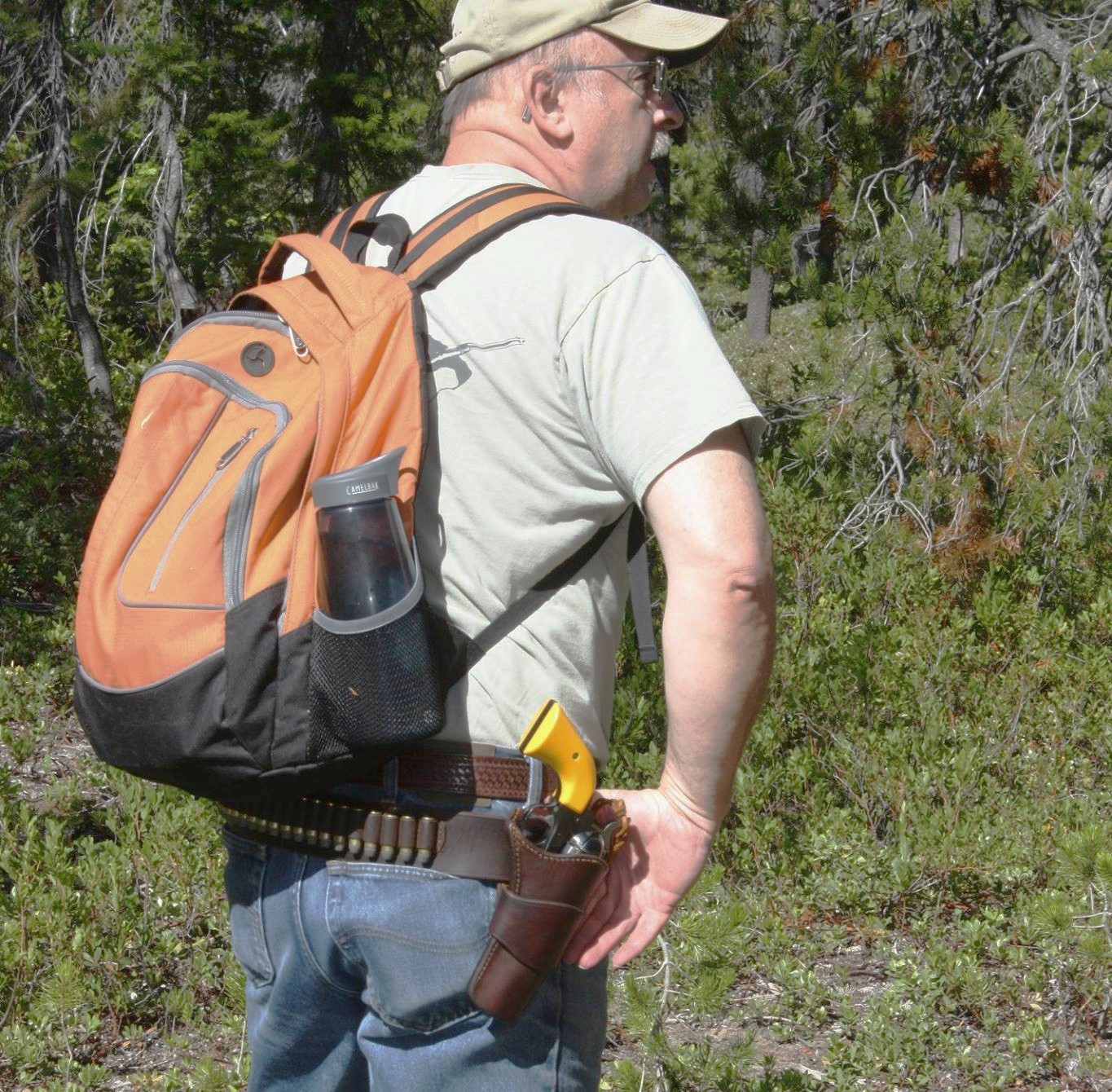
The single-action, while certainly more historic in context to the outdoors, has some drawbacks, the primary one being the time it takes to reload. While nobody is going to get into a firefight with a herd of deer, the process of booting out empties and putting fresh rounds in the chambers can be annoying.
The double-action can become a problem if the crane/yoke on which the cylinder rides in and out of the frame somehow becomes loose, perhaps by having the retention screw back out of the frame under heavy recoil. I’ve seen it happen.
Wheelguns—as I’ve said here many times—have the advantage of not needing a functioning magazine to do their business. One only needs spare ammunition to keep the revolver running, and this is no small consideration in a survival situation. If you wound up stuck in the boonies with a handgun as your survival tool, which would you rather have, a single-action Ruger Blackhawk .44 Special and a box of cartridges or a 10mm Glock with a malfunctioning magazine, or no magazine at all?
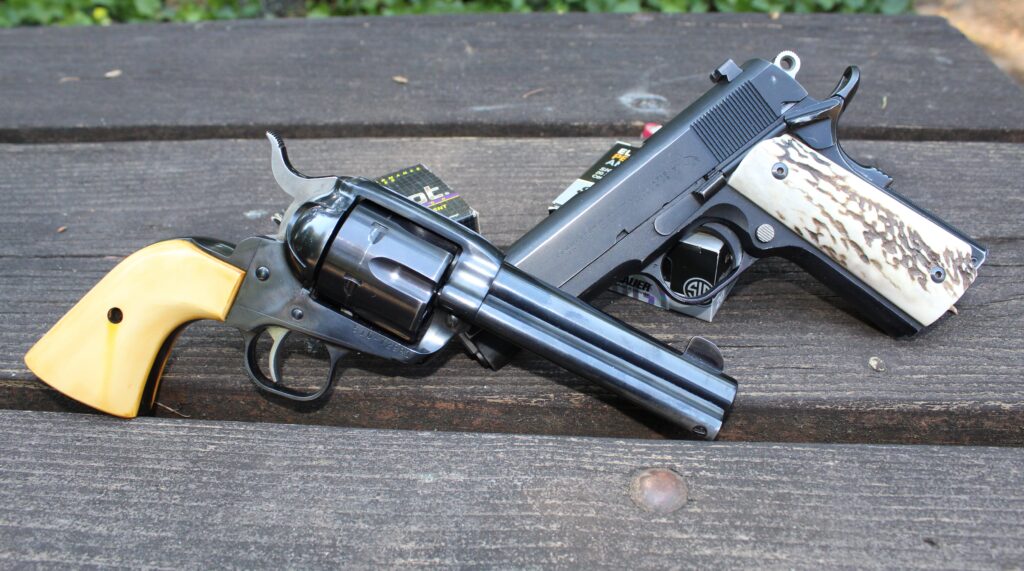
Single- and double-action revolvers are not difficult to shoot, and anyone with basic skills can do rather well with either. Semi-autos do require the strength to rack the slide, and for some folks, that can be a small problem.
I’ve had the good fortune to take up handloading, so I’m never without cartridges for my sixguns. Over the years, I’ve found certain load combinations which work for my purposes, and I use them in both single- and double-action wheelguns of the same caliber with no misgivings.
What matters in the final analysis is that one has a gun if one needs a gun, because it has been my experience that when you need a gun, you need it right now, which is why I invariably have a gun and at my stage in life, more often than not, it’s a wheelgun.