
Happy 250th Birthday, America!
The Department of Justice’s Second Amendment Champion
By Tanya Metaksa
Over 65 years ago, I learned about firearms and shooting sports after marrying my husband.
My activism to preserve the Second Amendment began in 1960s Connecticut, when my U.S. Senator Thomas Dodd, the first actively anti-Gun U.S. Senator, was promoting the 1968 Gun Control Act.
Across six decades engaged legislatively, politically, and judicially, I never imagined an administration would support a Second Amendment Section within the Department of Justice (DOJ). But 18 months ago, that happened. On Feb. 7, 2025, President Donald Trump issued an Executive Order prioritizing the Second Amendment as “an indispensable safeguard of security and liberty.” He then nominated Harmeet Dhillon to serve as Assistant Attorney General for the Civil Rights Division. She was approved by the Senate on April 3, 2025, by a vote of 52-45.
The Civil Rights Division of the DOJ had been created in 1957, with its initial focus on voting and post-Civil War criminal statutes, and a budget of under $2M. In the ensuing years, the focus has expanded and so has its budget. Its FY2026 budget was $107M with 353 positions, including 193 attorneys, while the FY2027 budget appropriation request is $164M with 639 positions and 403 attorneys.
Harmeet Dhillon, as Assistant Attorney General for the Civil Rights Division, has transformed the DOJ into an active, nationwide enforcer of an expansive view of the Second Amendment. She is accomplishing this by creating and managing a dedicated Second Amendment Section and by implementing targeted enforcement and litigation efforts.
Institutional Structure and Mission
Soon after taking office, Dhillon established the DOJ Civil Rights Division’s first-ever Second Amendment Section (often called CRIT’s Second Amendment Section), following a Trump executive order that mandated stronger protections for the right to keep and bear arms. The Section’s mission is publicly described as treating the Second Amendment as a “first-class” constitutional right. In addition, it incorporates gun-rights enforcement into civil rights work at the same level as other specialized sections (such as disability rights and immigrant rights).
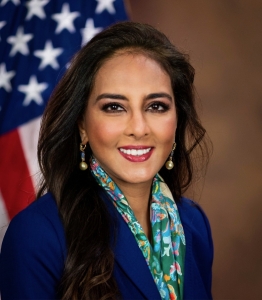
According to the DOJ, the Section’s stated mission is to ensure that law-abiding citizens may “responsibly possess, carry, and use firearms,” and to investigate law enforcement agencies that engage in a “pattern or practice” of infringing those rights. Dhillon has also described the office’s work as proactively seeking “litigation opportunities” to protect Second Amendment rights, including through statements of interest, motions to intervene, amicus briefs, and original lawsuits filed by the United States.
Enforcement Priorities and Litigation Portfolio
Dhillon’s Second Amendment section centers on three main regulatory targets: (1) delays and costs in concealed-carry permits; (2) restrictions on popular semi-automatic rifles and modern handguns; and (3) permit systems that effectively bar lawful gun ownership for ordinary citizens.
Examples of investigations and suits described in public reporting include:
- Challenges to the lengthy delays in issuing carry permits by the Los Angeles County Sheriff’s Department, framing them as unconstitutional permitting practices that deny individuals the timely exercise of the right to carry for self-defense.
- It brought a pattern-or-practice challenge against the Virgin Islands Police Department’s gun permit process, claiming local practices effectively undermine residents’ Second Amendment rights.
- Suits challenging bans on popular semi-automatic rifles in Denver, Colorado, and Washington, D.C., argued that restrictions on “commonly used” arms were protected under recent Supreme Court precedent.
In addition to filed cases, Dhillon has used pre-suit letters as leverage, often signaling that federal litigation is imminent if states or localities do not retreat from restrictive measures. One example is her letter to Virginia Governor Abigail Spanberger, warning that the DOJ would sue if the state enacted laws restricting gun rights and putting residents “on notice” that the Civil Rights Division would defend the Second Amendment. Another is a series of letters to California officials threatening suit over the state’s “Glock ban” and related handgun roster provisions, which DOJ contends criminalize the acquisition of constitutionally protected handguns and reflect a pattern or practice of law-enforcement misconduct.
Strategy and Staffing
Dhillon has described the Second Amendment Section as a staffed, specialized unit with an expanding group of lawyers dedicated to Second Amendment enforcement. Published reports and social media indicate that she has made a targeted effort to recruit and train more attorneys specifically for this section. Her stated goal is to ensure that all state regulations inconsistent with “pro–Second Amendment cases” are invalidated, settled, or withdrawn before she leaves office.
Operationally, the Section uses both traditional civil rights tools and more aggressive litigation strategies: pattern-or-practice investigations under current civil rights laws, direct lawsuits against state and local agencies, and participation through statements of interest and amicus briefs in private cases involving gun rights issues. Dhillon’s public messaging repeatedly highlights that jurisdictions cannot impose “multi-thousand dollar” permit fees or cause “unreasonably long delays” for concealed-carry applications, nor can they outlaw guns that “should be protected by the Second Amendment under recent Supreme Court precedents.” And the Section has intervened when such practices occur.
Criticism
Civil-rights and gun-control advocacy groups have sharply criticized Dhillon’s tenure, claiming that she has shifted the Civil Rights Division away from its core statutory mission toward a partisan agenda that favors expanding gun rights. A critique from civilrights.org states that Dhillon “has operated not as a law enforcement official faithfully executing civil rights statutes but…as a partisan operative dismantling and perverting the very infrastructure she was confirmed to lead.” Similarly, a letter from Senate critics, such as Senator Durbin of Illinois, describes the Second Amendment Section as a “profound retreat” from the Division’s traditional focus on protecting victims of the traditional denial of civil rights.
Further criticism appears in investigative reporting by outlets such as Mother Jones and The Trace. These sources note that in its first six months, the Second Amendment Section has primarily targeted local and state firearm regulations—delays, fees, and bans—in jurisdictions including Los Angeles County, the Virgin Islands, Denver, Colorado, and Washington, D.C., framing these actions as part of a broader campaign to dismantle gun-control measures nationwide. These accounts portray Dhillon’s work as a structural reorientation of federal civil rights enforcement: prioritizing gun rights claims and deploying federal power to challenge democratically enacted firearm regulations rather than traditional civil rights abuses.
Overall Assessment of Operation
Viewed as an operational program, Dhillon’s Second Amendment work has: (1) institutionalized gun-rights enforcement within the Civil Rights Division via a permanent Section; (2) launched multiple investigations and suits targeting carry-permit regimes and categorical firearm bans in several jurisdictions; and (3) articulated an ambitious, litigation-driven objective to invalidate or roll back regulations deemed inconsistent with recent Second Amendment case law. Supporters frame this as “national defense of the Second Amendment” and a long-overdue recognition of gun rights as civil rights.